Download FREE Sample


Overview
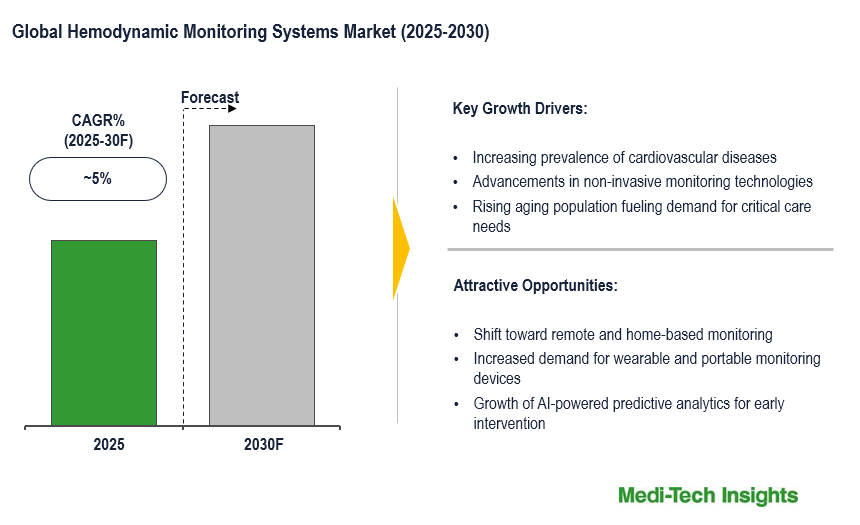
Hemodynamic monitoring systems play a vital role in assessing and managing a patient-s cardiovascular health by continuously measuring parameters such as cardiac output (CO), blood pressure, stroke volume (SV), systemic vascular resistance (SVR), and oxygen saturation. This information is crucial in critical care, emergency medicine, perioperative settings, and during major surgeries to detect instability and allows clinicians to identify subtle signs of cardiovascular insufficiency (CVI), such as declining perfusion or rising vascular resistance, before overt symptoms like hypotension or organ dysfunction appear. Early detection is especially critical in high-risk surgical patients and those with sepsis, where timely intervention can prevent progression to shock or multi-organfailure.
To learn more about this report, download the PDF brochure
Non-invasive cardiac output monitoring is reshaping hemodynamic care
A major technological advancement driving the hemodynamic monitoring systems market is the development of non-invasive cardiac output monitoring systems. Traditionally, the assessment of cardiac output relied on invasive procedures such as pulmonary artery catheterization, which, although accurate, came along with significant risks including infection, vascular injury, and increased patient discomfort. In response to these limitations, non-invasive technologies, particularly those based on bioimpedance and bioreactance, have emerged as safer and more practical alternatives. These methods function by measuring electrical conductivity changes across the thorax that occur in response to cardiac cycles, thereby enabling continuous, real-time monitoring of cardiac output without the need for catheter insertion. This innovation not only reduces the risk of procedural complications but also broadens the applicability of hemodynamic monitoring across a wider range of healthcare settings, including emergency departments, step-down units, and outpatient care.
Furthermore, non-invasive devices often feature enhanced portability and integration capabilities with electronic health records (EHRs), supporting remote monitoring and data-driven clinical decision-making. As healthcare systems increasingly prioritize patient safety, cost-effectiveness, and efficiency, the shift toward non-invasive cardiac output monitoring represents a significant step in advancing cardiovascular care and improving patient outcomes.

To learn more about this report, download the PDF brochure
Remote monitoring is expanding access to safer, proactive hemodynamic care
Remote and home-based hemodynamic monitoring is transforming how clinicians manage patients with cardiovascular and critical conditions. Wearable sensors, wireless data transfer, and AI-powered platforms now allow round-the-clock tracking outside the ICU. These systems have enabled continuous tracking of vital parameters such as cardiac output, stroke volume, blood pressure, and systemic vascular resistance without requiring hospitalization. Devices like wearable Doppler ultrasound patches, bioimpedance monitors, and smart cuffs transmit real-time data to cloud-based platforms, giving clinicians early warning of deterioration. This shift is particularly valuable for post-operative cardiac patients, individuals with chronic heart failure, and elderly populations. For rural and underserved regions, remote monitoring helps bridge healthcare gaps by reducing hospital dependency and enabling timely interventions. Remote hemodynamic monitoring not only empowers patients but also transforms care delivery into a more continuous, preventive, and patient-centric model.
Recent developments in hemodynamic monitoring systems market
Several key innovations and product launches in hemodynamic monitoring are shaping the market, such as introducing AI-driven, non-invasive, and portable solutions that enhance real-time patient assessment and clinical decision-making. For instance,
- In April 2025, Becton, Dickinson and Company launched HemoSphere Alta, an AI-driven hemodynamic monitoring platform designed to provide predictive insights and help clinicians manage blood pressure instability, optimize blood flow and avoid potential life-threatening situations during procedures
- In July 2024, Getinge AB launched Pulsiocare Monitor, an advanced hemodynamic monitoring platform combining PiCCO and ProAQT technologies for precise, mobile, and continuous assessment in ICUs and operating rooms
- In October 2023, Masimo expanded its non-invasive monitoring portfolio, ORi, the first FDA-cleared continuous parameter that provides enhanced insight into oxygenation under supplemental oxygen alongside SpO- monitoring
- In April 2023, GE Healthcare announced FDA clearance for its enhanced CARESCAPE monitors, offering a flexible, standardized solution adaptable to various patient acuity levels across hospital settings
Competitive Landscape Analysis
The global hemodynamic monitoring systems market comprises several well-established and emerging players, including Edwards Lifesciences Corporation; "https://www.philips.com/">Koninklijke Philips N.V.; GE Healthcare Technologies Inc.; Masimo Corporation; ICU Medical Inc.; Baxter International Inc.; Getinge AB; Omron Corporation; and Mindray Medical International; among others. Key strategies adopted by these players include the development of advanced technologies, mergers and acquisitions, and investment in R&D to meet growing global demand.
Report Scope
| Report Metric | Details |
| Base Year Considered | 2024 |
| Historical Data | 2023 - 2024 |
| Forecast Period | 2025 - 2030 |
| Growth | 5% |
| Market Drivers |
|
| Attractive Opportunities |
|
| Segment Scope | Product Type, System Type, and End-user |
| Regional Scope |
|
| Key Companies Mapped | Edwards Lifesciences Corporation; Koninklijke Philips N.V.; GE Healthcare Technologies Inc.; Masimo Corporation; ICU Medical Inc.; Baxter International Inc.; Getinge AB; Omron Corporation; and Mindray Medical International; among others |
| Report Highlights | Market Size & Forecast, Growth Drivers & Restraints, Trends, Competitive Analysis |
Global Hemodynamic Monitoring Systems Market Segmentation
This report by Medi-Tech Insights provides thesize of the global hemodynamic monitoring systems market at theregional- and country-level from 2023 to 2030. The report further segments the market based on product type, system type, and end-user.
Market Size & Forecast (2023-2030), By Product Type, USD Million
"list-style-type: none">- Monitoring Devices
- Disposables
- Software
Market Size & Forecast (2023-2030), By System Type, USD Million
-
- Invasive
- Minimally Invasive
- Non-Invasive
Market Size & Forecast (2023-2030), By End-user, USD Million
-
- Hospitals
- Ambulatory Surgical Centers
- Home-care Settings
- Others
Market Size & Forecast (2023-2030), By Region, USD Million
- North America
- US
- Canada
- Europe
- UK
- Germany
- France
- Italy
- Spain
- Rest of Europe
- Asia Pacific
- China
- India
- Japan
- Rest of Asia Pacific
- Latin America
- Middle East & Africa
Key Strategic Questions Addressed
- What is the market size & forecast of the hemodynamic monitoring systems market?
- What are historical, present, and forecasted market shares and growth rates of various segments and sub-segments of the hemodynamic monitoring systems market?
- What are the key trends defining the market?
- What are the major factors impacting the market?
- What are the opportunities prevailing in the market?
- Which region has the highest share in the global market? Which region is expected to witness the highest growth rate in the next 5 years?
- Who are the major players operating in the market?
- What are the key strategies adopted by players?
Need a More Tailored Analysis?
- Discuss the market sizing methodology and forecast assumptions with our healthcare analysts.
- Expand the scope with additional countries, market segments, technologies, or competitor profiling.
- Use the insights to support strategic planning, market entry, commercial due diligence, and long-term revenue growth initiatives.