Download FREE Sample


Report Overview
Apheresis is a medical procedure that involves the separation of blood components to remove or collect specific elements while returning the remaining blood to the patient. This technique is widely used for therapeutic and donation purposes, including the extraction of plasma, platelets, leukocytes, and red blood cells. In therapeutic apheresis, the procedure is employed to treat conditions such as autoimmune disorders, leukemia, and metabolic diseases by removing pathogenic substances. Additionally, apheresis plays a crucial role in blood banking and transfusion medicine, ensuring the availability of vital blood components for medical treatments.

To learn more about this report, download the PDF brochure
Expanding use of apheresis in chronic disease management
One of the primary factors driving the demand for apheresis is the rising prevalence of chronic diseases, particularly autoimmune disorders, hematologic malignancies, and metabolic conditions. Apheresis is frequently used in treating conditions such as Guillain-Barr syndrome, myasthenia gravis, and thrombotic thrombocytopenic purpura, where conventional treatments may be less effective. The increasing burden of chronic kidney disease (CKD) and cardiovascular disorders has also escalated the demand for therapeutic plasma exchange and LDL apheresis. Furthermore, the expanding applications of apheresis in regenerative medicine and stem cell therapies contribute to its adoption in clinical settings. With the aging population and rising disease burden, healthcare providers are increasingly integrating apheresis as a critical component of patient management,forcing its demand across hospitals and specialty clinics.
Advancements in apheresis improving precision and clinical outcomes
Significant technological advancements in apheresis systems are playing a crucial role in market expansion. Innovations such as automation, improved membrane filtration techniques, and software-integrated devices have enhanced the efficiency and safety of apheresis procedures. The introduction of selective apheresis, which allows for the precise removal of specific disease-causing factors, has broadened therapeutic applications. Additionally, the development of portable and point-of-care apheresis devices has improved accessibility, particularly in home healthcare and ambulatory settings. Another major advancement is integrating artificial intelligence (AI) and machine learning (ML) in apheresis systems, enabling real-time monitoring and personalized treatment adjustments. These technological innovations are improving patient outcomes, reducing procedure times, and expanding the scope of apheresis in clinical practice, thereby driving the market forward.
To learn more about this report, download the PDF brochure
Competitive Landscape Analysis
The global apheresis market is marked by the presence of established and emerging market players such as Fresenius SE & Co. KGaA; Haemonetics Corporation; Asahi Kasei Medical Co., Ltd.; Terumo BCT, Inc.; Baxter International Inc.; Becton, Dickinson and Company; Medica S.p.A; B. Braun Melsungen AG; Mallinckrodt Plc; and Nikkiso Co., Ltd. among others. Some of the key strategies adopted by market players include new product development, strategic partnerships and collaborations, and geographic expansion.
Report Scope
| Report Metric | Details |
| Base Year Considered | 2024 |
| Historical Data | 2023 - 2024 |
| Forecast Period | 2025 - 2030 |
| Growth | 8% |
| Market Drivers |
|
| Attractive Opportunities |
|
| Segment Scope | Product, Procedure, Technology, Application, and End-user |
| Regional Scope |
|
| Key Companies Mapped | Fresenius SE & Co. KGaA; Haemonetics Corporation; Asahi Kasei Medical Co., Ltd.; Terumo BCT, Inc.; Baxter International Inc.; Becton, Dickinson and Company; Medica S.p.A; B. Braun Melsungen AG; Mallinckrodt Plc; and Nikkiso Co., Ltd. among others |
| Report Highlights | Market Size & Forecast, Growth Drivers & Restraints, Trends, Competitive Analysis |
Global Apheresis Market Segmentation
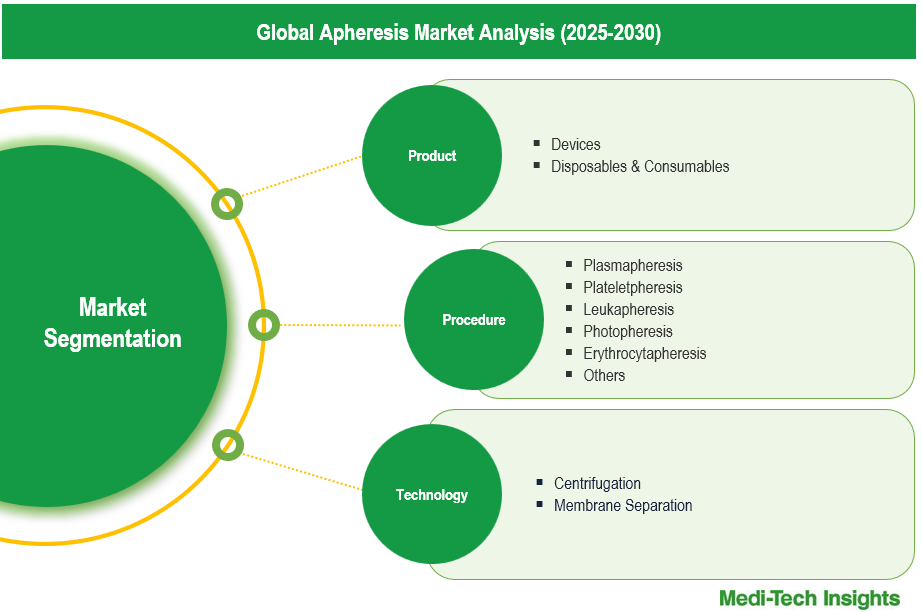
This report by Medi-Tech Insights provides thesize of the global apheresis market at theregional- and country-level from 2023 to 2030. The report further segments the market based on product, procedure, technology, application and end-user.
Market Size & Forecast (2023-2030), By Product, USD Million
- Devices
- Disposables & Consumables
Market Size & Forecast (2023-2030), By Procedure, USD Million
- Plasmapheresis
- Plateletpheresis
- Leukapheresis
- Photopheresis
- Erythrocytapheresis
- Others
-
Market & Forecast (2023-2030), By Technology, USD Million
- Centrifugation
- Membrane Separation
Market Size & Forecasty Application, USD Million
- Renal Disorders
- Neurological Disorders
- Hematological Disorders
- Autoimmune Disorders
- Others
Market Size & Forecast (2023-2030), By End-user, USD Million
- Hospitals
- Blood Banks
- Specialty Clinics
- Others
Market Size & Forecast (2023-2030), By Region, USD Million
- North America
- US
- Canada
- Europe
- UK
- Germany
- France
- Italy
- Spain
- Rest of Europe
- Asia Pacific
- China
- India
- Japan
- Rest of Asia Pacific
- Latin America
- Middle East & Africa
Need a More Tailored Analysis?
- Discuss the market sizing methodology and forecast assumptions with our healthcare analysts.
- Expand the scope with additional countries, market segments, technologies, or competitor profiling.
- Use the insights to support strategic planning, market entry, commercial due diligence, and long-term revenue growth initiatives.