Download FREE Sample


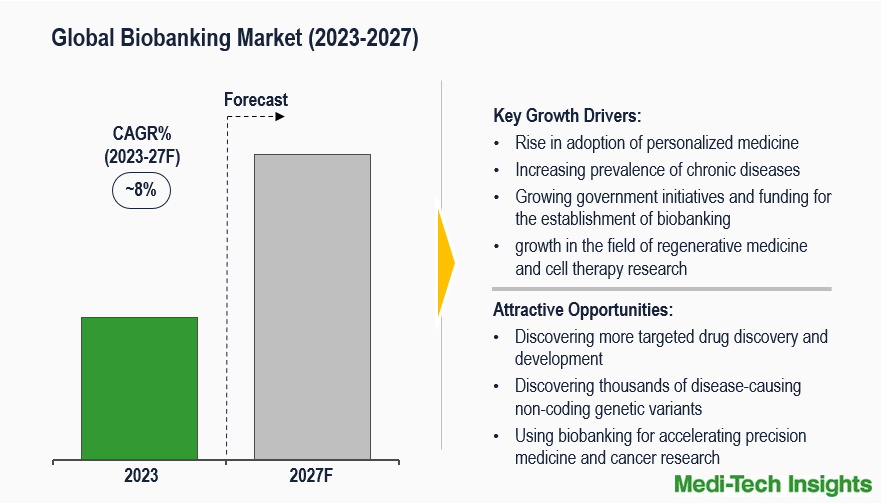
The Global Biobanking Market is expected to reach a US$53 billion market at a growth rate of ~8% by 2031. Advancements in genomic research, the rising prevalence of numerous chronic diseases such as cancer, Alzheimer's, and cardiovascular diseases, increasing demand for personalized medicine, surging need for drug discovery & development, growth in the field of regenerative medicine and cell therapy research, increasing trend for conservation of the cord blood stem cells of newborns, and growing investment from the private & government sector for the establishment and expansion of biobanks are some of the key factors driving the global biobanking market.
Biobanks are specialized facilities designed to store and manage biological samples, including human tissues, fluids, and genetic materials, under controlled conditions. These samples are invaluable resources for scientific research, medical diagnostics, and drug development. The biobanks can be further classified as population-based or disease-oriented biobanks:
- Population-based biobanks: Population-based biobanks provide specimens from individuals of a general population to study the role of individual genetic susceptibility and exposure to external factors in the development of specific disorders by linking molecular data with other associated information
- Disease-oriented biobanks: Disease-oriented biobanks collect disease-specific biospecimens. They may be focused on a single type of tissue or include biospecimens from different sources that are relevant to a disease such as cancer
Growing Adoption of Automation Solutions for Safeguarding Biobanks Samples Drive the Market
Focus on developing an automated solution and a more personalized approach to healthcare is rapidly evolving biobanking technologies including sample storage, retrieval systems, AI-driven automation processes, data analytics, robotics, and data management solutions. Automated biobanking technologies offer advantages over traditional manual storage systems by protecting sample integrity and security, streamlining biobanking activities, and making the most efficient use of space and energy. The advantages of using automated solutions include:
- Reduced risk of sample contamination and degradation using precise, monitored environmental controls
- Protect against sample mishandling and misplacement through automated barcode scanning technology
- Eliminate manual variability and errors via automated sample tracking, sample picking, and worklist generation
- Improve efficiencies through LIMS integration
- Combine scalable liquid handling and storage systems for a powerfully optimized, integrated solution
- Focus on high-value activities through hands-free, hassle-free workflows
Fill out the "Quick Inquiry Form" to request a sample copy.
Adoption of Biobanks for Research Activities Boost the Market Growth
Biobanking is gaining importance in the field of biomedical research. They serve as a library for medical researchers. Through biobanking, scientists can store research samples safely for as long as they wish without compromising the quality of their research results. Biobanking enables researchers to study the biological basis of diseases, identify new biomarkers, and develop new treatments and therapies. They allow researchers to identify patients who are at risk for certain diseases and develop personalized treatments based on their genetic profiles. Biobanking also provides researchers with access to large, diverse sample collections, which can help accelerate drug discovery and development. Further, biobanking facilitates collaboration between researchers and institutions, allowing for the sharing of samples and data to advance medical research. Thus, Biobanks are playing a major role in the modern world of research infrastructures for basic, preclinical, translational, and clinical research which is further expected to boost the market in the forecasted period. For instance,
- In December 2023, Biobanking and Biomolecular Resources Research Infrastructure - European Research Infrastructure Consortium (BBMRI-ERIC), a pan-European infrastructure of national biobank networks announced the launch of the Innovative Federated Platform Finder and Locator, designed to facilitate researchers' access to biobanks and biomolecular resources that benefit both biobanks and researchers
Role of Biobanking in the Fight Against Climate Change
Biobanking is making a substantial, positive impact on environmental sustainability. Biobanking itself may not be a direct tool for fighting climate change. Still, as its primary purpose Biobanks, repositories of biological samples such as tissues, blood, and DNA, have emerged as unsung heroes in the battle against climate change. Biobanking helps in:
- Reducing the Need for Redundant Testing: By preserving biological samples for future use, biobanks eliminate the need for researchers to continuously collect new samples and conduct multiple experiments over time using the same set of samples reducing ted for laboratory animals for research purposes.
- Energy-Efficient Sample Storage: Modern biobanks prioritize energy-efficient storage methods, such as advanced cryopreservation techniques and automated storage systems. These technologies not only preserve sample integrity but also minimize energy consumption, ultimately reducing the carbon footprint of biobanking operations.
- Minimizing Biological Waste: Biobanks provide a repository for storing biological waste material over an extended period. This dedication ensures that valuable materials do not degrade or become waste. By preventing the disposal of samples, biobanks contribute to sustainable research practices.
Biobanking Market - COVID-19 Impact
The emergence of the coronavirus has positively influenced the expansion of the biobanking market. High-quality COVID-19 specimens are essential to both diagnostic testing and research, and biobanks are a vital repository for these specimens. Biobanks allow researchers to access the samples they need to study the disease and develop vaccines and treatments. Many different COVID-19 initiatives have been launched with the participation of government, academic, and industrial researchers. Thus, Biobanks have played a key role in the fight against COVID-19 and the development and validation of new diagnostics, therapeutics, and vaccines.
Biobanking Market - Key Constraints/Challenges
The lack of workflow standardization and data harmonization, insufficient interoperability among databases and IT platforms, maintaining the quality and integrity of biological samples, data security, and privacy concerns, variations in ethical, legal, and societal issues related to legislation, and a prevailing reluctance among researchers to share materials are some of the key factors hampering the growth of biobanking market.
Europe Accounts for the Largest Share of the Global Market
From a geographical perspective, Europe holds a major market share of the biobanking market. This can be mainly attributed to the presence of well-established biobanks in European countries, growing investment from private and government for regenerative medicine research activities, an increase in the trend of conservation of the cord blood stem cells of newborns, and innovative storage methods and retrieval systems in the region. North America region has made substantial investments in biobanking infrastructure and offers a wide network of centers for biosample storage in the U.S. Moreover, increased R&D programs and the implementation of stringent quality control measures have resulted in the establishment of new biorepositories, thereby driving revenue in North America. However, the Asia-Pacific region is expected to witness the fastest growth in the coming years due to a growing prevalence of chronic diseases, technological advancement in automation, and growing awareness regarding precision medicine in the region.
Biobanking Market - Competitive Landscape
The top market players in the global biobanking market include Thermo Fisher Scientific Inc., Tecan Trading AG, QIAGEN, Hamilton Company, Azenta Life Sciences (Brooks Life Sciences), STEMCELL Technologies Inc., PrecisionMed(BioIVT Company), BioLifeSolutions Inc., BioRep S.r.l., Cryo-Cell International, Inc., Biogen, Taylor-Wharton, BioIVT & Elevating Science, among others.
Organic and Inorganic Growth Strategies Adopted by Players to Establish Their Foothold in the Market
Players operating in this market are adopting both organic and inorganic growth strategies such as collaborations, and acquisitions to garner market share. For instance,
- In November 2023, UK Biobank Unveiled incredible new data from whole genome sequencing (1)of its half a million participants. This is set to drive the discovery of new diagnostics, treatments, and cures and, uniquely, is available to approved researchers worldwide, via a protected database containing only de-identified data (e.g. name, address, date of birth, name of GP, and more stripped out)
- Biolifesolutions Inc. announced that the SU780XLE Ultra-Low Temperature (ULT) Freezer has been tested and certified by Underwriter Laboratories (UL) to meet the International Organization for Standardization (ISO)Class 6 cleanroom standard (ISO 14644-14:2016). This ENERGY STAR-certified ULT model is well-established as a sustainable ULT storage solution for laboratories and biobanking facilities worldwide
- In June 2023,
The market is expected to grow due to advancements in biobanking technologies, growing investment in biobanking despite the high cost involved in setting up and running the biobanks, and aggressive organic and inorganic growth strategies followed by the players.
Biobanking Market Scope
|
Report
Metric |
Details |
|
Market Size
and Growth Rate |
The Global
Biobanking Market is expected to reach a US$53 billion market at a growth
rate of ~8% by 2027. |
|
Historical
data |
2018-2022 |
|
Base year |
2023 |
|
Forecast
period |
2023-2027 |
|
Biobanking in
Research Activities |
|
|
Role in
Environmental Sustainability |
|
|
Competitive
Landscape |
Top market
players include Thermo Fisher Scientific, Tecan Trading, QIAGEN, Hamilton
Company, Azenta Life Sciences, STEMCELL Technologies, PrecisionMed,
BioLifeSolutions, BioRep, Cryo-Cell International, Biogen, Taylor-Wharton,
BioIVT & Elevating Science, among others |
|
Overall
Market Outlook |
Expected
growth due to advancements in biobanking technologies, high investment
despite setup and running costs, and aggressive growth strategies by market
players |
Need a More Tailored Analysis?
- Discuss the market sizing methodology and forecast assumptions with our healthcare analysts.
- Expand the scope with additional countries, market segments, technologies, or competitor profiling.
- Use the insights to support strategic planning, market entry, commercial due diligence, and long-term revenue growth initiatives.