Download FREE Sample


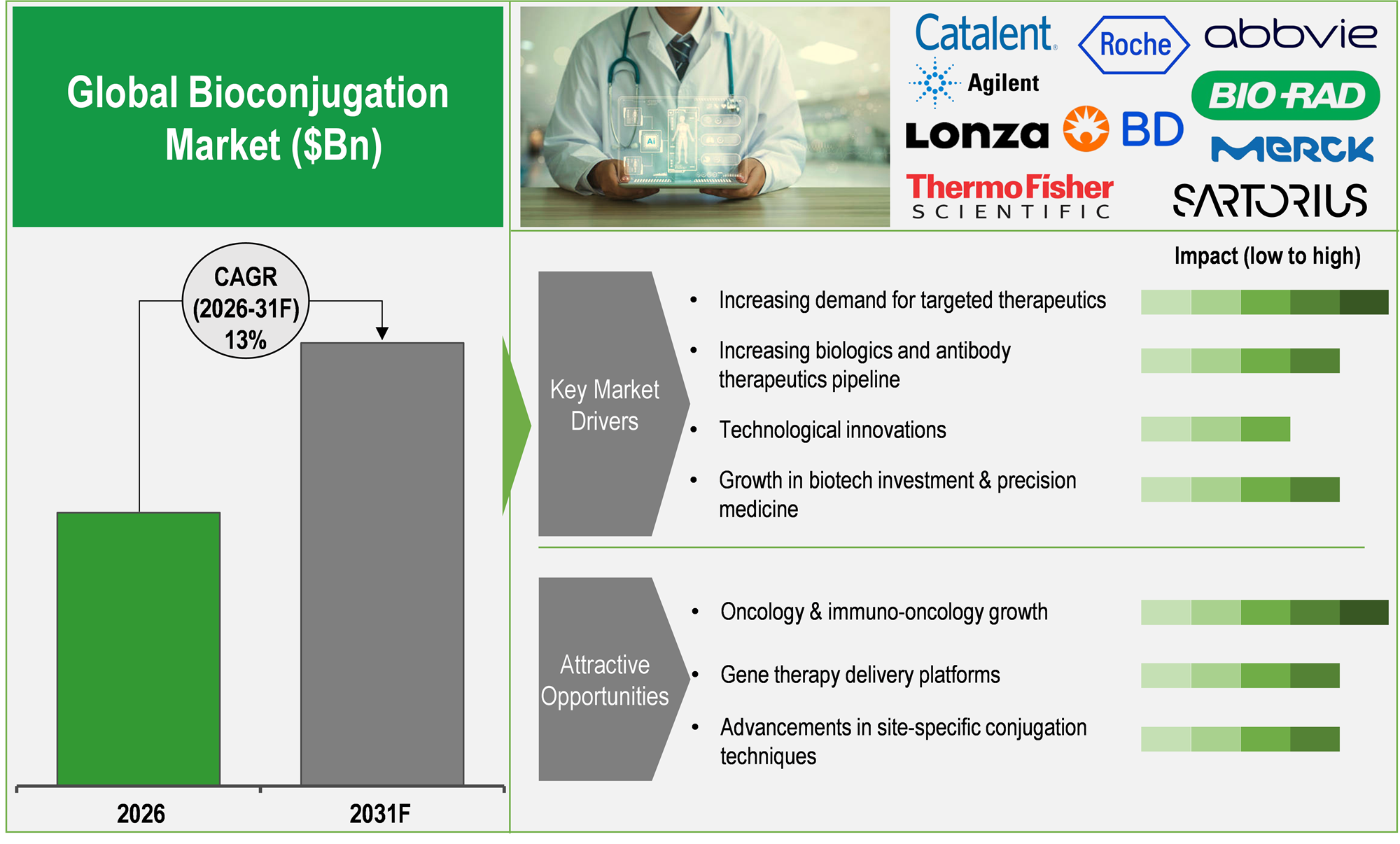
The global bioconjugation market size is set to grow at 13% CAGR over the next 5 years. Increasing demand for targeted therapeutics, technological innovations, growth in biotech investment & precision medicine, and expanding use in diagnostics and imaging are some of the key factors driving the growth of the global market. However, high cost & complexity of manufacturing and regulatory challenges are expected to impact the market’s growth.
Bioconjugation is the chemical or biological process of linking two molecules, most often a biomolecule such as an antibody, protein, or peptide, with another molecule such as a drug, fluorophore, or polymer, to create a functional unit. Bioconjugation is important in targeted drug delivery, diagnostics, and molecular imaging as a means of improved targeting and greater efficacy. Some examples of bioconjugation are antibody–drug conjugates (ADCs), biosensors, and molecular imaging agents. Bioconjugation provides a better therapeutic index, reduces off−target effects and enables real−time monitoring of biologics in both clinical and research environments.
Increasing demand for targeted therapeutics to drive market growth
Growing demand for targeted therapeutics is one of the prime drivers of the bioconjugation market. These therapies provide improved accuracy in disease treatment such as cancer, autoimmune diseases, and infectious diseases. In contrast to conventional therapeutics, targeted therapeutics only target diseased cells with minimal to no damage to normal tissue, thus minimizing side effects and enhancing patient outcomes. By linking drugs to biological target molecules like antibodies, peptides, and ligands bioconjugation allows fine-tuned precision. The rise of complex diseases, the demand by patients for personalized medicine and the increased success of ADCs is encouraging investment and innovation into bioconjugation technologies creating growth in the clinical and in commercial markets.
To learn more about this report, download the PDF brochure
Expanding use in diagnostics and imaging to boost market growth
The increasing application of bioconjugation in diagnostics and imaging is a major force in driving the growth of the market by allowing for very sensitive and specific detection of diseases. Bioconjugated molecules, including antibodies conjugated to fluorescent labels, enzymes, or radiolabels, are critical in applications such as immunoassays, biosensors, and molecular imaging modalities (e.g., PET, MRI). These technologies enhance early diagnosis of disease, disease assessment, and personalized treatment plans. As the need for accurate, real-time diagnosis in cancer, infectious disease, and neurology increases, bioconjugation technologies will also become increasingly important. This growing diagnostic application of targeted biomolecules, such as labeled biomarkers, is driving innovation and also the need to produce targeted biomolecules in commercial laboratories, research institutions, and imaging centers across the globe.
Growth in oncology & immuno‑oncology, a major opportunity
The rapid growth of oncology and immuno-oncology presents a significant opportunity for the bioconjugation market. Increasing adoption of antibody-drug conjugates (ADCs), immunoconjugates, radioimmunoconjugates, and targeted biologics is driving demand for advanced bioconjugation technologies that improve drug specificity, efficacy, and safety. As pharmaceutical companies continue to invest in next-generation cancer therapies, site-specific conjugation methods are enabling the development of highly stable and effective therapeutics with reduced off-target toxicity. Furthermore, the expanding pipeline of oncology biologics, coupled with rising clinical trials and regulatory approvals for targeted cancer treatments, is expected to accelerate the adoption of innovative bioconjugation platforms, creating substantial growth opportunities throughout the forecast period.
To learn more about this report, download the PDF brochure
Product & Service Segment Outlook
The reagents and consumables segment is expected to account for the largest share of the bioconjugation market, driven by their recurring use in research, clinical development, and commercial biopharmaceutical manufacturing. Products such as linker and crosslinking reagents, labelling reagents, fluorescent tags, enzymes, haptens, and bead coupling reagents are essential for developing antibody-drug conjugates (ADCs), protein therapeutics, molecular diagnostics, and imaging applications. Meanwhile, the services segment is projected to witness the fastest growth due to increasing outsourcing of custom conjugation, analytical characterization, and manufacturing to CROs and CDMOs, enabling biopharmaceutical companies to accelerate development while reducing costs and improving scalability.
Regional Outlook: North America maintains its leading position in the bioconjugation market
North America held the largest share of the bioconjugation market, supported by a strong biopharmaceutical industry, extensive biologics and antibody-drug conjugate (ADC) research, significant R&D investments, and the presence of leading biotechnology companies and contract development and manufacturing organizations (CDMOs). Favourable regulatory support and increasing clinical trials further strengthen regional growth. Meanwhile, Asia-Pacific is projected to witness the fastest growth during the forecast period, driven by expanding biopharmaceutical manufacturing capabilities, rising biotechnology investments, increasing outsourcing to CROs and CDMOs, and growing adoption of precision medicine across China, India, Japan, and South Korea.
Competitive Landscape Analysis
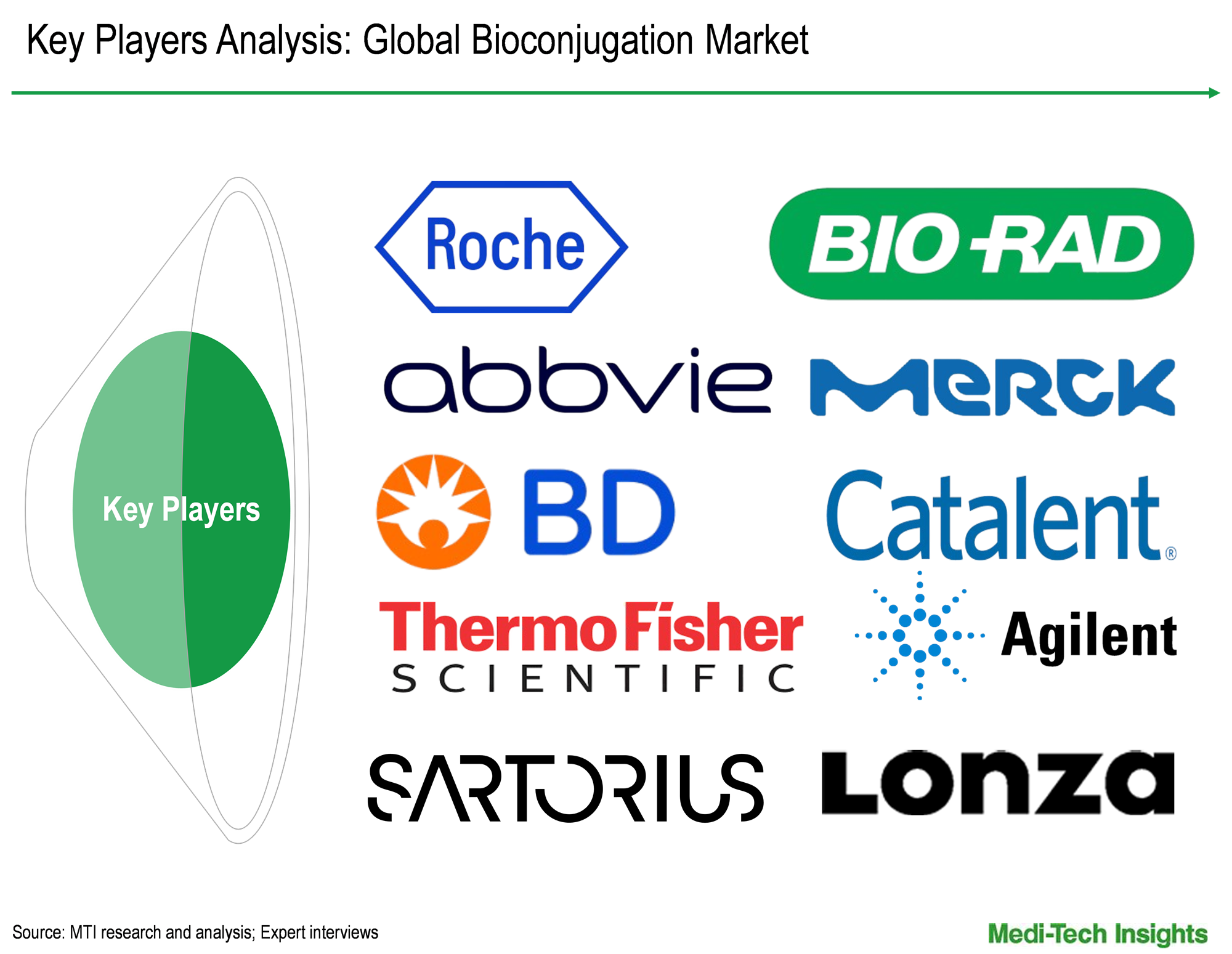
The global bioconjugation market is marked by the presence of established and emerging market players such as-
- Thermo Fisher Scientific Inc.
- Lonza
- Merck KGaA
- Hoffmann-La Roche Ltd
- Agilent Technologies, Inc.
- Becton, Dickinson and Company (BD)
- Catalent, Inc.
- AbbVie Inc.
- Bio-Rad Laboratories, Inc.
- Sartorius AG
Get a sample report for competitive landscape analysis
Growth strategies adopted by players to establish their foothold in the bioconjugation market
Players operating in this market are adopting various growth strategies such as new product launch; acquisitions; expansions; and strategic partnerships, agreements, and collaborations, to garner market share. For instance,
- In May 2026, Lonza expanded its Oss, Netherlands bioconjugation capabilities, enhancing process development, analytical expertise, and manufacturing capacity for antibody-drug conjugates and other next-generation bioconjugates, supporting growing customer demand
- In October 2025, Syngene announced plans to establish a GMP bioconjugation suite in Bengaluru (India), enabling end-to-end antibody-drug conjugate (ADC) development, from monoclonal antibody production to commercial manufacturing, strengthening its integrated CRDMO capabilities
- In July 2025, Biosynth expanded its Berlin facility with a commercial-scale bioconjugation suite, increasing manufacturing capacity for antibody-drug conjugates and other bioconjugates while supporting clinical and commercial production for global biopharmaceutical customers
- In November 2024, Lonza announced the expansion of its Visp, Switzerland bioconjugation facility with two new manufacturing suites, doubling commercial bioconjugate capacity to support the increasing demand for antibody-drug conjugates and other targeted biologic therapies
- In November 2024, Thermo Fisher expanded its Accelerator Drug Development platform, integrating CRO, CDMO, and clinical supply services to accelerate biologics, antibody-drug conjugate, and advanced therapeutic development.
Report Scope
Report Metric | Details |
Base Year Considered | 2025 |
Historical Data | 2024 – 2025 |
Forecast Period | 2026 – 2031 |
Growth Rate | 13% |
Segment Scope | Product & Service, Technique, Biomolecule Type, Application, End User |
Regional Scope |
|
Market Drivers |
|
Attractive Opportunities |
|
Key Companies Mapped | Thermo Fisher Scientific Inc.; Lonza; Merck KGaA; Hoffmann-La Roche Ltd; Agilent Technologies, Inc.; Becton, Dickinson and Company (BD); Catalent, Inc.; AbbVie Inc.; Bio-Rad Laboratories, Inc.; and Sartorius AG; among others |
Report Highlights | Market Size & Forecast, Growth Drivers & Restraints, Trends, Competitive Analysis |
Market Segmentation
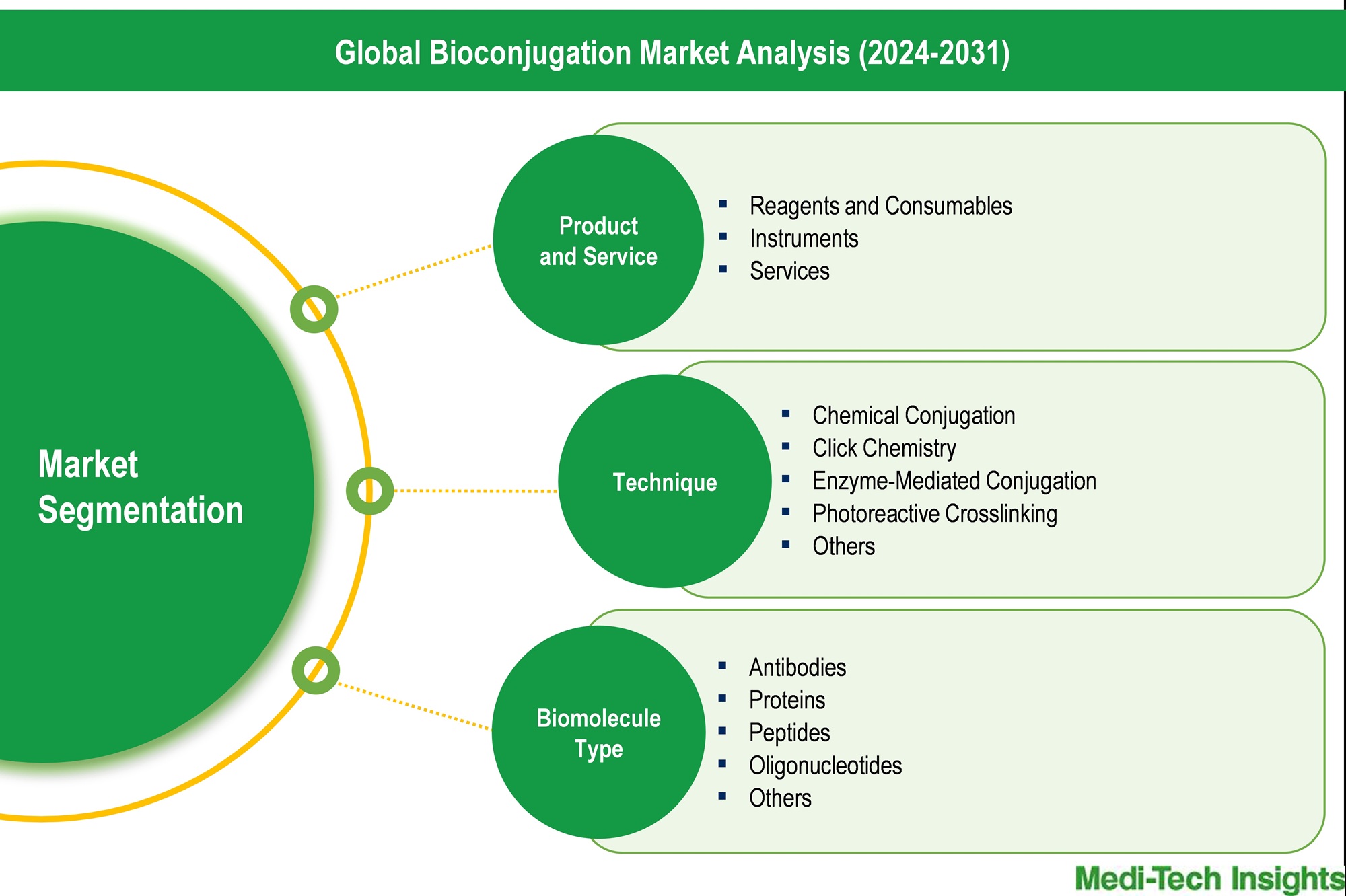
This report by Medi-Tech Insights provides the size of the global bioconjugation market at the regional and country-level from 2024 to 2031. The report further segments the market by product & service, technique, biomolecule type, application, and end user.
- Market Size & Forecast (2024-2031), By Product & Service, USD Billion
- Reagents and Consumables
- Reagents & Kits
- Linker & Crosslinking Reagents & Kits
- Labelling Reagents & Kits
- Modification Reagents & Kits
- Other Reagents & Kits
- Labels
- Fluorescent Tags
- Enzymes
- Haptens
- Polymers
- Bead Coupling
- Other Labels
- Other Reagents & Consumables
- Reagents & Kits
- Instruments
- Chromatography Systems
- Spectroscopy Instruments
- Mass Spectrometers
- Flow Cytometers
- Electrophoresis Equipment
- Filtration Systems
- Mixers & Shakers
- Incubators
- Other Instruments
- Services
- Custom Synthesis & Conjugation Services
- Analytical & Characterization
- Scale-up & Manufacturing
- Other Services
- Reagents and Consumables
- Market Size & Forecast (2024-2031), By Technique, USD Billion
- Chemical Conjugation
- Click Chemistry
- Enzyme-Mediated Conjugation
- Photoreactive Crosslinking
- Others
- Market Size & Forecast (2024-2031), By Biomolecule Type, USD Billion
- Antibodies
- Proteins
- Peptides
- Oligonucleotides
- Others
- Market Size & Forecast (2024-2031), By Application, USD Billion
- Therapeutics
- Antibody-drug Conjugates
- Protein-drug Conjugates
- Peptide-drug Conjugates
- Other Therapeutics
- Diagnostics
- Research and Development
- Therapeutics
- Market Size & Forecast (2024-2031), By End User, USD Billion
- Pharmaceutical & Biotechnology Companies
- CROs & CMOs
- Academic & Research Institutes
- Others
- Market Size & Forecast (2024-2031), By Region, USD Billion
- North America
- US
- Canada
- Europe
- UK
- Germany
- France
- Italy
- Spain
- Rest of Europe
- Asia Pacific
- China
- India
- Japan
- Rest of Asia Pacific
- Latin America
- Middle East & Africa
Frequently Asked Questions About This Report
What is the growth rate of the bioconjugation market?
The bioconjugation market is set to witness a growth rate of 13% during the forecast period from 2026 to 2031
What is the current and forecasted market size of the global bioconjugation market?
The global bioconjugation market size is valued at $XX billion in 2025 and is projected to reach $XX billion in 2031
What are the key trends defining the market?
Expansion of ADCs & ADC-focused manufacturing services and outsourcing to CROs/CDMOs are major trends in the bioconjugation market
What are the major factors impacting the market growth?
Increasing demand for targeted therapeutics, technological innovations, growth in biotech investment & precision medicine, and expanding use in diagnostics and imaging are some of the key factors driving the bioconjugation market
What are the opportunities prevailing in the market?
Oncology & immune-oncology growth, gene therapy delivery platforms, and advancements in site-specific conjugation techniques offer numerous growth opportunities for companies operating in the bioconjugation market
Who are the major players operating in the market?
Some of the major players operating in the bioconjugation market include Thermo Fisher Scientific Inc.; Lonza; Merck KGaA; Hoffmann-La Roche Ltd; Agilent Technologies, Inc.; Becton, Dickinson and Company (BD); Catalent, Inc.; AbbVie Inc.; Bio-Rad Laboratories, Inc.; and Sartorius AG; among others
Which region has the highest share in the global market? Which region is expected to witness the highest growth rate in the next 5 years?
North America held the largest share of the global bioconjugation market in 2025, while Asia-Pacific is projected to grow at the highest CAGR during the forecast period
What are the key strategies adopted by players?
Key players in the bioconjugation market are adopting strategies such as new product launch; acquisitions; expansions; and strategic partnerships, agreements, and collaborations to expand their market presence
Need a More Tailored Analysis?
- Discuss the market sizing methodology and forecast assumptions with our healthcare analysts.
- Expand the scope with additional countries, market segments, technologies, or competitor profiling.
- Use the insights to support strategic planning, market entry, commercial due diligence, and long-term revenue growth initiatives.