Download FREE Sample


Report Overview
Cell and gene therapy represent two transformative approaches in modern medicine to treat or potentially cure diseases at their root cause. Cell therapy involves the transplantation or modifying living cells to restore or enhance their function, often used for regenerative medicine and immunotherapy applications. Gene therapy, on the other hand, focuses on modifying or replacing faulty genes to correct genetic disorders, cancers, and other chronic conditions. These therapies hold immense promise for conditions previously considered untreatable, driving extensive research and commercial interest.
To learn more about this report, download the PDF brochure
The expanding applications of CAR-T cell therapy to drive market growth
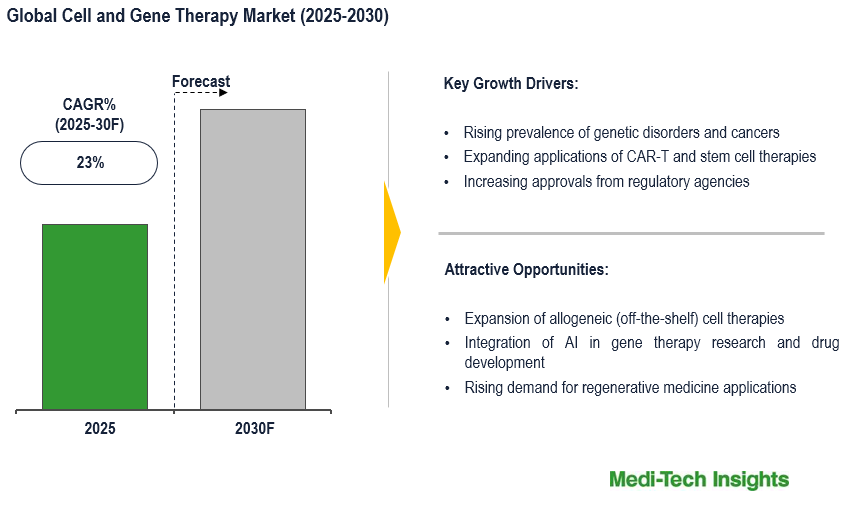
CAR-T (Chimeric Antigen Receptor T-cell) therapy is revolutionizing the treatment of hematologic cancers, significantly boosting the demand for cell and gene therapies. This therapy involves modifying a patient-s T cells to express a receptor specific to cancer cells, allowing for precise and potent immune responses. The dramatic success of CAR-T therapies in treating relapsed or refractory leukemias and lymphomas have fueled their rapid adoption. Regulatory agencies have granted approvals for multiple CAR-T therapies, and ongoing clinical trials are expanding applications into solid tumours and autoimmune disorders. Additionally, advancements in allogeneic (off-the-shelf) CAR-T therapies aim to overcome existing challenges related to patient-specific manufacturing. As CAR-T therapies' efficacy and safety profiles improve, they are expected to play a central role in the broader adoption of cell and gene therapies, enhancing patient outcomes and market growth.
Next-generation gene technologies enhancing precision and accessibility
Innovations in gene editing, particularly CRISPR-Cas9 and base editing, are revolutionizing the field of gene therapy by enabling highly precise genetic modifications. CRISPR technology allows targeted corrections of faulty genes with minimal off-target effects, significantly improving treatment safety and effectiveness. Furthermore, newer gene-editing platforms, such as prime editing, offer enhanced control over genetic alterations, expanding therapeutic possibilities for rare genetic disorders and cancers. The integration of artificial intelligence (AI) in gene editing is also accelerating the discovery of novel therapeutic targets and improving editing efficiency. Additionally, advancements in non-viral delivery methods, such as lipid nanoparticles, are making gene therapy more scalable and accessible. As these technologies continue to evolve, they are expected to drive a new wave of gene-based therapies, improving affordability, regulatory acceptance, and widespread clinical adoption across diverse therapeutic areas.
To learn more about this report, download the PDF brochure
Competitive Landscape Analysis
The global cell and gene therapy market is marked by the presence of established and emerging market players such as Sartorius AG; Novartis AG; Thermo Fisher Scientific, Inc.; Merck KGaA; Charles River Laboratories; Cell and Gene Therapy Catapult; Lonza; WuXi AppTec; Takara Bio Inc.; Bristol Myers Squibb; FUJIFILM Holdings Corporation; and F. Hoffmann-La Roche Ltd. among others. Some of the key strategies adopted by market players include new product development, strategic partnerships and collaborations, and geographic expansion.
Report Scope
| Report Metric | Details |
| Base Year Considered | 2024 |
| Historical Data | 2023 - 2024 |
| Forecast Period | 2025 - 2030 |
| Growth | 23% |
| Market Drivers |
|
| Attractive Opportunities |
|
| Segment Scope | Therapy Type, Indication, and End-user |
| Regional Scope |
|
| Key Companies Mapped | Sartorius AG; Novartis AG; Thermo Fisher Scientific, Inc.; Merck KGaA; Charles River Laboratories; Cell and Gene Therapy Catapult; Lonza; WuXi AppTec; Takara Bio Inc.; Bristol Myers Squibb; FUJIFILM Holdings Corporation; and F. Hoffmann-La Roche Ltd. among others |
| Report Highlights | Market Size & Forecast, Growth Drivers & Restraints, Trends, Competitive Analysis |
Global Cell and Gene Therapy Market Segmentation
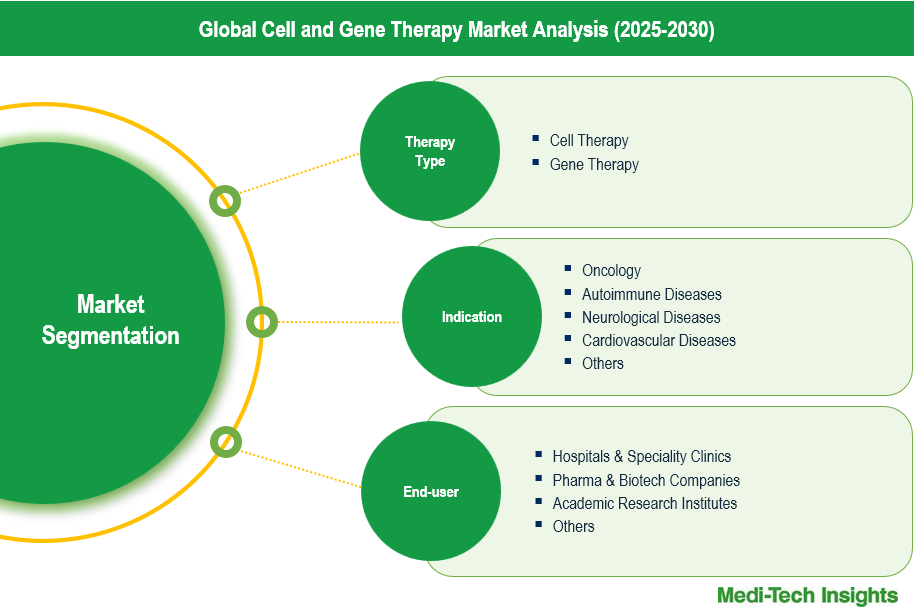
This report by Medi-Tech Insights provides thesize of the global cell and gene therapy market at theregional- and country-level from 2023 to 2030. The report further segments the market based on therapy type, indication, and end-user.
Market Size & Forecast (2023-2030), By Therapy Type, USD Million
- Cell Therapy
- Gene Therapy
Market Size & Forecast (2023-2030), By Indication, USD Million
- Oncology
- Autoimmune Diseases
- Neurological Diseases
- Cardiovascular Diseases
- Others
Market Size & Forecast (2023-2030), By End-user, USD Million
- Hospitals & Speciality Clinics
- Pharma & Biotech Companies
- Academic Research Institutes
- Others
- North America
- US
- Canada
- Europe
- UK
- Germany
- France
- Italy
- Spain
- Rest of Europe
- Asia Pacific
- China
- India
- Japan
- Rest of Asia Pacific
- Latin America
- Middle East & Africa
- North America
Need a More Tailored Analysis?
- Discuss the market sizing methodology and forecast assumptions with our healthcare analysts.
- Expand the scope with additional countries, market segments, technologies, or competitor profiling.
- Use the insights to support strategic planning, market entry, commercial due diligence, and long-term revenue growth initiatives.