Download FREE Sample


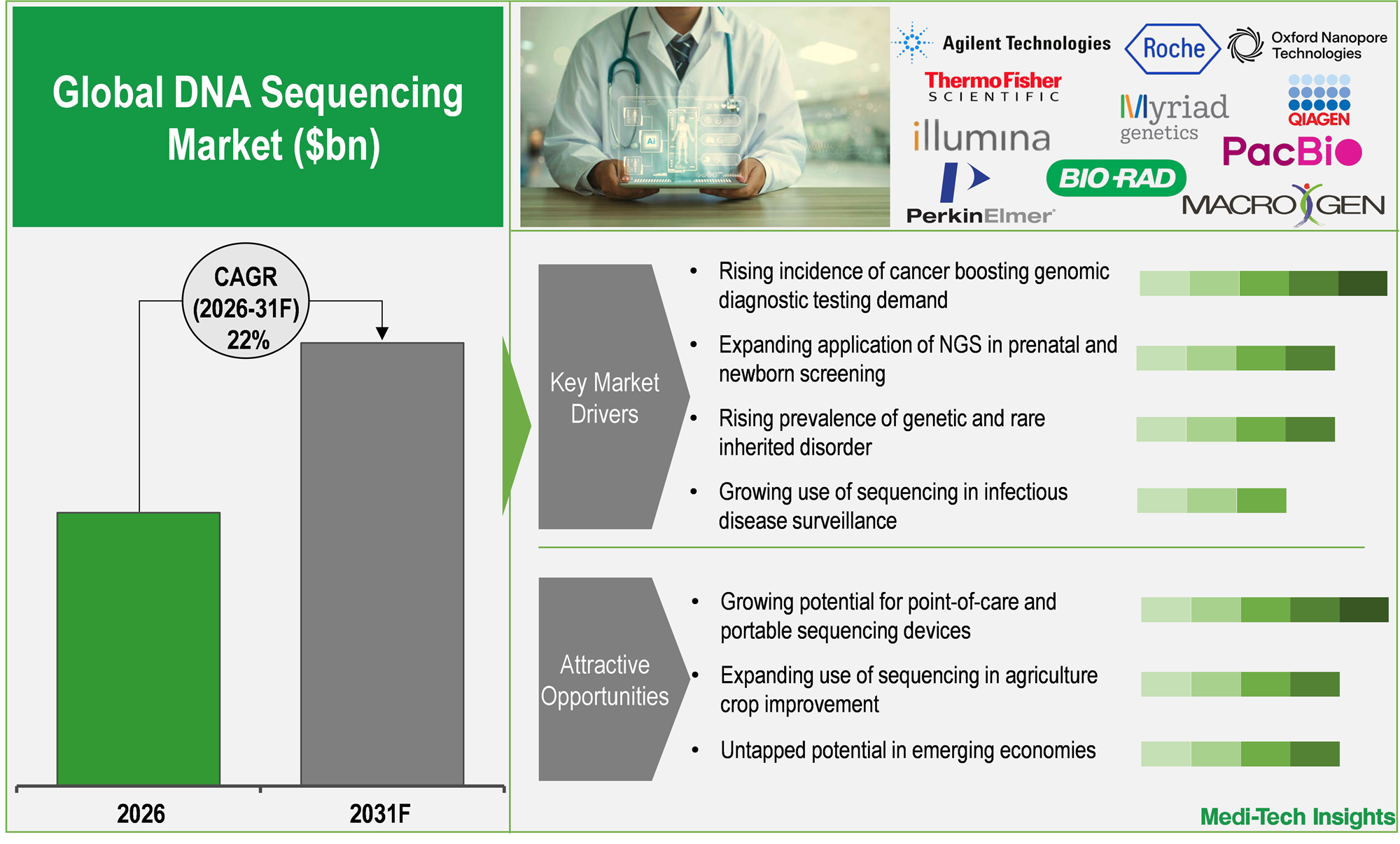
The global DNA sequencing market size is set to grow at a CAGR of 22% over the next 5 years. Rising incidence of cancer boosting genomic diagnostic testing demand, expanding application of NGS in prenatal and newborn screening, rising prevalence of genetic and rare inherited disorders, expanding pharmacogenomics research supporting targeted drug development, and growing use of sequencing in infectious disease surveillance are some of the key factors driving the growth of the global market. However, high upfront cost of advanced sequencing instruments and platforms, shortage of trained bioinformaticians to interpret genomic data, and difficulty integrating sequencing data with existing hospital IT systems are expected to impact the market’s growth.
DNA sequencing refers to the laboratory and computational process of determining the precise order of nucleotide bases-adenine, thymine, cytosine, and guanine within a DNA molecule. The DNA sequencing market comprises instruments, reagents, consumables, software, and services used to read, analyze, and interpret genetic information across research, clinical, and applied settings. Technologies range from traditional Sanger sequencing to next-generation and third-generation platforms capable of high-throughput, long-read, and single-molecule analysis. These solutions are utilized by hospitals, diagnostic laboratories, academic institutions, pharmaceutical companies, and forensic agencies to support applications such as disease diagnosis, oncology profiling, prenatal testing, drug discovery, agricultural genomics, and pathogen identification.
To learn more about this report, download the PDF brochure
Expanding pharmacogenomics research supporting targeted drug development to drive market growth
Expanding pharmacogenomics research supporting targeted drug development is emerging as a significant driver for the DNA sequencing market, as pharmaceutical companies increasingly rely on genomic insights to design therapies tailored to individual genetic profiles. Growing recognition that drug response variability stems largely from genetic differences among patients is prompting biopharmaceutical firms to integrate sequencing technologies earlier into the drug discovery pipeline, enabling more precise identification of biomarkers linked to efficacy and adverse reactions. Pharmacogenomic testing is becoming a core component of clinical trial design, particularly in oncology, where sequencing helps stratify patient populations based on tumor mutations, thereby improving trial outcomes and accelerating regulatory approval timelines.
Moreover, regulatory agencies are increasingly encouraging the inclusion of pharmacogenomic data during drug development, further reinforcing sequencing adoption across the pharmaceutical value chain. This trend is further supported by the declining cost of sequencing technologies, making large-scale genomic screening more economically viable for both established pharmaceutical companies and emerging biotech firms. Additionally, expanding collaborations between sequencing technology providers and drug developers are enabling the development of companion diagnostics that pair specific therapies with genetically defined patient subgroups, strengthening the link between genomic data and clinical decision-making.
Furthermore, the growing emphasis on precision medicine is encouraging healthcare systems to incorporate pharmacogenomic testing into routine clinical practice, helping physicians select optimal therapies while minimizing trial-and-error prescribing. As pharmaceutical pipelines continue prioritizing targeted, personalized treatments, sustained investment in pharmacogenomics research is expected to remain a key catalyst driving continued growth of the global DNA sequencing market.
Expanding use of sequencing in agricultural crop improvement is emerging as a significant growth avenue
The application of DNA sequencing technologies within agriculture is emerging as a significant growth avenue for the market, as breeders and researchers increasingly rely on genomic data to accelerate crop development. Whole-genome sequencing and genotyping platforms enable scientists to identify genes linked to desirable traits such as drought tolerance, disease resistance, higher yield, and nutritional quality, thereby shortening traditional breeding cycles that once took several years. Marker-assisted selection and genomic selection approaches, both dependent on sequencing data, allow breeders to predict plant performance with greater accuracy before physical cultivation begins.
Furthermore, the growing global demand for climate-resilient and high-yield crop varieties, driven by unpredictable weather patterns and rising food security concerns, is pushing agricultural companies and research institutions to adopt sequencing at scale. Falling sequencing costs and improved bioinformatics tools have made large-scale genomic studies more accessible to seed companies and public research bodies alike. Therefore, as precision agriculture continues to gain traction worldwide, sequencing is transitioning from a research-oriented activity into a routine component of commercial crop improvement programs, presenting substantial revenue opportunities for DNA sequencing providers.
To learn more about this report, download the PDF brochure
Technology Segment Outlook
By technology, the DNA sequencing market is segmented into Next Generation Sequencing (NGS), Sanger Sequencing, and Third Generation Sequencing. Adoption across these technologies is influenced by sequencing accuracy, throughput, turnaround time, cost, and the growing demand for comprehensive genomic information across research, clinical diagnostics, oncology, and precision medicine.
Next-generation sequencing is expected to account for the largest share of the DNA sequencing market due to its high throughput, scalability, and ability to analyze millions of DNA fragments simultaneously. NGS supports diverse applications, including whole genome and exome sequencing, targeted sequencing, oncology profiling, inherited disease testing, and infectious disease research. Declining sequencing costs, expanding clinical applications, and growing adoption of precision medicine are further supporting demand. Continued improvements in automation, workflow efficiency, and sequencing accuracy are also broadening NGS adoption across research and healthcare settings.
Third-generation sequencing is expected to register the fastest growth, supported by advances in long-read sequencing technologies that enable more comprehensive characterization of complex genomic regions. Unlike short-read approaches, technologies such as SMRT and nanopore sequencing can generate much longer DNA reads, facilitating the detection of structural variants, repetitive sequences, haplotypes, and other genomic features that may be difficult to resolve using conventional NGS. Improvements in accuracy, portability, turnaround time, and real-time sequencing capabilities are expanding applications across genomics research, rare disease analysis, cancer research, and clinical diagnostics.
Regional Outlook: North America maintains its leading position in the DNA sequencing market
Regional market development is influenced by genomic research infrastructure, healthcare expenditure, adoption of precision medicine, availability of sequencing technologies, government genomics initiatives, and the presence of sequencing technology providers and research institutions. North America is expected to account for the largest share of the DNA sequencing market, supported by advanced genomic research infrastructure, high adoption of precision medicine, and strong investment in biotechnology and healthcare research. The region has extensive sequencing capacity across academic institutions, pharmaceutical companies, biotechnology firms, and clinical laboratories. Increasing use of sequencing in oncology, inherited disease testing, reproductive health, and drug development is further supporting demand. The presence of leading sequencing technology providers and expanding clinical applications is also contributing to the region's established market position.
Asia Pacific is expected to register the fastest growth in the DNA sequencing market, driven by expanding healthcare infrastructure, increasing genomic research activity, and growing adoption of precision medicine. Countries such as China, Japan, South Korea, India, Singapore, and Australia are investing in national genomics programs, sequencing infrastructure, and biotechnology capabilities. Growing demand for cancer genomics, rare disease testing, infectious disease surveillance, and population-scale genomic studies is creating additional opportunities. Increasing healthcare spending and the gradual reduction in sequencing costs are also enabling broader adoption across research institutions, clinical laboratories, and pharmaceutical and biotechnology companies.
Competitive Landscape Analysis
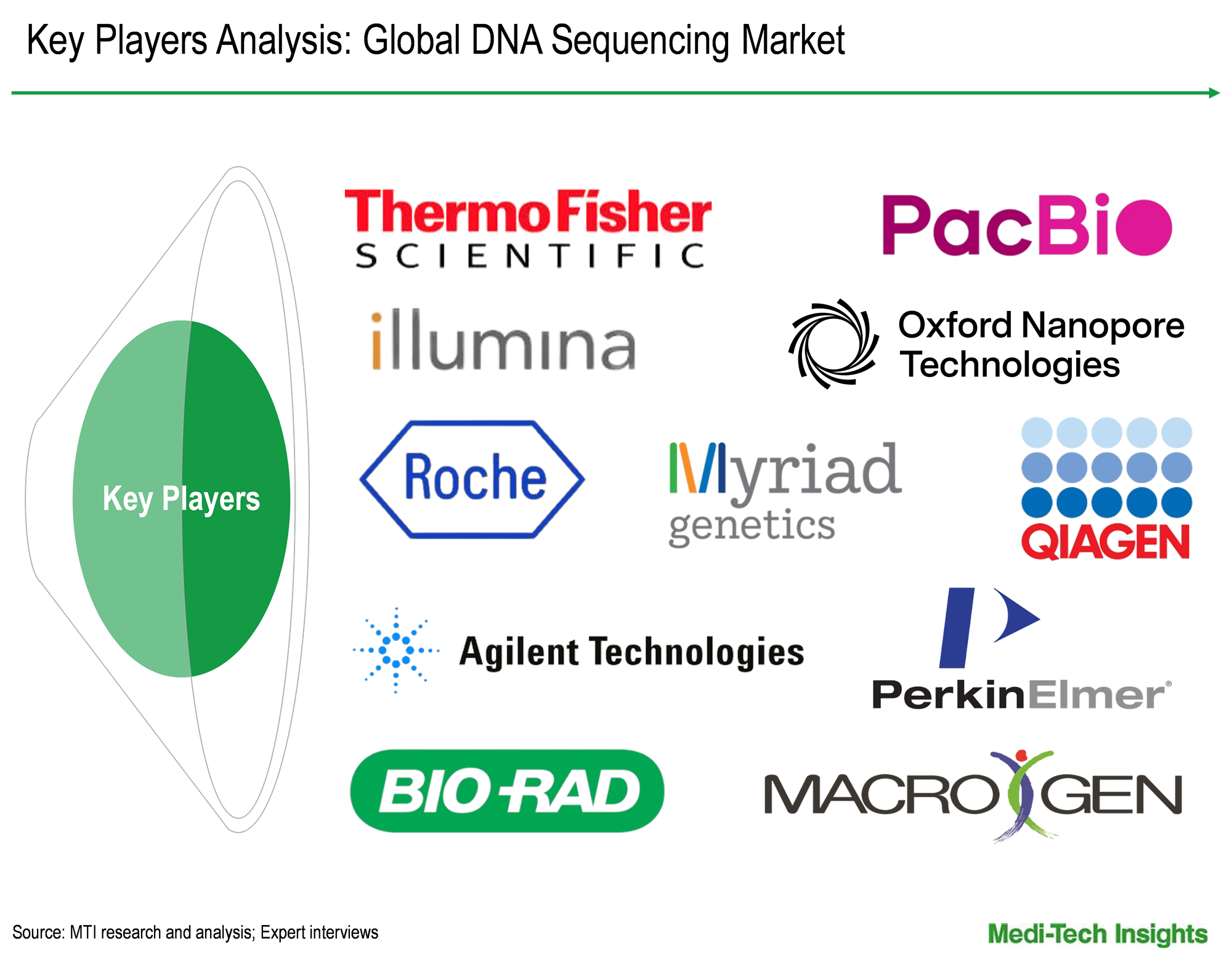
The global DNA sequencing market is marked by the presence of established and emerging market players such as-
- Thermo Fisher Scientific, Inc.
- Agilent Technologies
- Illumina, Inc.
- QIAGEN
- Roche Ltd.
- Oxford Nanopore Technologies
- Macrogen, Inc.
- PerkinElmer Genomics
- PacBio
- Bio-Rad Laboratories, Inc.
- Myriad Genetics
Get a sample report for competitive landscape analysis
Growth strategies adopted by players to establish their foothold in the DNA sequencing market
Players operating in this market are adopting various growth strategies such as new product launches and approvals; acquisitions; expansions; and strategic partnerships, agreements, & collaborations, to garner market share. For instance,
- In January 2026, Illumina completed the acquisition of SomaLogic, a data‑driven proteomics technology company, bringing SomaLogic's aptamer‑based affinity proteomics platform into Illumina's sequencing ecosystem to accelerate its multiomics strategy and expand customer access to proteomic insights at scale
- In May 2025, Mission Bio partnered with Integrated DNA Technologies to combine rhAmpSeq targeted resequencing with Tapestri single-cell DNA sequencing, enabling precise on- and off-target genome-editing analysis. The workflow expands sequencing applications in cell and gene therapy research and genome-editing validation
- In March 2024, PacBio launched its PureTarget repeat expansion panel, a targeted long-read sequencing solution designed to comprehensively analyze 20 genes linked to serious neurological disorders, including hard-to-sequence tandem repeat expansions associated with conditions such as Huntington's disease and ALS
- In November 2023, Oxford Nanopore Technologies acquired Northern Nanopore Instruments to strengthen its solid-state nanopore technology and intellectual property portfolio. The acquisition expands its long-term technology pipeline and supports development of next-generation nanopore-based DNA/RNA sequencing and molecular sensing applications
Report Scope
Report Metric | Details |
Base Year Considered | 2025 |
Historical Data | 2024 – 2025 |
Forecast Period | 2026 – 2031 |
Growth Rate | 22% |
Segment Scope | Product and Service, Technology, Workflow, Application, and End User |
Regional Scope |
|
Market Drivers |
|
Attractive Opportunities |
|
Key Companies Mapped | Thermo Fisher Scientific, Inc. (US); Agilent Technologies (US); Illumina, Inc. (US); QIAGEN (Netherlands); Roche Ltd. (Switzerland); Oxford Nanopore Technologies (US); Macrogen, Inc. (South Korea); PerkinElmer Genomics (US); PacBio (US); Bio-Rad Laboratories, Inc. (US); Myriad Genetics (US) and among others |
Report Highlights | Market Size & Forecast, Growth Drivers & Restraints, Trends, Competitive Analysis |
Global DNA Sequencing Market Segmentation
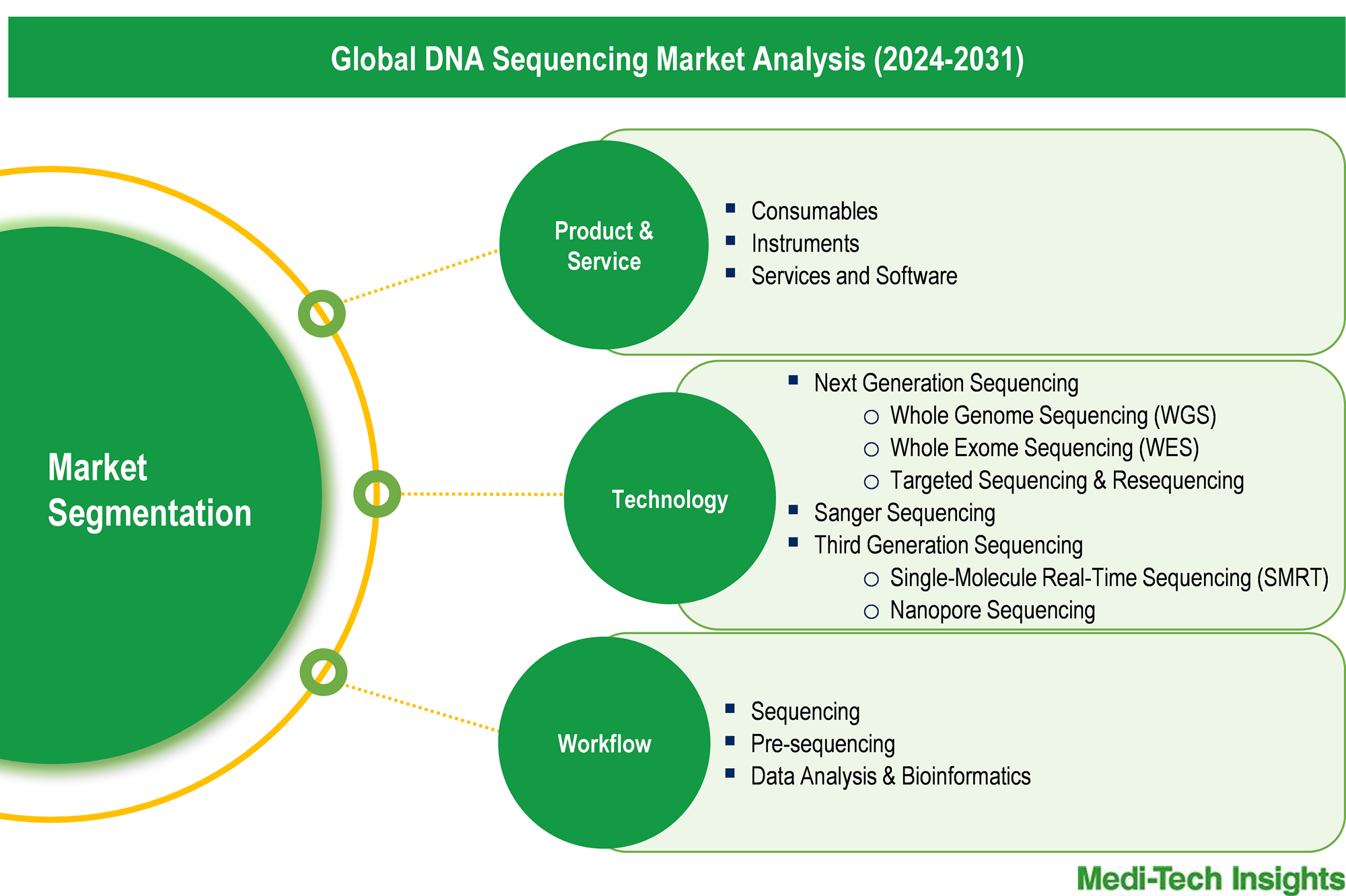
This report by Medi-Tech Insights provides the size of the global DNA sequencing market at the regional and country-level from 2024 to 2031. The report further segments the market by product and service, technology, workflow, application, and end user
Market Size & Forecast (2024-2031), By Product and Service, USD Billion
- Consumables
- Instruments
- Services and Software
Market Size & Forecast (2024-2031), By Technology, USD Billion
- Next Generation Sequencing
- Whole Genome Sequencing (WGS)
- Whole Exome Sequencing (WES)
- Targeted Sequencing & Resequencing
- Sanger Sequencing
- Third Generation Sequencing
- Single-Molecule Real-Time Sequencing (SMRT)
- Nanopore Sequencing
Market Size & Forecast (2024-2031), By Workflow, USD Billion
- Sequencing
- Pre-sequencing
- Data Analysis & Bioinformatics
Market Size & Forecast (2024-2031), By Application, USD Billion
- Oncology
- Reproductive Health
- Clinical Investigation
- Agrigenomics & Forensics
- HLA Typing/Immune System Monitoring
- Metagenomics, Epidemiology & Drug Development
- Consumer Genomics
- Other Applications
Market Size & Forecast (2024-2031), By End User, USD Billion
- Academic and Research Institute
- Pharmaceutical and Biotechnology Companies
- Hospital and Clinical Diagnostic Laboratories
- Other End Users
Market Size & Forecast (2024-2031), By Region, USD Billion
- North America
- US
- Canada
- Europe
- UK
- Germany
- France
- Italy
- Spain
- Rest of Europe
- Asia Pacific
- China
- India
- Japan
- Rest of Asia Pacific
- Latin America
- Middle East & Africa
Related Reports:
Frequently Asked Questions About This Report
What is the growth rate of the DNA sequencing market?
The DNA sequencing market is set to witness a growth rate of 22% during the forecast period from 2026 to 2031
What are the key trends defining the market?
Growing integration of artificial intelligence (AI) in genomic data analysis and rising popularity of multi-omics approaches combining genomic datasets are major trends in the DNA sequencing market
What are the major factors impacting the market growth?
Rising incidence of cancer boosting genomic diagnostic testing demand, expanding application of NGS in prenatal and newborn screening, rising prevalence of genetic and rare inherited disorders, expanding pharmacogenomics research supporting targeted drug development, and growing use of sequencing in infectious disease surveillance are some of the key factors driving the DNA sequencing market
What are the opportunities prevailing in the market?
Growing potential for point-of-care and portable sequencing devices, expanding use of sequencing in agricultural crop improvement, untapped potential in emerging economies, and growing scope for long-read sequencing in complex genome mapping offer numerous growth opportunities for companies operating in the DNA sequencing market
Who are the major players operating in the market?
Some of the major players operating in the menstrual health apps market include Thermo Fisher Scientific, Inc. (US); Agilent Technologies (US); Illumina, Inc. (US); QIAGEN (Netherlands); Roche Ltd. (Switzerland); Oxford Nanopore Technologies (US); Macrogen, Inc. (South Korea); PerkinElmer Genomics (US); PacBio (US); Bio-Rad Laboratories, Inc. (US); Myriad Genetics (US) and among others
What are the key strategies adopted by players?
Key players in the DNA sequencing market are adopting strategies such as new product launch/approval, acquisitions, collaborations, and strategic alliances to expand their market presence
Need a More Tailored Analysis?
- Discuss the market sizing methodology and forecast assumptions with our healthcare analysts.
- Expand the scope with additional countries, market segments, technologies, or competitor profiling.
- Use the insights to support strategic planning, market entry, commercial due diligence, and long-term revenue growth initiatives.