Download FREE Sample


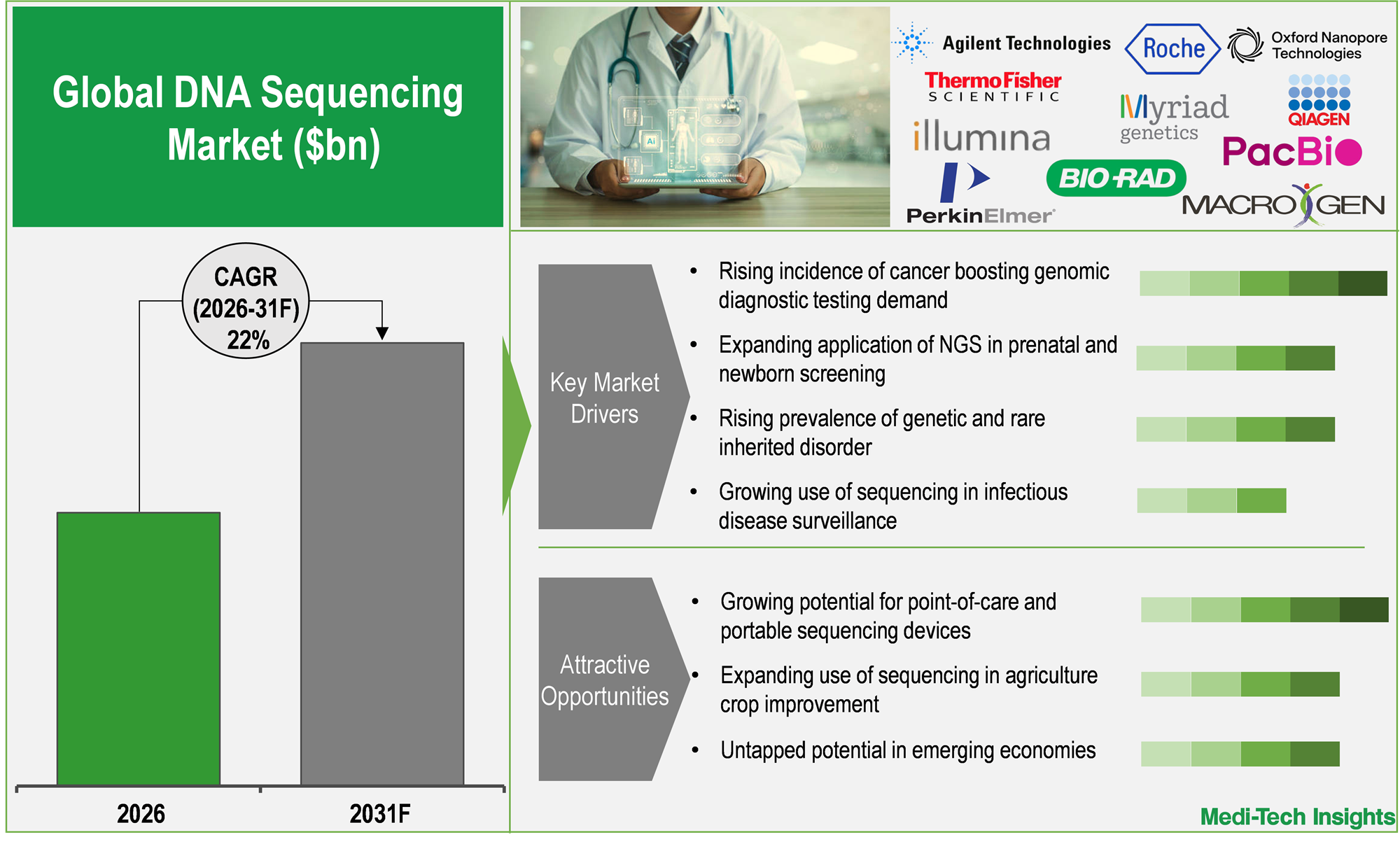
The global next generation sequencing market is set to witness a growth rate of ~15% in the next 5 years. Rising demand for precision medicine, technological advancements in sequencing platforms, falling costs of sequencing, growing use in clinical diagnostics, expanding applications beyond human genomics, increased government and private funding, are some of the key factors driving the next generation sequencing market.
Next Generation Sequencing (NGS) is a DNA sequencing technology that has transformed the sequencing of whole genomes, exomes and targeted regions of the genome rapidly and with high accuracy. Unlike Sanger sequencing, which sequences large number of DNA fragments in parallel, but not simultaneously, NGS sequences about the same number of DNA fragments usually within the same time frame. It is extensively used in research, clinical diagnoses, personalized medicine, and agricultural industries for tasks such as mutation discovery, pathogen detection, gene expression analysis, and genotyping analysis. NGS has transformed genomics, allowing the implementation of massive projects that have driven progress in precision medicine, oncology, rare disease discovery, and infectious disease monitoring.

To learn more about this report, download the PDF brochure
Rising demand for precision medicine to drive market growth
Precision medicine is a method of customizing disease prevention and treatment, which utilize genomic information to assist in the delivery of the appropriate treatment to the appropriate patient at the appropriate time. Precision medicine has resulted in new treatments and FDA-approved drugs that are customized to unique characteristics of an individual. Next-generation sequencing technology has revolutionized the science of genomics and is quickly reshaping clinical diagnosis and precision medicine. This technology permits rapid and affordable examination of large-scale genomic data, making it possible to thoroughly examine the genetic scenery of disease. The speed, precision, and decreasing cost of NGS have facilitated the development of precision medicine, which entails planning treatment according to an individual's disease-causing molecular changes. Although NGS has been tried in various health care environments, its application is most advanced in cancer.
Integration of AI and ML into genomic data analysis - A key market trend
AI has significantly influenced the analysis of NGS data. AI algorithms increase efficiency and precision as they help in automating and enhancing various aspects of NGS data analysis. For instance, a key application of AI in NGS data analysis includes the alignment of sequences to a known reference genome, a crucial step in detecting genome variations and mutations. AI algorithms help in streamlining this process by identifying the most suitable matching sequences and compensating for data errors or variations. AI also helps in the development of novel NGS data analysis tools and methodologies. For instance, AI can be used to create algorithms capable of predicting the performance of various NGS assays or to discover innovative approaches to NGS data analysis. The ability of AI algorithms to speedily and accurately process large quantities of data renders them indispensable tools in the field of NGS data analysis.

To learn more about this report, download the PDF brochure
Competitive Landscape Analysis
The global next generation sequencing market is marked by the presence of established and emerging market players such as Illumina, Inc.; Thermo Fisher Scientific, Inc.; Agilent Technologies, Inc.; F. Hoffmann-La Roche Ltd; DH Life Sciences, LLC; BGI Genomics Co., Ltd.; QIAGEN N.V.; Revvity; Eurofins Scientific; and PacBio; among others. Some of the key strategies adopted by market players include new product development, strategic partnerships and collaborations, and geographic expansion.
Report Scope
| Report Scope | Details |
| Base Year Considered | 2024 |
| Historical Data | 2023 2024 |
| Forecast Period | 2025 2030 |
| Growth Rate | 15% |
| Market Drivers |
|
| Attractive Opportunities |
|
| Segment Scope | Product and Service, Technology, Application, Workflow, End User |
| Regional Scope |
|
| Key Companies Mapped | Illumina, Inc.; Thermo Fisher Scientific, Inc.; Agilent Technologies, Inc.; F. Hoffmann-La Roche Ltd; DH Life Sciences, LLC; BGI Genomics Co., Ltd.; QIAGEN N.V.; Revvity; Eurofins Scientific; and PacBio; among others |
| Report Highlights | Market Size & Forecast, Growth Drivers & Restraints, Trends, Competitive Analysis |
Global Next Generation Sequencing Market Segmentation
This report by Medi-Tech Insights provides the size of the global next generation sequencing market at the regional- and country-level from 2023 to 2030. The report further segments the market based on product and service, technology, application, workflow, and end user.
Market Size & Forecast (2023-2030), By Product and Service, USD Million
- Instruments
- Consumables
- Services
- NGS Data Analysis Software and Platforms
Market Size & Forecast (2023-2030), By Technology, USD Million
- Whole Genome Sequencing (WGS)
- Whole Exome Sequencing
- Targeted Sequencing & Resequencing
- Others
Market Size & Forecast (2023-2030), By Application, USD Million
- Oncology
- Clinical Investigation
- Infectious Diseases
- Inherited Diseases
- Other Diseases
- Reproductive Health
- NIPT
- PGT
- Newborn Genetic Screening
- Single Gene Analysis
- HLA Typing/Immune System Monitoring
- Metagenomics, Epidemiology & Drug Development
- Agri genomics & Forensics
- Consumer Genomics
- Others
Market Size & Forecast (2023-2030), By Workflow, USD Million
- Pre-Sequencing
- Sequencing
- NGS Data Analysis
Market Size & Forecast (2023-2030), By End User, USD Million
- Academic and Research Institutes
- Hospitals and Clinics
- Pharmaceutical and Biotechnology Companies
- Contract Research Organizations (CROs)
- Others
Market Size & Forecast (2023-2030), By Region, USD Million
- North America
- US
- Canada
- Europe
- UK
- Germany
- France
- Italy
- Spain
- Rest of Europe
- Asia Pacific
- China
- India
- Japan
- Rest of Asia Pacific
- Latin America
- Middle East & Africa
Key Strategic Questions Addressed
- What is the market size & forecast of the next generation sequencing market?
- What are historical, present, and forecasted market shares and growth rates of various segments and sub-segments of the next generation sequencing market?
- What are the key trends defining the market?
- What are the major factors impacting the market?
- What are the opportunities prevailing in the market?
- Which region has the highest share in the global market? Which region is expected to witness the highest growth rate in the next 5 years?
- Who are the major players operating in the market?
- What are the key strategies adopted by players?
Need a More Tailored Analysis?
- Discuss the market sizing methodology and forecast assumptions with our healthcare analysts.
- Expand the scope with additional countries, market segments, technologies, or competitor profiling.
- Use the insights to support strategic planning, market entry, commercial due diligence, and long-term revenue growth initiatives.