Download FREE Sample


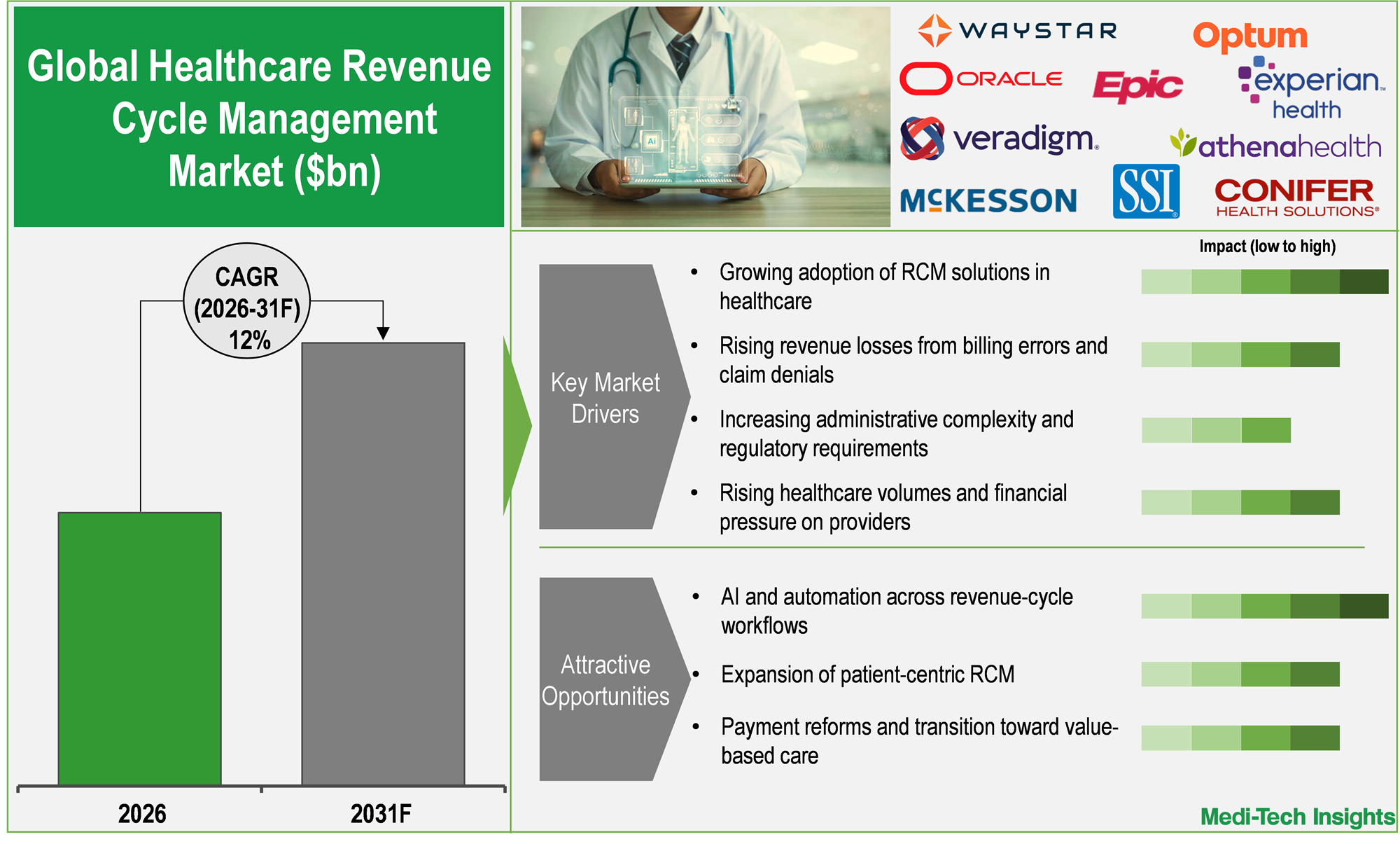
The global healthcare revenue cycle management (RCM) market size is set to grow at 12% CAGR over the next 5 years. Growing adoption of RCM solutions in healthcare; rising revenue losses from billing errors and claim denials; increasing administrative complexity and regulatory requirements; rising healthcare volumes and financial pressure on providers; and growing potential of RCM outsourcing in healthcare are some of the key factors driving the growth of the global market. However, high implementation and maintenance costs; complex & continuously changing reimbursement environment; and data security, interoperability and legacy-system challenges are expected to impact the market’s growth.
Healthcare Revenue Cycle Management (RCM) refers to the financial and administrative processes healthcare providers use to manage and collect revenue generated from patient services. It encompasses activities involved in capturing patient and insurance information, verifying coverage, coding and billing services, submitting and processing claims, managing denials, posting payments, and collecting outstanding balances. RCM helps healthcare providers streamline financial workflows, improve billing accuracy, accelerate reimbursement, reduce claim denials and revenue leakage, and enhance overall financial performance. The market includes technology solutions and technology-enabled services designed to automate, optimize, and manage revenue-cycle processes while helping healthcare organizations navigate increasingly complex payer requirements and administrative workflows.
Growing adoption of RCM solutions across healthcare providers fuels global market demand
An efficient revenue cycle is critical to the financial and operational performance of healthcare providers. Healthcare organizations are increasingly adopting RCM solutions to streamline complex administrative and financial processes, improve reimbursement, and reduce revenue leakage. Hospitals and health systems, physician practices and medical groups, ambulatory providers, and post-acute care organizations use RCM solutions to manage patient registration, insurance verification, coding, billing, claims processing, denial management, payment posting, collections, and accounts receivable. These solutions help providers automate repetitive workflows, improve billing accuracy, increase clean claim rates, identify and resolve denials, accelerate reimbursement, and reduce administrative costs.
Furthermore, growing payer complexity, frequent changes in reimbursement policies, increasing documentation and coding requirements, and rising financial pressures are encouraging providers to modernize revenue-cycle operations. RCM platforms increasingly incorporate automation, analytics, artificial intelligence (AI), and interoperability capabilities to improve workflow visibility and support data-driven financial management. As healthcare organizations seek to optimize cash flow while allowing clinical staff to focus on patient care, demand for technology-enabled RCM solutions and services is increasing across diverse provider settings. Consequently, continued adoption of RCM solutions is expected to drive growth in the global healthcare revenue cycle management market.
To learn more about this report, download the PDF brochure
Growing potential of RCM outsourcing in healthcare propel market growth
Leveraging technology offered by outsourcing partnerships can offer streamlined workflows, increased efficiency, focus on patient care, timely and improved reimbursement, error-free billing, improved payments, and accuracy, all of which can lead to reduced costs and increased revenue collection. Another reason why healthcare RCM outsourcing is on the rise is that many health systems have learned they have lagged internally in building technologies and can no longer keep up with the speed of technological advancements. Thus, they are gradually adopting digitally enabled modular solutions to revamp their healthcare RCM operations by collaborating with third-party service providers who can combine people, processes, and technology into one robust revenue cycle solution.
Automation, data analytics, patient-centric approach and payment reforms set to drive the global healthcare RCM market
By integrating next-generation digital technologies, vendors can enhance consumer centricity, improve patient touch-points, optimize reimbursement, and minimize denials to improve cash flow across the healthcare ecosystem. The most significant healthcare RCM trends that will amplify the organization's financial health are:
- Automation: Automating the revenue cycle can move the process along faster while still providing exceptional patient care. Automation can help healthcare businesses save money and time by reducing operational costs and downtime
- Vital role of data analytics in the healthcare revenue cycle: Powerful technologies, including cloud, AI, machine learning (ML), and predictive analytics, will catalyze health systems to proactively monitor and quickly address compliance and revenue risks as they emerge
- More focus on a patient-centric approach by medical practices: Focusing on more of a patient-centric approach can assure medical practice of augmented revenue flow, particularly enhancing business to a better level. Technology is making it easier for organizations to engage with patients and provide them with better experiences
- Payment reforms: The healthcare system is undergoing major initiatives such as value-based care and bundled payments. In recent years, value-based care has been another fast-emerging trend that has begun to gain traction
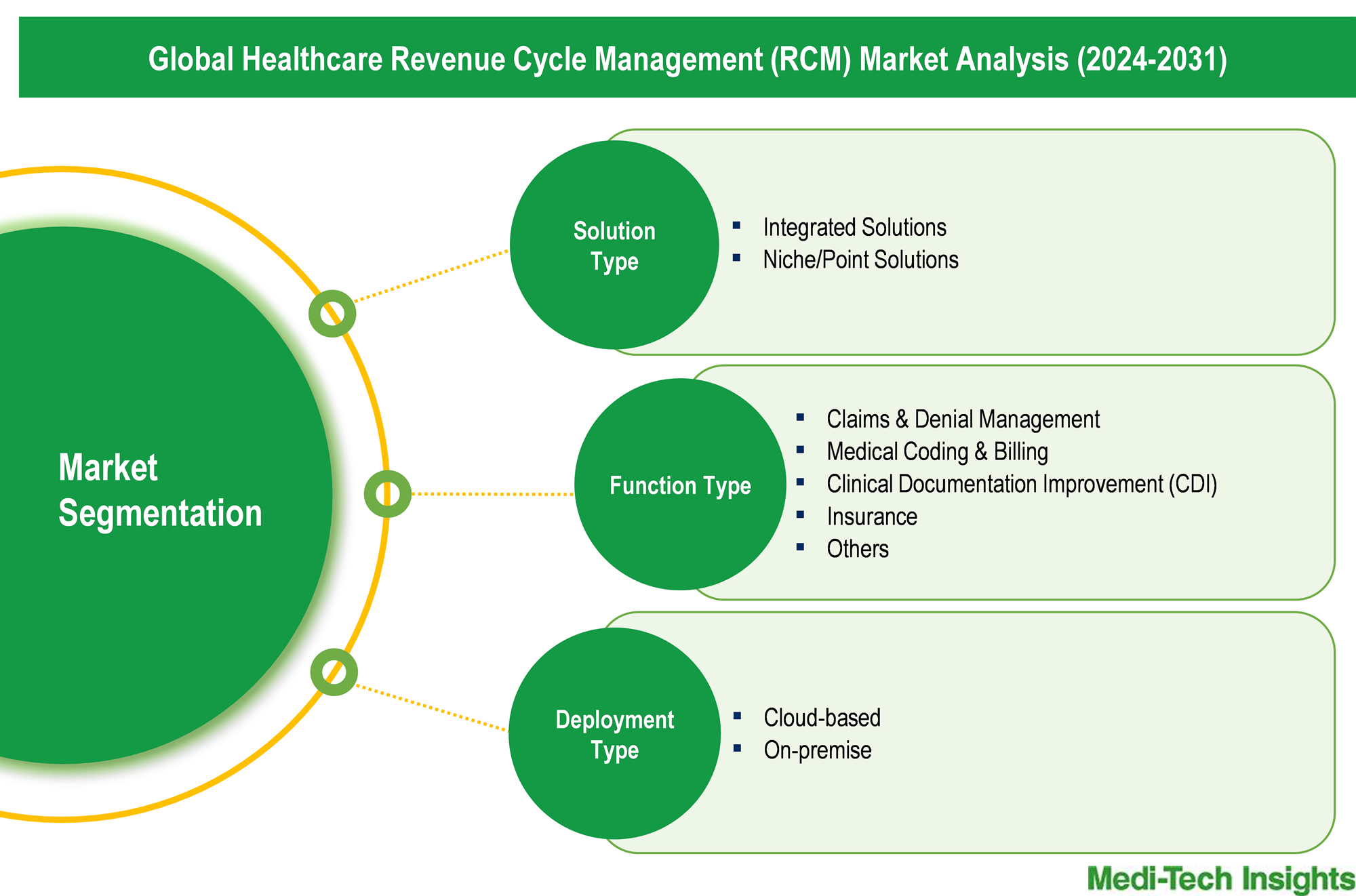
To learn more about this report, download the PDF brochure
Solution Type Segment Outlook
Based on solution type, the Healthcare Revenue Cycle Management market is segmented into integrated solutions and niche/point solutions, with integrated platforms providing end-to-end capabilities while point solutions address specific revenue-cycle functions. Integrated solutions accounted for the larger share of the market, driven by healthcare providers' preference for unified platforms that connect patient access, eligibility, coding, billing, claims, denial management, collections, and financial reporting. These solutions provide greater workflow visibility, reduce the need for multiple systems, improve data integration, and support standardized revenue-cycle processes across hospitals, health systems, and physician organizations.
Niche/point solutions are expected to register the fastest growth, supported by increasing demand for targeted automation in high-impact areas such as denial management, eligibility verification, prior authorization, claims optimization, and patient payments. Providers can deploy these solutions alongside existing RCM platforms to address specific performance gaps without replacing core systems, supporting faster implementation and measurable improvements in revenue-cycle efficiency.
Regional Outlook: North America maintains its leading position in the healthcare revenue cycle management market
From a geographical perspective, North America holds a major share of the global healthcare revenue cycle management market. This can be mainly attributed to the growing adoption of RCM in healthcare, an increasing adoption of cloud-based solutions, the growing demand to manage unstructured healthcare data, an increasing adoption of electronic health records, and the presence of key market players, in this region. However, the Asia-Pacific region is expected to witness a strong growth in the healthcare RCM market in the upcoming years due to an increasing patient volume and growth in health insurance, growing demand for robust process improvement in healthcare, growing demand for efficient healthcare services, and the loss of revenue due to billing errors, and declining reimbursement in the region.
Competitive Landscape Analysis
The global healthcare revenue cycle management market is marked by the presence of established and emerging market players such as-
- Optum Inc.
- Epic Systems Corporation
- Oracle Health
- Veradigm Inc.
- athenahealth Inc.
- McKesson Corporation
- The SSI Group LLC
- Waystar
- Experian Health
- Conifer Health Solutions LLC
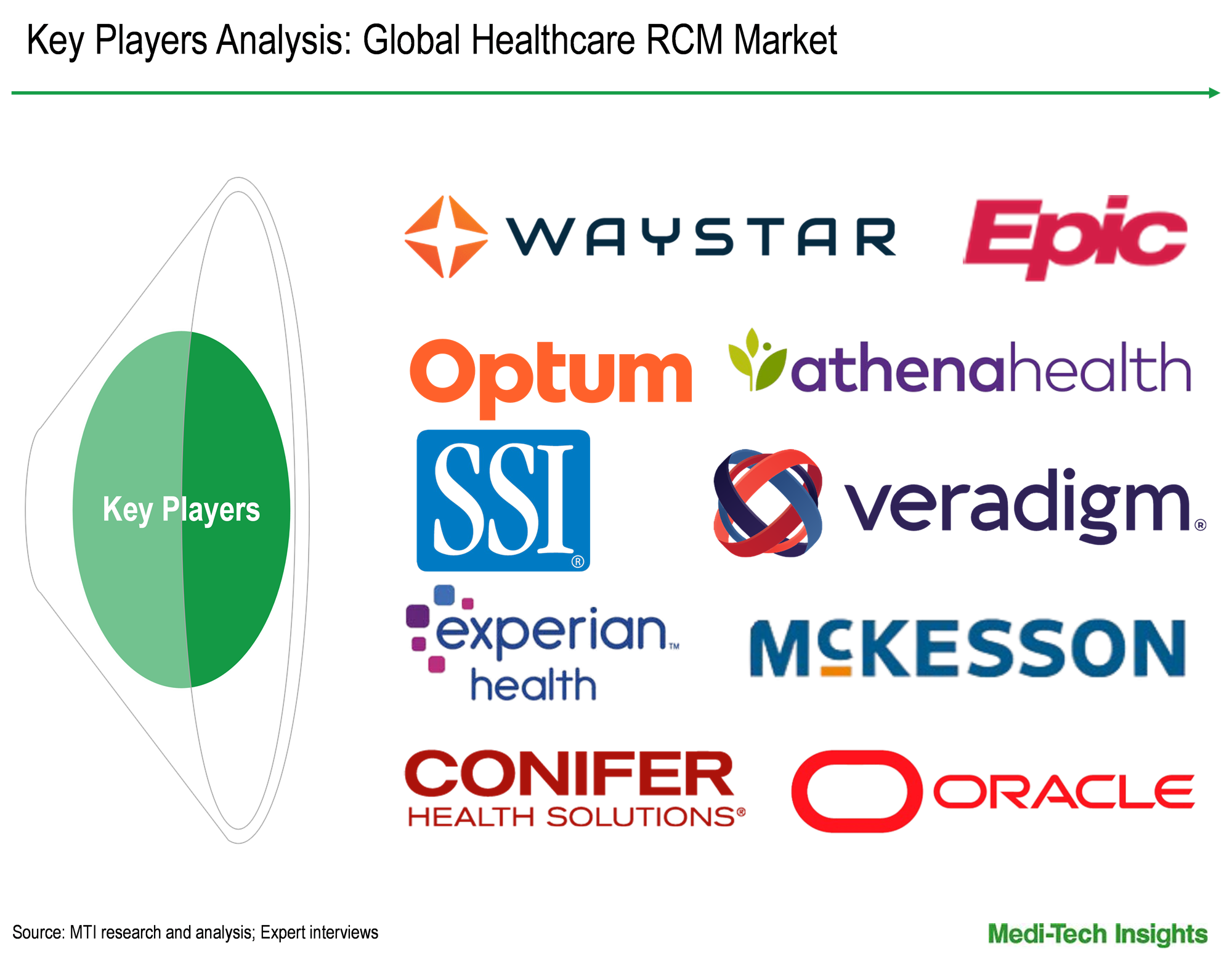
Get a sample report for competitive landscape analysis
Growth strategies adopted by players to establish their foothold in the healthcare revenue cycle management market
Players operating in this market are adopting various growth strategies such as new product launch; acquisitions; expansions; and strategic partnerships, agreements, and collaborations, to garner market share. For instance,
- In September 2026, UF Health collaborated with R1 to deploy Phare OS, an AI-native revenue-cycle platform integrating automated workflows, payer intelligence, and human oversight to improve operational efficiency and financial performance
- In September 2026, ECLAT Health Solutions launched evaire Recover, an agentic AI platform that prioritizes claims, manages denials, provides real-time payer guidance, and automates payment reconciliation to accelerate collections and improve revenue-cycle efficiency
- In June 2026, LifeMed and EXL collaborated to transform RCM through AI-powered automation, using provider-specific data to automate compliance checks, optimize billing codes, and manage denials and appeals before claims reach payers
- In January 2026, Veradigm launched an AI-enabled application for Revenue Cycle Services clients, providing automated insights into denial trends, payment patterns, and operational bottlenecks to help independent practices identify revenue leakage and improve financial performance
- In November 2025, PwC and AWS collaborated to deliver Revenue Cycle Managed Services through AWS, combining AI, cloud infrastructure, and managed services to automate billing, claims, denials, collections, and reimbursement workflows
Market Scope
Report Metric | Details |
Base Year Considered | 2025 |
Historical Data | 2024 – 2025 |
Forecast Period | 2026 – 2031 |
Growth Rate | 12% |
Segment Scope | Solution Type, Function Type, Deployment Type, and End User |
Regional Scope |
|
Market Drivers |
|
Attractive Opportunities |
|
Key Companies Mapped | Optum Inc.; Epic Systems Corporation; Oracle Health; Veradigm Inc.; athenahealth Inc.; McKesson Corporation; The SSI Group LLC; Waystar; Experian Health; Conifer Health Solutions LLC; among others |
Report Highlights | Market Size & Forecast, Growth Drivers & Restraints, Trends, Competitive Analysis |
Global Healthcare Revenue Cycle Management Market Segmentation
This report by Medi-Tech Insights provides the size of the global healthcare revenue cycle management market at the regional and country-level from 2024 to 2031. The report further segments the market by solution type, function type, deployment type, and end user.
- Market Size & Forecast (2024-2031), By Solution Type, USD Billion
- Integrated Solutions
- Niche/Point Solutions
- Market Size & Forecast (2024-2031), By Function Type, USD Billion
- Claims & Denial Management
- Medical Coding & Billing
- Clinical Documentation Improvement (CDI)
- Insurance
- Others
- Market Size & Forecast (2024-2031), By Deployment Type, USD Billion
- Cloud-based
- On-premise
- Market Size & Forecast (2024-2031), By End User, USD Billion
- Hospitals
- Physician’s Office
- Other End Users
- Market Size & Forecast (2024-2031), By Region, USD Billion
- North America
- US
- Canada
- Europe
- UK
- Germany
- France
- Italy
- Spain
- Rest of Europe
- Asia Pacific
- China
- India
- Japan
- Rest of Asia Pacific
- Latin America
- Middle East & Africa
- North America
Frequently Asked Questions About This Report
What is the growth rate of the healthcare revenue cycle management market?
The healthcare revenue cycle management market is set to witness a growth rate of 12% during the forecast period from 2026 to 2031
What are the key trends defining the market?
Automation, data analytics, patient-centric approach and payment reforms; increasing adoption of AI-powered RCM and predictive analytics; and greater emphasis on digital patient financial engagement are major trends in the healthcare revenue cycle management market
What are the major factors impacting the market growth?
Growing adoption of RCM solutions in healthcare; rising revenue losses from billing errors and claim denials; increasing administrative complexity and regulatory requirements; rising healthcare volumes and financial pressure on providers; and growing potential of RCM outsourcing in healthcare are some of the key factors driving the healthcare revenue cycle management market
What are the opportunities prevailing in the market?
AI and automation across revenue-cycle workflows; expansion of patient-centric RCM; data analytics and predictive RCM; and payment reforms and transition toward value-based care offer numerous growth opportunities for companies operating in the healthcare revenue cycle management market
Which region has the highest share in the global market? Which region is expected to witness the highest growth rate in the next 5 years?
North America held the largest share of the global healthcare revenue cycle management market in 2025, while Asia-Pacific is projected to grow at the highest CAGR during the forecast period
Who are the major players operating in the market?
Some of the major players operating in the healthcare revenue cycle management market include Optum Inc.; Epic Systems Corporation; Oracle Health; Veradigm Inc.; athenahealth Inc.; McKesson Corporation; The SSI Group LLC; Waystar; Experian Health; Conifer Health Solutions LLC; among others
What are the key strategies adopted by players?
Key players in the healthcare revenue cycle management market are adopting strategies such as new product launch; acquisitions; expansions; and strategic partnerships, agreements, and collaborations to expand their market presence
Need a More Tailored Analysis?
- Discuss the market sizing methodology and forecast assumptions with our healthcare analysts.
- Expand the scope with additional countries, market segments, technologies, or competitor profiling.
- Use the insights to support strategic planning, market entry, commercial due diligence, and long-term revenue growth initiatives.