Download FREE Sample


Report Overview
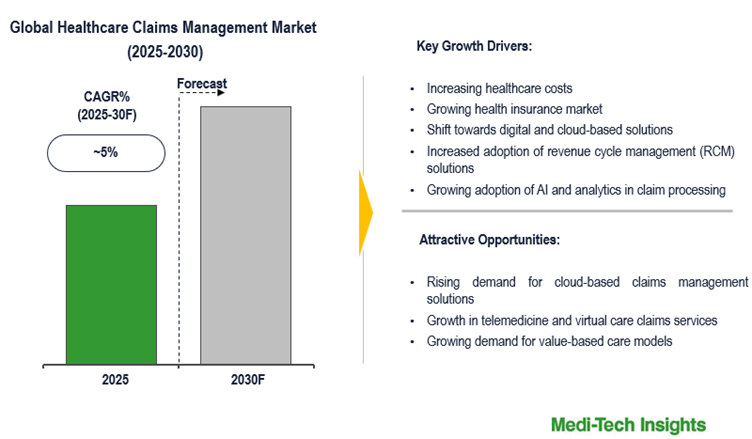
Healthcare claims management refers to the process of handling medical insurance claims, from initial submission to final reimbursement. It involves verifying patient information, coding medical procedures, ensuring compliance with regulations, processing payments, and managing denials or rejections. The goal is to streamline claim processing, reduce errors, prevent fraud, and ensure timely reimbursement for healthcare providers while maintaining compliance with insurance policies and government regulations.
To learn more about the research report, download a sample report.
Adoption of AI and analytics in healthcare insurance claims management drives market growth
Automation and AI technologies have become essential in healthcare insurance claims management, enabling insurers to streamline workflows, minimize manual tasks, and enhance accuracy. AI-powered chatbots and virtual assistants offer real-time customer support, while automated claims processing systems efficiently manage repetitive tasks like data entry and document handling. Additionally, AI-driven algorithms help detect fraudulent claims, allowing insurers to mitigate risks proactively. With vast amounts of data available, insurers are increasingly leveraging advanced analytics and predictive modeling to optimize claims management. By analyzing historical data, they can identify patterns, detect anomalies, and improve claim outcome predictions. Predictive modeling also enhances resource allocation, identifies high-risk claims, and accelerates settlements, leading to greater customer satisfaction and cost savings.
To learn more about the research report, download a sample report.
Adoption of AI and analytics in healthcare insurance claims management drives market growth
Automation and AI technologies have become essential in healthcare insurance claims management, enabling insurers to streamline workflows, minimize manual tasks, and enhance accuracy. AI-powered chatbots and virtual assistants offer real-time customer support, while automated claims processing systems efficiently manage repetitive tasks like data entry and document handling. Additionally, AI-driven algorithms help detect fraudulent claims, allowing insurers to mitigate risks proactively. With vast amounts of data available, insurers are increasingly leveraging advanced analytics and predictive modeling to optimize claims management. By analyzing historical data, they can identify patterns, detect anomalies, and improve claim outcome predictions. Predictive modeling also enhances resource allocation, identifies high-risk claims, and accelerates settlements, leading to greater customer satisfaction and cost savings.
Competitive Landscape Analysis
The global healthcare claims management market is marked by the presence of established and emerging market players such as McKesson Corporation; The SSI Group, Inc.; Quest Diagnostics; Kareo; Optum, Inc. (a subsidiary of UnitedHealth Group); Conifer Health Solutions; CareCloud; eClinicalWorks; IBM; Cerner Corporation; Oracle Corporation; Cognizant; and Change healthcare; among others. Some of the key strategies adopted by market players include new product development, strategic partnerships and collaborations, and investments.
Report Scope
|
Report Scope |
Details |
|
Base Year Considered |
2024 |
|
Historical Data |
2023 - 2024 |
|
Forecast Period |
2025 - 2030 |
|
Growth Rate |
~5% |
|
Market Drivers |
|
|
Attractive Opportunities |
|
|
Segment Scope |
Product, Component, Solutions Type, Deployment Mode, and End User |
|
Regional Scope |
|
|
Key Companies Mapped |
McKesson Corporation; The SSI Group, Inc.; Quest Diagnostics; Kareo; Optum, Inc. (a subsidiary of UnitedHealth Group); Conifer Health Solutions; CareCloud; eClinicalWorks; IBM; Cerner Corporation; Oracle Corporation; Cognizant; and Change Healthcare |
|
Report Highlights |
Market Size & Forecast, Growth Drivers & Restraints, Trends, Competitive Analysis |
Market Segmentation
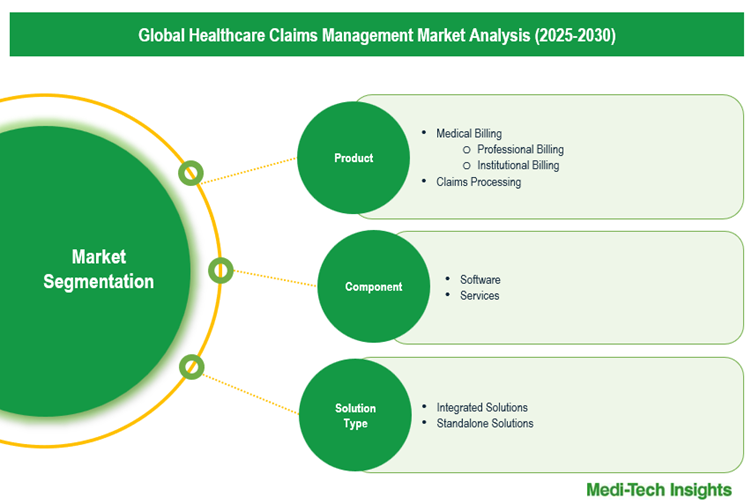
This report by Medi-Tech Insights provides thesize of the global healthcare claims management market at theregional- and country-level from 2023 to 2030. The report further segments the market based on product, component, solution type, deployment mode, and end user.
- Market Size & Forecast (2023-2030), By Product, USD Million
- Medical Billing
- Professional Billing
- Institutional Billing
- Claims Processing
- Market Size & Forecast (2023-2030), By Component, USD Million
- Software
- Services
- Market Size & Forecast (2023-2030), By Solution Type, USD Million "list-style-type: none">
- Integrated Solutions
- Standalone Solutions
- Market Size & Forecast (2023-2030), By Deployment Mode, USD Million
- On-Premise
- Web-Based
- Cloud-Based
- Market Size & Forecast (2023-2030), By End User, USD Million
-
- Healthcare Providers
- Healthcare Payers
- Others
- Market Size & Forecast (2023-2030), By Region, USD Million
- North America
- US
- Canada
- Europe
- UK
- Germany
- France
- Italy
- Spain
- Rest of Europe
- Asia Pacific
- China
- India
- Japan
- Rest of Asia Pacific
- Latin America
- Middle East & Africa
- North America
Key Strategic Questions Addressed
- What is the market size & forecast of the healthcare claims management market?
- What are the historical, present, and forecasted market shares and growth rates of various segments and sub-segments of the healthcare claims management market?
- What are the key trends defining the market?
- What are the major factors impacting the market?
- What are the opportunities prevailing in the market?
- Which region has the highest share in the global market? Which region is expected to witness the highest growth rate in the next 5 years?
- Who are the major players operating in the market?
- What are the key strategies adopted by players?
Need a More Tailored Analysis?
- Discuss the market sizing methodology and forecast assumptions with our healthcare analysts.
- Expand the scope with additional countries, market segments, technologies, or competitor profiling.
- Use the insights to support strategic planning, market entry, commercial due diligence, and long-term revenue growth initiatives.