Download FREE Sample


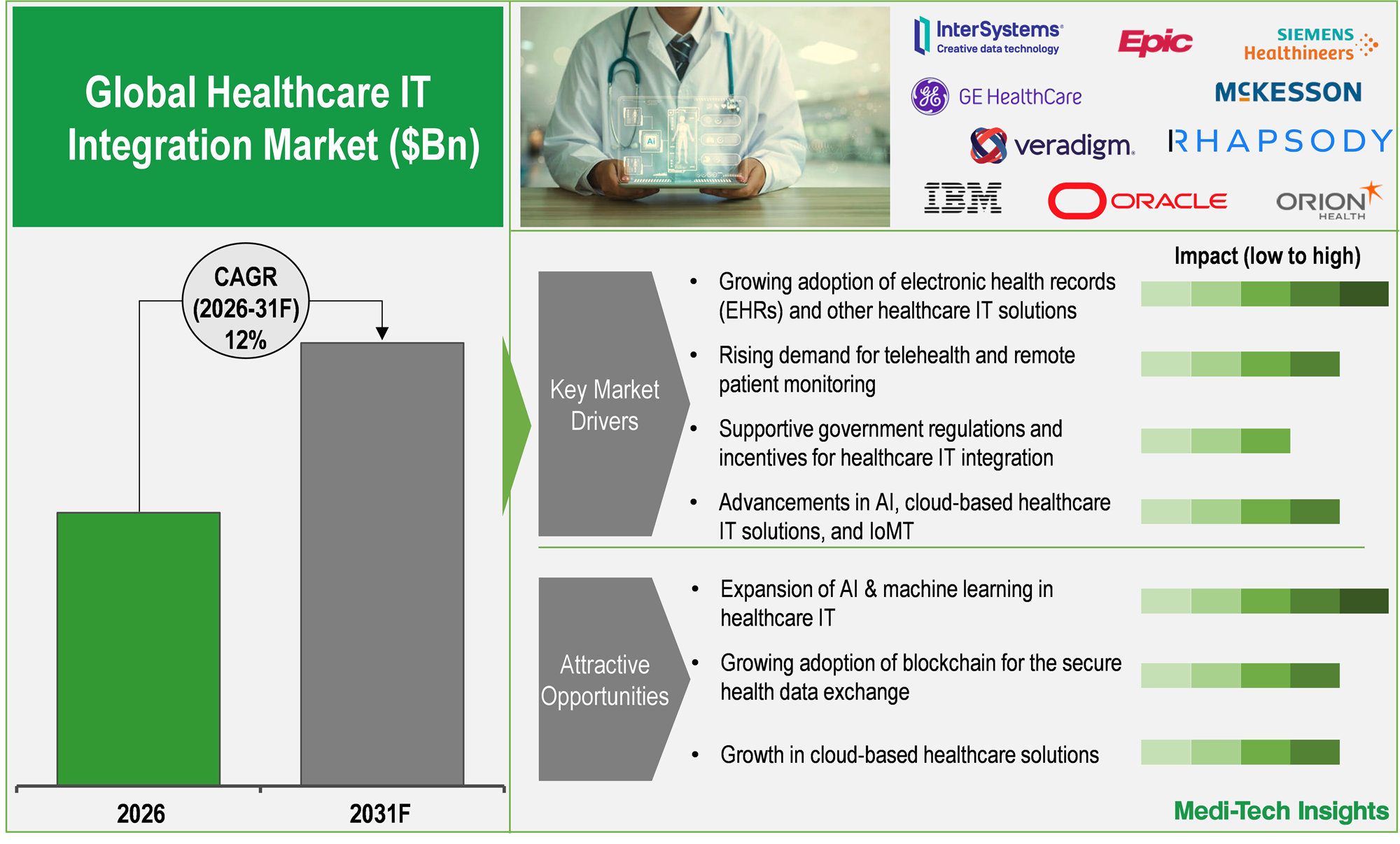
The global healthcare information technology (IT) integration market size is set to grow at 12% CAGR over the next 5 years. Growing adoption of EHRs & other healthcare IT solutions; rising demand for telehealth & remote patient monitoring; supportive government regulations & incentives for healthcare IT integration; advancements in AI, cloud-based healthcare IT solutions, & the Internet of Medical Things (IoMT); and expanding usage of connected care technologies are some of the key factors driving the growth of the global market. However, EHR interoperability issues; data inconsistency; health data security and privacy concerns; and high cost associated with healthcare IT integration solutions are expected to impact the market’s growth.
Healthcare information technology (HIT) integration is the process of connecting and consolidating data from diverse healthcare systems, applications, and devices to ensure seamless data exchange, interoperability, and enhanced healthcare delivery. This encompasses information from electronic health records (EHRs), medical devices, laboratory information systems (LIS), and various other healthcare IT solutions.
Growing adoption of EHR in healthcare IT integration fuels its demand
As healthcare organizations shift to digital systems, the demand for seamless interoperability and data exchange has increased, driving the need for IT integration solutions. Electronic health record (EHR) integration connects an organization's EHR software with other essential healthcare systems, enabling providers and staff across various departments to access patient records efficiently. This integration is facilitated through application programming interfaces (APIs), which serve as a bridge between different software solutions.
EHR integration and healthcare interoperability ensure smooth electronic data exchange within hospitals and clinics, allowing patient records to be accessed across multiple platforms for improved coordination and productivity. Governments worldwide have introduced policies, regulations, and financial incentives to accelerate EHR adoption. Additionally, the rise of telemedicine and remote patient monitoring (RPM) especially post-pandemic has further fuelled the need for EHR integration with digital health platforms. With the rapid pace of digital transformation in healthcare, IT integration solutions will continue to be essential for enhancing efficiency, patient outcomes, and data-driven decision-making. For instance, in November 2024, Suki announced two new partnerships with EHR vendors, MEDENT and Azalea Health, who will each use Suki-s AI engine Suki Platform to directly embed AI capabilities within their respective solutions, enhancing user experience and improving patient care.
To learn more about this report, download the PDF brochure
Rising demand for telehealth and remote patient monitoring drive market growth
The COVID-19 pandemic greatly accelerated the adoption of telehealth services, establishing virtual care as a key component of modern healthcare. Telehealth applications enable doctors and patients to connect remotely, eliminating the need for physical presence in the same city. EHR-telehealth platform integration ensures seamless access to patient records during virtual consultations, while API-enabled data sharing facilitates real-time exchange of medical information between telehealth providers, pharmacies, and laboratories. This allows doctors to review patients- health histories, access recent test results and scans, and make informed diagnoses.
Having access to comprehensive medical records is essential for effective treatment, and EHR data integration enhances health platforms by enabling physicians to deliver more informed care, especially for patients who face travel limitations. Additionally, the Internet of Medical Things (IoMT) and wearable health technologies are revolutionizing remote patient monitoring by providing continuous health tracking beyond traditional clinical settings. Moreover, the integration of AI and machine learning in telehealth and remote patient monitoring (RPM) is advancing diagnostics, clinical decision support, and patient monitoring, further improving healthcare outcomes.
Expansion of AI & machine learning in healthcare IT- a major opportunity
The rapid adoption of AI and machine learning across healthcare is creating new opportunities for IT integration platforms that can connect, standardize, and manage data from EHRs, medical devices, imaging systems, laboratories, and other digital health applications. AI-driven clinical decision support, predictive analytics, automation, and personalized care require access to high-quality, interoperable data. Standards such as FHIR are increasingly supporting this connectivity, while healthcare organizations are exploring AI-enabled health IT solutions. As AI adoption expands, demand is expected to increase for integration platforms capable of aggregating, harmonizing, and securely exchanging diverse healthcare data to support AI and ML applications.
To learn more about this report, download the PDF brochure
Product Segment Outlook
Interface/Integration Engines represent the largest product segment, driven by their central role in connecting fragmented EHRs, laboratory, pharmacy, radiology, and other healthcare information systems. Growing interoperability requirements, FHIR adoption, legacy-system modernization, and demand for real-time data exchange are encouraging providers to deploy integration engines capable of transforming, routing, and standardizing data across heterogeneous IT environments.
Medical Device Integration Software is expected to witness the fastest growth, supported by the proliferation of connected medical devices, remote monitoring technologies, and digitally enabled clinical workflows. These solutions automatically capture and transfer data from patient monitors, ventilators, infusion pumps, imaging systems, and other devices into EHRs and clinical applications, reducing manual documentation while enabling real-time, data-driven clinical decision-making.
Regional Outlook: North America maintains its leading position in the healthcare IT integration market
The global Healthcare IT Integration market is experiencing strong growth as healthcare providers increasingly prioritize interoperability, seamless data exchange, and integration of fragmented IT systems. North America represents the largest regional market, supported by widespread EHR adoption, mature healthcare IT infrastructure, and strong emphasis on interoperability and secure health-data exchange. Regulatory initiatives, healthcare provider consolidation, cloud adoption, and investments in digital health are encouraging hospitals and health systems to integrate fragmented clinical and administrative systems, sustaining demand for healthcare IT integration solutions.
Asia Pacific is expected to register the fastest growth, driven by accelerating healthcare digitization, expanding hospital networks, and government initiatives supporting electronic health records and interoperable healthcare systems. Increasing adoption of telehealth, cloud platforms, connected medical devices, and AI-enabled applications is creating greater demand for integration infrastructure across fragmented healthcare ecosystems, particularly in emerging markets such as India and China.
Competitive Landscape Analysis
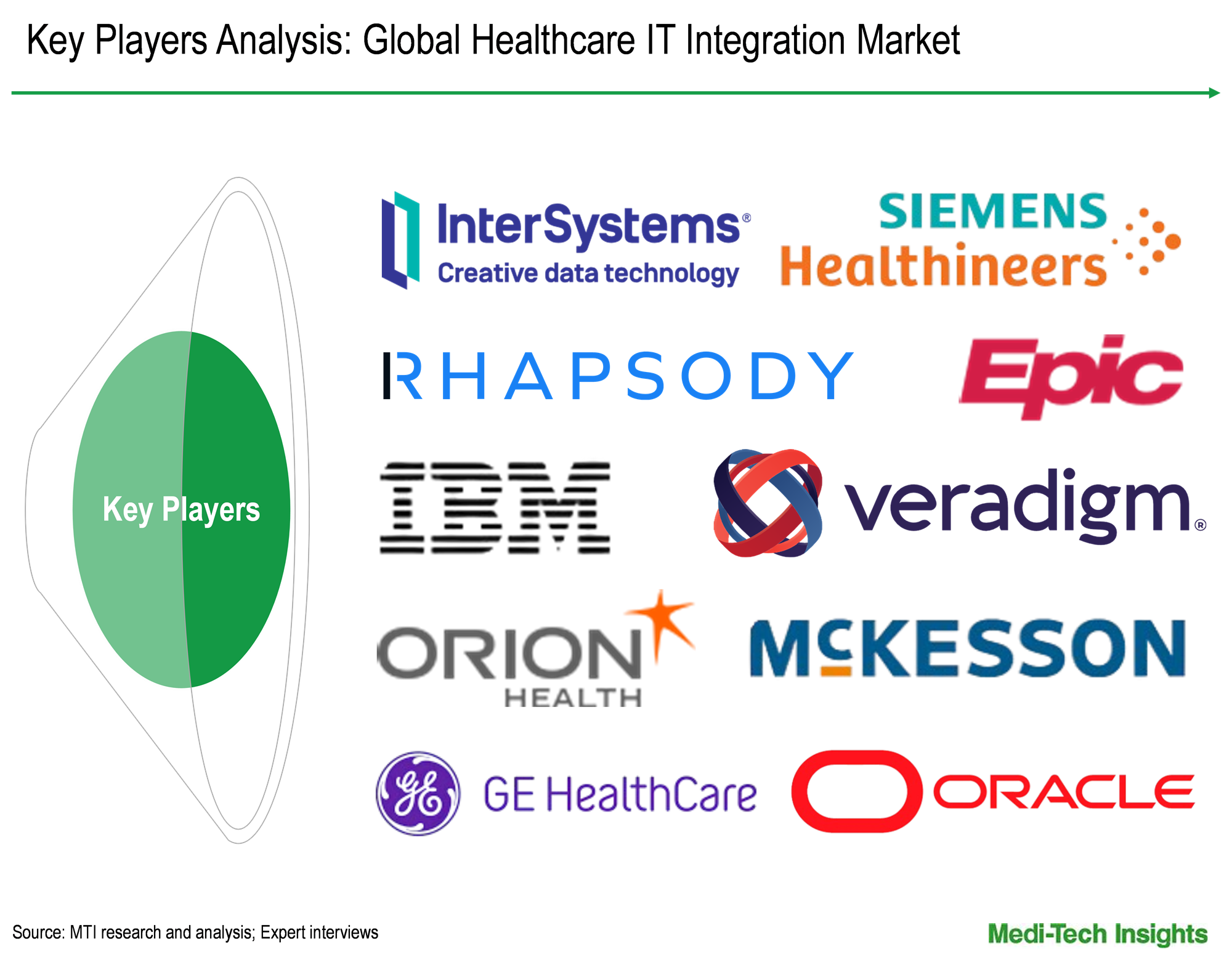
The global healthcare IT integration market is marked by the presence of established and emerging market players such as-
- Veradigm Inc.
- Oracle Cerner
- GE Healthcare
- IBM Corporation
- Siemens Healthineers
- Rhapsody
- InterSystems Corporation
- Epic Systems Corporation
- Orion Health
- McKesson Corporation
Get a sample report for competitive landscape analysis
Growth strategies adopted by players to establish their foothold in the healthcare IT integration market
Players operating in this market are adopting various growth strategies such as new product launch; acquisitions; expansions; and strategic partnerships, agreements, and collaborations, to garner market share. For instance,
- In June 2026, Redox launched AI-powered integration tools, including an MCP server and AI Assistant Suite, enabling natural-language integration management and intelligent healthcare data processing through Redox Engine
- In September 2025, NextGen Healthcare partnered with Kno2 to expand nationwide interoperability, enabling more than 100,000 providers to participate in TEFCA-based healthcare data exchange
- In April 2025, GE HealthCare joined OR.NET e.V. in to advance the Service-oriented Device Connectivity (SDC) protocol for medical-device interoperability. The collaboration aims to enable secure, vendor-neutral connectivity and real-time data exchange between medical devices, supporting more integrated clinical workflows
- In December 2024, HEALWELL AI agreed to acquire Orion Health for NZ$175 million, combining Orion Health’s healthcare interoperability platforms with HEALWELL’s AI capabilities to create a global healthcare technology leader
- In August 2024, MEDITECH launched Traverse Exchange, a nationwide interoperability network enabling secure data exchange across MEDITECH and other EHRs, with FHIR-based connectivity and a TEFCA on-ramp
Report Scope
Report Metric | Details |
Base Year Considered | 2025 |
Historical Data | 2024 – 2025 |
Forecast Period | 2026 – 2031 |
Growth Rate | 12% |
Segment Scope | Product, Service Type, and End User |
Regional Scope |
|
Market Drivers |
|
Attractive Opportunities |
|
Key Companies Mapped | Veradigm Inc.; Oracle Cerner; GE Healthcare; IBM Corporation; Siemens Healthineers; Rhapsody; InterSystems Corporation; Epic Systems Corporation; Orion Health; McKesson Corporation; among others |
Report Highlights | Market Size & Forecast, Growth Drivers & Restraints, Trends, Competitive Analysis |
Global Healthcare IT Integration Market Segmentation
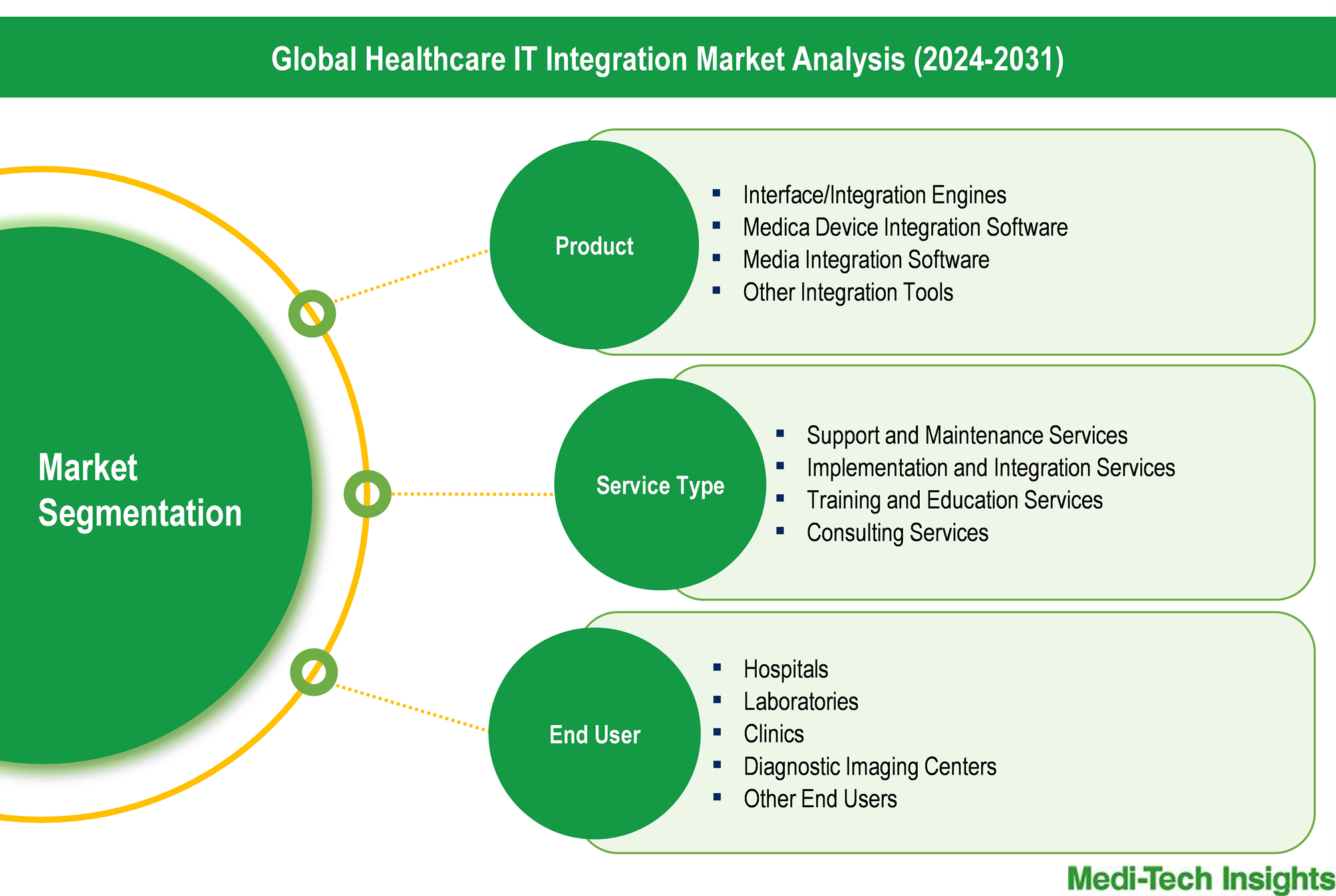
This report by Medi-Tech Insights provides the size of the global healthcare IT integration market at the regional and country-level from 2024 to 2031. The report further segments the market by product, service type, and end user.
Market Size & Forecast (2024-2031), By Product, USD Billion
- Interface/Integration Engines
- Medica Device Integration Software
- Media Integration Software
- Other Integration Tools
Market Size & Forecast (2024-2031), By Service Type, USD Billion
- Support and Maintenance Services
- Implementation and Integration Services
- Training and Education Services
- Consulting Services
Market Size & Forecast (2024-2031), By End User, USD Billion
- Hospitals
- Laboratories
- Clinics
- Diagnostic Imaging Centers
- Other End Users
Market Size & Forecast (2024-2031), By Region, USD Billion
- North America
- US
- Canada
- Europe
- UK
- Germany
- France
- Italy
- Spain
- Rest of Europe
- Asia Pacific
- China
- India
- Japan
- Rest of Asia Pacific
- Latin America
- Middle East & Africa
Frequently Asked Questions About This Report
What is the growth rate of the healthcare IT integration market?
The healthcare IT integration market is set to witness a growth rate of 12% during the forecast period from 2026 to 2031
What are the key trends defining the market?
Growing adoption of HL7 integration solutions and expansion of telemedicine, remote diagnostics, & e-pharmacies in the healthcare IT are major trends in the healthcare IT integration market
What are the major factors impacting the market growth?
Growing adoption of EHRs & other healthcare IT solutions; rising demand for telehealth & remote patient monitoring; supportive government regulations & incentives for healthcare IT integration; advancements in AI, cloud-based healthcare IT solutions, & the Internet of Medical Things (IoMT); and expanding usage of connected care technologies are some of the key factors driving the healthcare IT integration market
What are the opportunities prevailing in the market?
Expansion of AI & machine learning in healthcare IT; growing adoption of blockchain for secure health data exchange; and growth in cloud-based healthcare solutions offer numerous growth opportunities for companies operating in the healthcare IT integration market
Which region has the highest share in the global market? Which region is expected to witness the highest growth rate in the next 5 years?
North America held the largest share of the global healthcare IT integration market in 2025, while Asia-Pacific is projected to grow at the highest CAGR during the forecast period
Who are the major players operating in the market?
Some of the major players operating in the healthcare IT integration market include Veradigm Inc.; Oracle Cerner; GE Healthcare; IBM Corporation; Siemens Healthineers; Rhapsody; InterSystems Corporation; Epic Systems Corporation; Orion Health; McKesson Corporation; among others
Need a More Tailored Analysis?
- Discuss the market sizing methodology and forecast assumptions with our healthcare analysts.
- Expand the scope with additional countries, market segments, technologies, or competitor profiling.
- Use the insights to support strategic planning, market entry, commercial due diligence, and long-term revenue growth initiatives.