Download FREE Sample


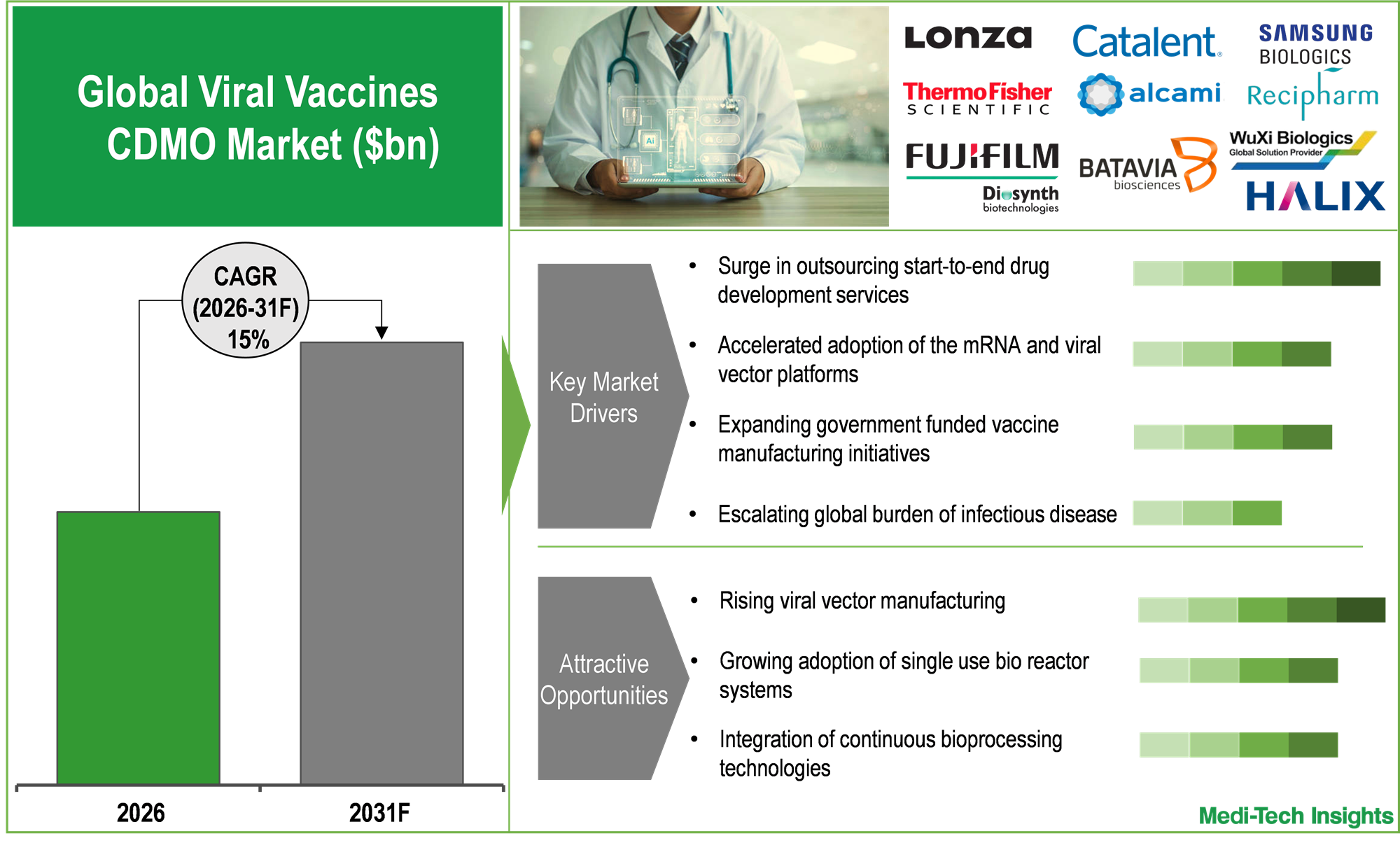
The global viral vaccines CDMO market size is set to grow at a CAGR of 15% over the next 5 years. Key drivers include the escalating global burden of infectious diseases, surge in outsourcing start-to-end development services, accelerated adoption of the mRNA and viral vector platforms, rising adoption of telehealth services, expanding government-funded vaccine manufacturing initiatives, and growing need for specialized CDMO services for new viral vaccine technologies. However, stringent regulatory compliance and GMP certification barriers, high capital intensity and infrastructure complexity, and skilled workforce scarcity in viral manufacturing disciplines are expected to impact the market’s growth.
The viral vaccine contract development and manufacturing organization (CDMO) market refers to the specialized outsourced services sector encompassing end-to-end development, production, and manufacturing support for viral vaccine candidates provided by third-party organizations to pharmaceutical and biopharmaceutical companies. These services are typically accessed through contractual partnerships and enable clients to leverage capabilities such as formulation and process development, fill-finish operations, quality control, and regulatory compliance support. CDMOs in this space offer user-accessible, scalable manufacturing solutions that provide pharmaceutical innovators with technical expertise and infrastructure to advance vaccine pipelines efficiently. Additionally, some CDMOs extend beyond basic manufacturing to include analytical testing, clinical-stage production, and biologics characterization. The market serves biotech startups, established pharmaceutical companies, academic institutions, and government agencies developing prophylactic and therapeutic viral vaccines.
Accelerated adoption of the mRNA and viral vector platform to drive market growth
The accelerated adoption of mRNA and viral vector platforms has emerged as a pivotal driver reshaping the viral vaccines CDMO market. The unprecedented success of mRNA-based COVID-19 vaccines developed by Moderna and Pfizer-BioNTech demonstrated the remarkable speed, scalability, and efficacy potential of these novel platform technologies, fundamentally transforming vaccine development paradigms globally.
Pharmaceutical and biopharmaceutical companies are increasingly channeling investments toward mRNA and viral vector-based pipeline candidates targeting infectious diseases, oncology, and rare genetic conditions. According to WHO and industry reports, the number of mRNA-based vaccine candidates in clinical development has grown substantially post-pandemic, compelling CDMOs to rapidly expand specialized manufacturing capabilities, including lipid nanoparticle formulation, cold-chain infrastructure, and vector production expertise.
Furthermore, government-backed initiatives, including BARDA funding programs in the US and Coalition for Epidemic Preparedness Innovations (CEPI) partnerships in Norway, are actively encouraging platform-agnostic manufacturing readiness, thereby accelerating CDMO engagement across these advanced modalities. This technological momentum is compelling CDMOs to continuously upgrade their bioprocessing infrastructure, workforce expertise, and quality systems to meet growing client demand for these sophisticated next-generation vaccine platforms.
To learn more about this report, download the PDF brochure
Growing adoption of single-use bioreactor systems creates growth opportunities in the viral vaccines CDMO market
The increasing utilization of single-use bioreactor systems has emerged as a compelling opportunity redefining manufacturing capability within the viral vaccines CDMO landscape. These disposable bioprocessing technologies have fundamentally shifted production approaches away from conventional stainless-steel infrastructure toward more adaptable, economically viable, and sterility-assured manufacturing environments.
Disposable bioprocessing adoption among CDMOs has expanded considerably, with organizations progressively incorporating single-use technologies across both upstream cell culture and downstream purification operations. By eliminating time-intensive cleaning validation protocols and substantially reducing cross-contamination possibilities, these systems offer measurable operational advantages for CDMOs simultaneously managing multiple client vaccine programs.
Moreover, the reduced capital expenditure requirements associated with disposable infrastructure allow CDMOs to commission manufacturing capacity more rapidly compared to traditional facility models, thereby strengthening responsiveness to evolving client demands. The inherent volumetric scalability of these platforms, spanning early-stage development through commercial-scale production, enables uninterrupted program progression without necessitating significant process redesign.
To learn more about this report, download the PDF brochure
Vaccine Type Segment Outlook
The viral vaccines CDMO market is segmented into Attenuated Vaccines, Inactivated Vaccines, DNA Vaccines, and Subunit Vaccines. Demand across these vaccine categories is influenced by factors such as manufacturing complexity, regulatory requirements, immunogenicity profiles, and the increasing outsourcing of vaccine development and production activities to specialized CDMOs.
Attenuated vaccines account for the largest share of the viral vaccines CDMO market due to their long-established use in preventing infectious diseases and their ability to generate strong, durable immune responses. Widely utilized for diseases such as measles, mumps, rubella, and varicella, these vaccines require sophisticated cell culture, viral propagation, and formulation capabilities, driving substantial demand for CDMO expertise. Furthermore, established regulatory pathways, broad global immunization programs, and continued production requirements support the segment's dominant market position.
DNA vaccines are expected to witness the fastest growth during the forecast period owing to advances in genetic engineering, plasmid manufacturing technologies, and the growing focus on next-generation vaccine platforms. These vaccines offer advantages such as rapid design, scalable production, improved stability, and the ability to induce both humoral and cellular immune responses. Increasing investments in infectious disease preparedness, therapeutic vaccine research, and innovative delivery technologies are further accelerating the adoption of DNA vaccines, creating significant opportunities for CDMOs specializing in nucleic acid-based manufacturing services.
Regional Outlook: North America maintains its leading position in the viral vaccines CDMO market
North America maintains its leading position in the viral vaccines CDMO market, supported by advanced biomanufacturing infrastructure, robust cold chain capabilities, and well-established lyophilization technologies. The region further benefits from significant government funding, the presence of leading CDMO organizations, and increasing pharmaceutical outsourcing investments. Europe follows closely, with growth driven by expanding viral vector manufacturing capabilities, favorable regulatory frameworks, and rising biopharmaceutical R&D expenditure. Additionally, increasing adoption of advanced bioprocessing technologies and strong academic-industry collaborations are further supporting regional market growth.
Asia-Pacific is expected to register the fastest growth in the viral vaccines CDMO market during the forecast period, driven by expanding biopharmaceutical manufacturing capabilities, increasing investments in vaccine research and development, and growing government support for domestic vaccine production. Countries such as China, India, South Korea, and Japan are strengthening their biomanufacturing infrastructure to meet rising regional and global vaccine demand. Additionally, lower manufacturing costs, a large patient population, increasing outsourcing by global pharmaceutical companies, and favorable regulatory initiatives are attracting substantial CDMO investments, accelerating market expansion across the region.
Competitive Landscape Analysis
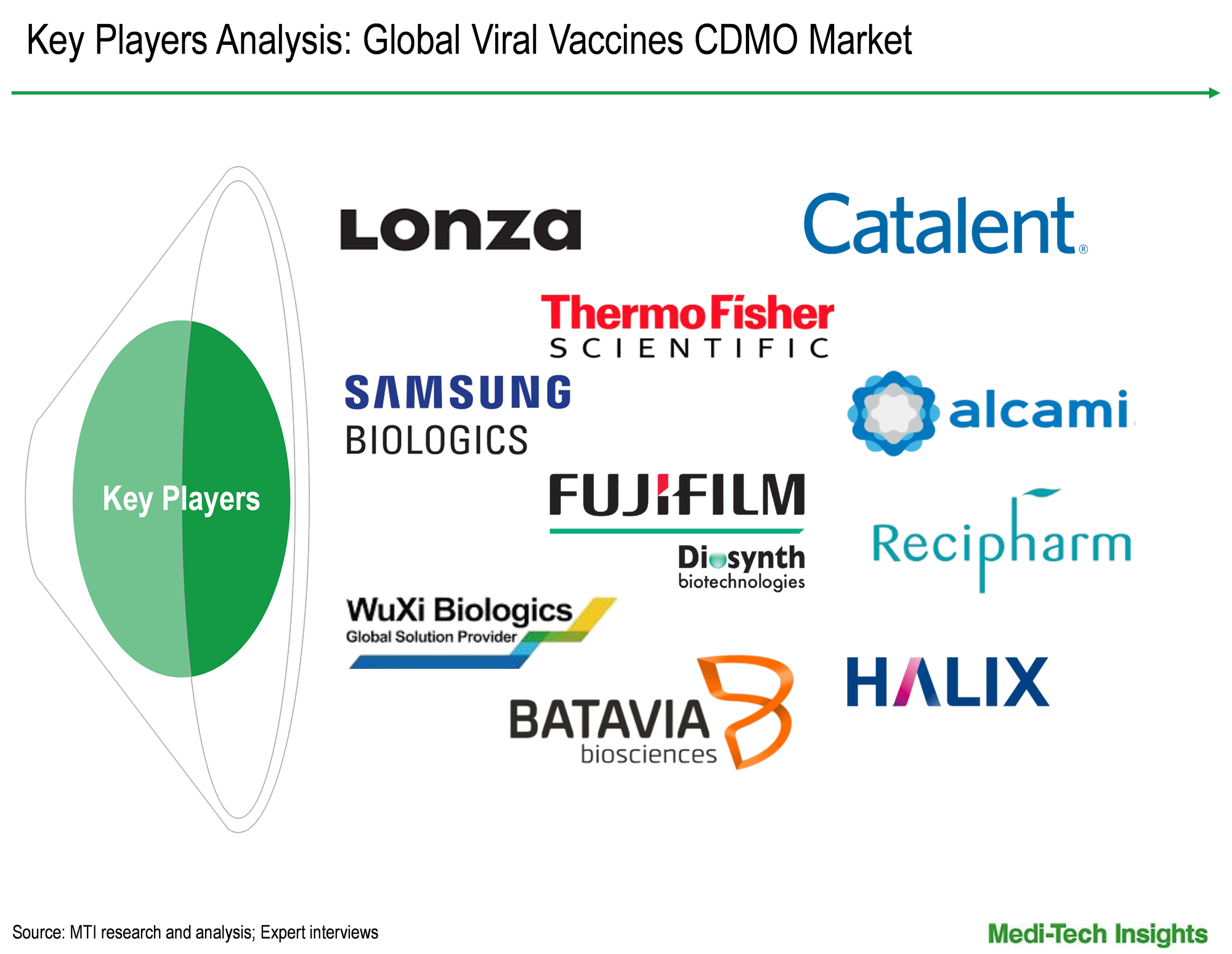
The global viral vaccines CDMO market is marked by the presence of established and emerging market players such as-
- Lonza Group (Switzerland)
- Catalent Pharma (US)
- Thermo Fisher Scientific, Inc. (US)
- Alcami Corporation (US)
- Samsung Biologics (South Korea)
- Fujifilm Diosynth Biotechnologies (UK)
- WuXi Biologics (China)
- Recipharm AB (Sweden)
- HALIX B.V. (Netherlands)
- Batavia Biosciences B.V. (Netherlands)
Get a sample report for competitive landscape analysis
Growth strategies adopted by players to establish their foothold in the viral vaccines CDMO market
Players operating in this market are adopting various growth strategies such as acquisitions, expansions, and strategic partnerships, agreements, and collaborations, to garner market share. For instance,
- In March 2025, Batavia Biosciences announced a strategic collaboration with Egypt's Vaccine Biotechnology City (VBC) and MEVAC, focusing on local manufacturing of Measles, Rubella, and Rotavirus vaccines through technology and process transfer
- In December 2024, Bavarian Nordic partnered with the Serum Institute of India to produce Mpox vaccine for the Indian market while also enabling contract manufacturing services to expand Bavarian Nordic's global production capacity.
- In October 2024, SK bioscience acquired IDT Biologika, a leading vaccine CDMO, to expand its global viral vaccine manufacturing capabilities, increase production capacity, strengthen recombinant vaccine expertise, and pursue new vaccine CDMO contracts worldwide
- In October 2023, Vaxcyte and Lonza expanded their collaboration with a new commercial manufacturing agreement supporting global production of pneumococcal vaccine candidates VAX-24 and VAX-31, with a dedicated suite at Lonza's Visp, Switzerland biopark.
Report Scope
Report Metric | Details |
Base Year Considered | 2025 |
Historical Data | 2024 – 2025 |
Forecast Period | 2026 – 2031 |
Growth Rate | 15% |
Segment Scope | Vaccine Type, Service Type, Workflow, and End User |
Regional Scope |
|
Market Drivers |
|
Attractive Opportunities |
|
Key Companies Mapped | Lonza Group (Switzerland); Catalent Pharma (US); Thermo Fisher Scientific, Inc. (US); Alcami Corporation (US); Samsung Biologics (South Korea); Fujifilm Diosynth Biotechnologies (UK); WuXi Biologics (China).; Recipharm AB (Sweden); HALIX B.V (Netherlands); Batavia Biosciences B.V (Netherlands), and others |
Report Highlights | Market Size & Forecast, Growth Drivers & Restraints, Trends, Competitive Analysis |
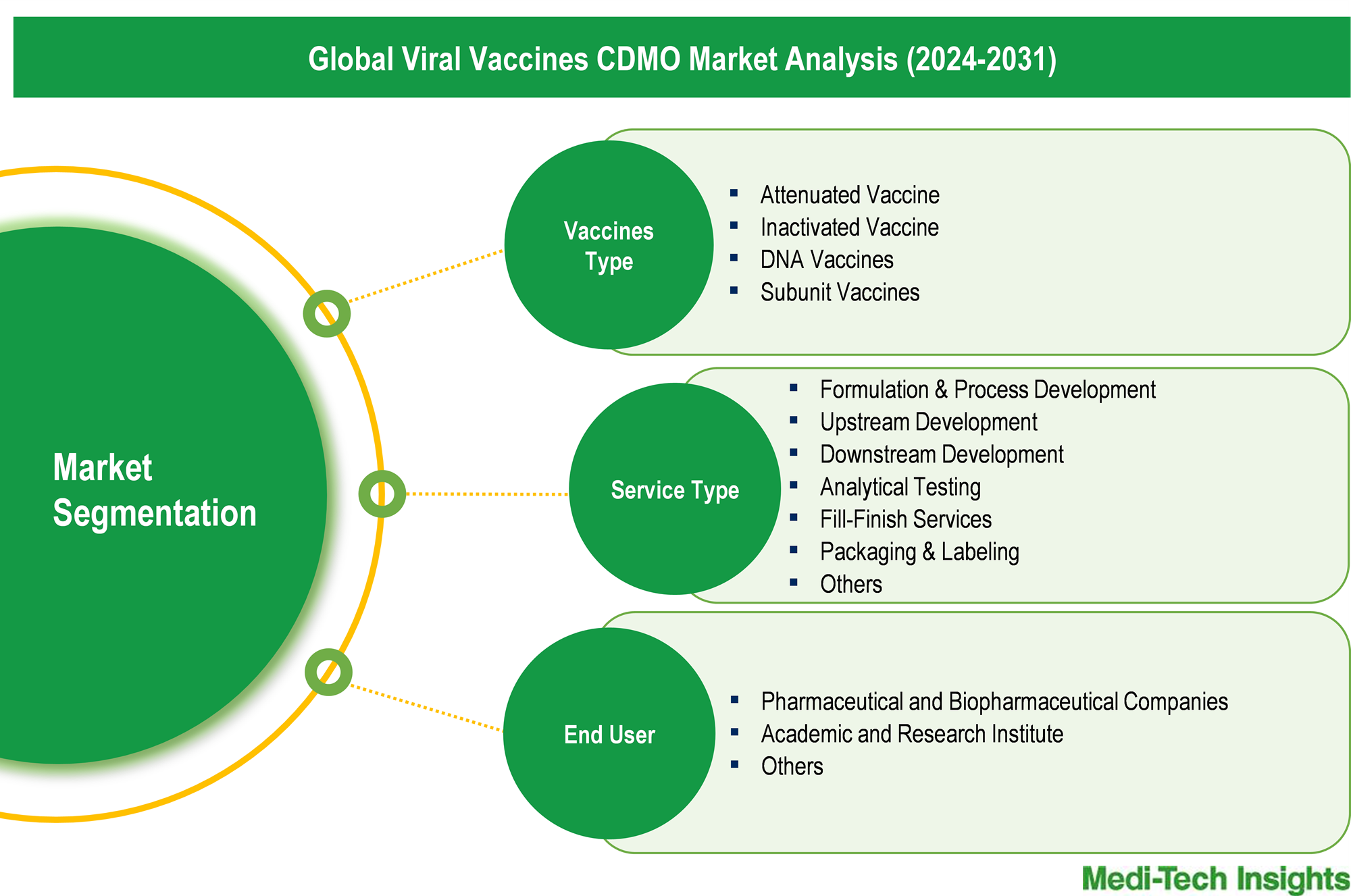
Global Viral Vaccine CDMO Market Segmentation
This report by Medi-Tech Insights provides the size of the global viral vaccines CDMO market at the regional and country-level from 2024 to 2031. The report further segments the market by vaccine type, service type, workflow, and end user.
Viral Vaccine CDMO Market Size & Forecast (2024-2031), By Vaccine Type, USD Billion
- Attenuated Vaccine
- Inactivated Vaccine
- DNA Vaccines
- Subunit Vaccines
Viral Vaccine CDMO Market Size & Forecast (2024-2031), By Service Type, USD Billion
- Formulation & Process Development
- Upstream Development
- Downstream Development
- Analytical Testing
- Fill-Finish Services
- Packaging & Labeling
- Others
Viral Vaccine CDMO Market Size & Forecast (2024-2031), By Workflow, USD Billion
- Clinical
- Commercial
Viral Vaccine CDMO Market Size & Forecast (2024-2031), By End User, USD Billion
- Pharmaceutical and Biopharmaceutical Companies
- Academic and Research Institute
- Other End Users
Viral Vaccine CDMO Market Size & Forecast (2024-2031), By Region, USD Billion
- North America
- US
- Canada
- Europe
- UK
- Germany
- France
- Italy
- Spain
- Rest of Europe
- Asia Pacific
- China
- India
- Japan
- Rest of Asia Pacific
- Latin America
- Middle East & Africa
Frequently Asked Questions About This Report
What is the growth rate of the viral vaccines CDMO market?
The viral vaccines CDMO market is set to witness a growth rate of 15% during the forecast period from 2026 to 2031
What are the key trends defining the market?
Increased focus on cold chain and lyophilization capabilities and shift towards risk sharing and outcome-based CDMO contract structures are major trends in the viral vaccines CDMO market
What are the major factors impacting the market growth?
Escalating global burden of infectious diseases, surge in outsourcing by innovator biopharmaceutical companies, accelerated adoption of the mRNA and viral vector platforms, rising adoption of telehealth services, expanding government-funded vaccine manufacturing initiatives, and growing need for specialized CDMO service for new viral vaccine technologies are some of the key factors driving the viral vaccines CDMO market
What are the opportunities prevailing in the market?
Untapped potential in the emerging market, integration of continuous bioprocessing technologies, rising viral vector manufacturing, and growing adoption of single-use bioreactor systems offer numerous growth opportunities for companies operating in the viral vaccines CDMO market
Who are the major players operating in the market?
Some of the major players operating in the viral vaccines CDMO market include Lonza Group (Switzerland); Catalent Pharma (US); Thermo Fisher Scientific, Inc. (US); Alcami Corporation (US); Samsung Biologics (South Korea); Fujifilm Diosynth Biotechnologies (UK); WuXi Biologics (China); Recipharm AB (Sweden); HALIX B.V (Netherlands); Batavia Biosciences B.V (Netherlands); and others
What are the key strategies adopted by players?
Key players in the viral vaccines CDMO market are adopting strategies such as acquisitions, partnerships, collaborations, agreements, expansions to expand their market presence
Need a More Tailored Analysis?
- Discuss the market sizing methodology and forecast assumptions with our healthcare analysts.
- Expand the scope with additional countries, market segments, technologies, or competitor profiling.
- Use the insights to support strategic planning, market entry, commercial due diligence, and long-term revenue growth initiatives.