Download FREE Sample


Artificial Intelligence (AI) in ophthalmology refers to the use of advanced technologies such as machine learning, deep learning, and computer vision to assist in the detection, diagnosis, monitoring, and management of various eye conditions and vision impairments. These AI-powered tools analyze diagnostic imaging, including retinal scans, optical coherence tomography (OCT), and fundus photographs, to identify abnormalities such as diabetic retinopathy, glaucoma, macular degeneration, and cataracts with enhanced precision and speed. Such solutions are increasingly integrated into diagnostic devices, screening platforms, and clinical workflows, enabling ophthalmologists to make faster, more accurate, and data-driven decisions. By automating image interpretation and risk assessment, AI in ophthalmology supports early disease detection, personalized treatment planning, and improved patient outcomes across hospitals, eye clinics, and diagnostic centers.
Expanding use
of optical coherence tomography with AI analytics to
drive market growth
The
growing integration of AI with optical coherence tomography (OCT) is
significantly accelerating adoption of AI-enabled
diagnostic tools in ophthalmology.
OCT has become a cornerstone imaging modality for visualizing retinal layers
with micron-level resolution and pairing it with AI algorithms allows for
automated segmentation, anomaly detection, and quantitative analysis that were
previously time-intensive and dependent on specialist expertise. According to
the World Health Organization (WHO), uncorrected vision
impairment and preventable blindness
continue to affect hundreds of millions of people globally, underscoring the
urgent need for scalable, accurate diagnostic tools, particularly in regions
with limited access to trained ophthalmologists.
AI-powered
OCT analytics enable early identification of conditions such as diabetic
macular edema, glaucoma, and age-related macular degeneration by detecting subtle
structural changes often missed during manual review. Leading device
manufacturers and research institutions are increasingly embedding deep
learning models directly into OCT systems, allowing real-time image
interpretation and automated report generation during routine eye examinations.
Furthermore, the incorporation of AI into OCT workflows supports large-scale screening programs, reducing diagnostic turnaround time and clinician workload while improving consistency across readings. This is especially valuable in tele-ophthalmology settings, where AI-assisted OCT interpretation allows remote specialists to review scans without requiring an in-person visit. As healthcare systems worldwide continue prioritizing early detection and preventive eye care, the convergence of OCT imaging with advanced AI analytics is expected to remain a key growth driver for the AI in the ophthalmology market.
Expansion into rare and underdiagnosed eye disorder detection to create growth opportunities
According
to the WHO, over 2.2 billion people globally live with some form of vision
impairment, a substantial share of which remains undiagnosed due to limited
access to specialized ophthalmic expertise, particularly for rare and complex
retinal and optic nerve disorders. AI-driven diagnostic platforms present a
significant opportunity to bridge this gap by enabling automated detection of
conditions such as retinitis pigmentosa, inherited retinal dystrophies, and
other low-prevalence disorders that are often missed during routine screenings.
By training deep learning models on diverse, high-resolution imaging datasets,
these systems can recognize subtle disease patterns that may otherwise require
years of clinical experience to identify.
Additionally, research institutes and academic medical centers are increasingly collaborating with technology developers to build specialized AI datasets for uncommon ocular conditions, improving diagnostic sensitivity in underserved and remote populations. This expansion supports earlier intervention, reduces preventable vision loss, and strengthens the case for AI adoption beyond common disease screening, positioning it as a critical tool for comprehensive, equitable eye-care delivery worldwide.
Application Segment Outlook
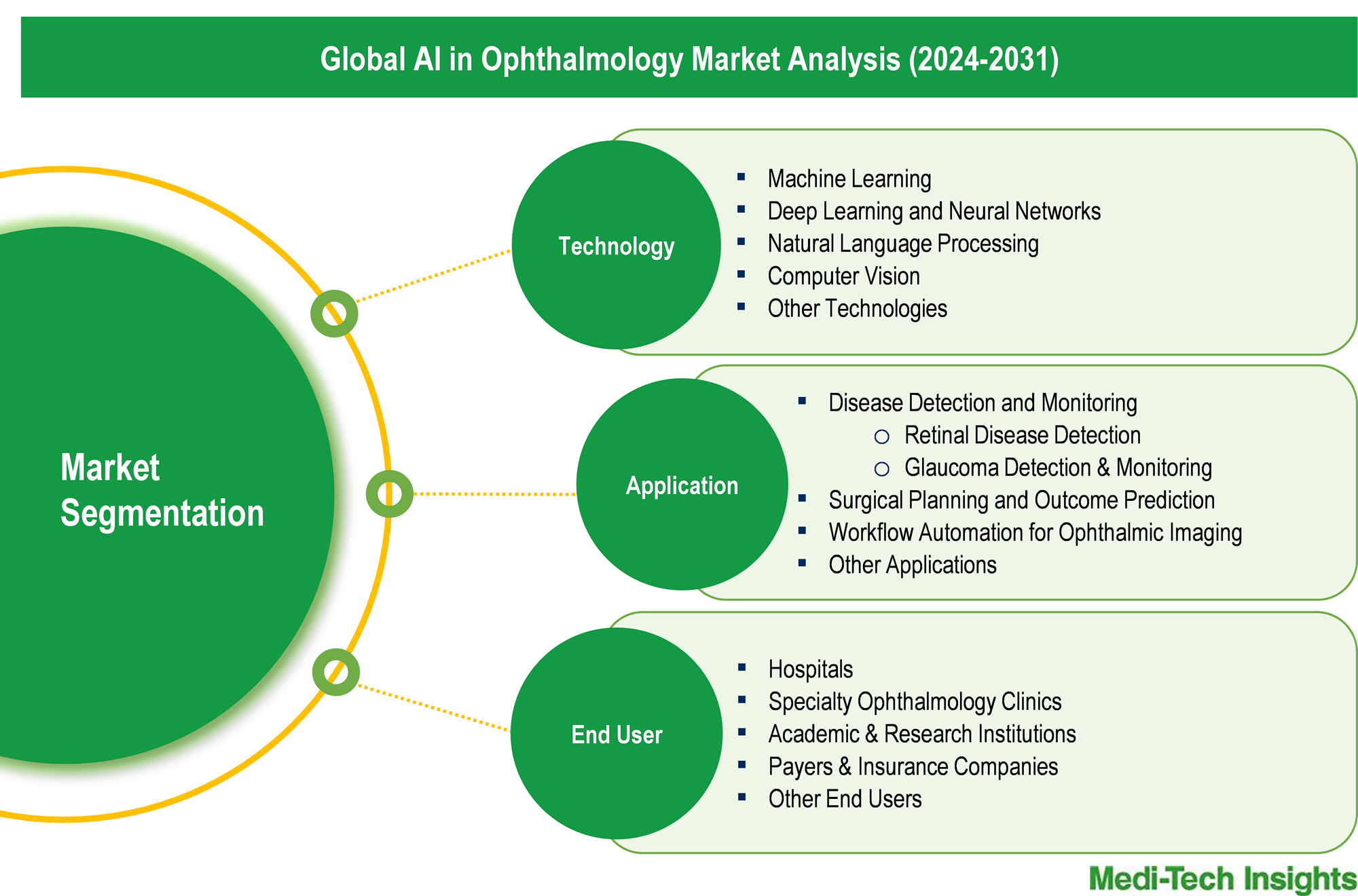
By application, the AI in the ophthalmology
market is segmented into disease detection and monitoring, surgical planning
and outcome prediction, and workflow automation for ophthalmic imaging, among
others. The disease detection and monitoring segment holds the largest market
share, driven by widespread adoption of AI-enabled screening tools for
conditions such as diabetic retinopathy, glaucoma, and age-related macular
degeneration. Growth in this segment is further supported by rising chronic
disease burden and increasing emphasis on early, automated diagnosis.
Surgical planning and outcome prediction is emerging as a rapidly growing segment, as AI algorithms assist surgeons in pre-operative assessment, lens power calculation, and predicting post-surgical outcomes for procedures like cataract and refractive surgeries, thereby improving precision and reducing complications. Workflow automation for ophthalmic imaging is also gaining momentum, as AI streamlines image acquisition, quality control, and reporting processes. This reduces clinician workload, enhances diagnostic turnaround time, and supports scalable screening programs across high-volume eye-care settings.
Regional Outlook: North America maintains its leading position due to the adoption of deep learning for retinal image analysis and growing integration of AI with OCT scans
North America maintains its leading
position in the AI in ophthalmology market, driven
by early adoption of deep learning algorithms for retinal image analysis and
growing integration of AI with OCT scans. The region benefits from strong
healthcare infrastructure, presence of key
technology developers, and supportive regulatory pathways for AI-based
diagnostic devices. Europe holds a significant share, supported by increasing
government initiatives for AI-driven healthcare, rising prevalence of diabetic
retinopathy and glaucoma, and growing collaboration between research
institutions and medtech companies for clinical validation of AI tools.
Asia-Pacific is projected to witness the fastest growth, fueled by a large patient population, rising burden of vision impairment, expanding ophthalmic care infrastructure, and increasing government-backed screening programs, particularly across countries such as China, India, and Japan, driving broader adoption of AI-based diagnostics.
Competitive Landscape Analysis
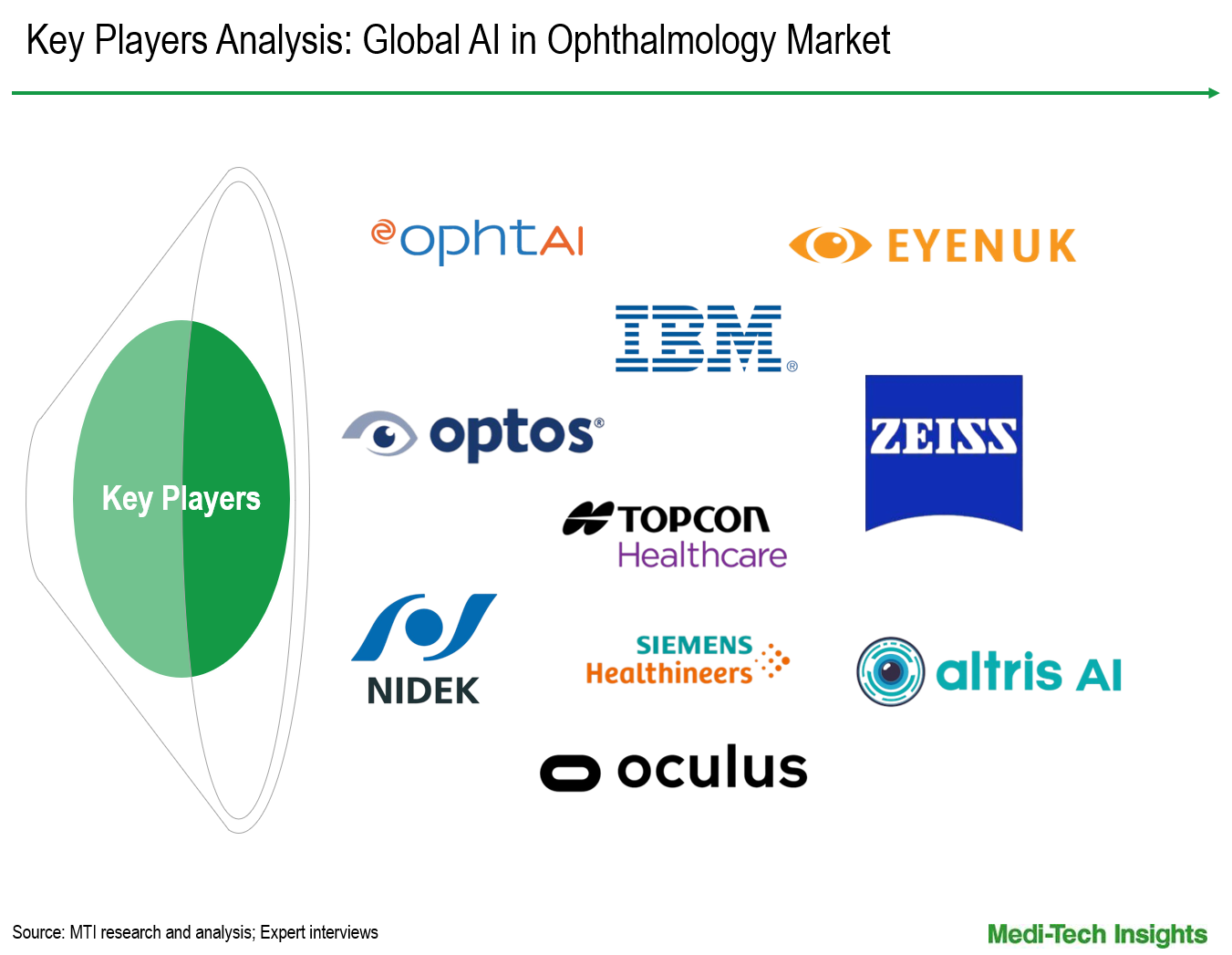
The global AI in
ophthalmology market is marked by the presence of established and
emerging market players such as-
- OphtAI (France)
- Eyenuk, Inc. (US)
- IBM Corporation (US)
- Optos plc (UK)
- Zeiss (Germany)
- Topcon Healthcare (US)
- Nidek Co., Ltd. (Japan)
- Altris AI (US)
- Oculus Maxima Limited (UK)
- Siemens Healthineers (Germany)
Growth strategies adopted by players to establish their foothold in the AI in ophthalmology market
Players operating in this market are adopting various
growth strategies such as new product launches and approvals, acquisitions,
expansions, and strategic
partnerships, agreements, and collaborations, to garner market share. For instance,
In October 2026, Verana Health introduced Agent Claire for
conversational real-world data queries alongside new Qdata datasets for retinal
vein occlusion and Stargardt disease. Partnering with Bitfount, it also
integrated AI-analyzed OCT and fundus scans with EHR records to streamline
ophthalmic clinical trial prescreening
In July 2026, Bausch + Lomb introduced Orphia, an AI-powered digital
health platform under its Digital Health Services division. Developed alongside
Hippocratic AI, Orphia is brand-agnostic and features conversational patient
engagement; launching initially with pre-surgery cataract education and
workflow support
In April 2025, ZEISS unveiled its cloud-based, AI-driven Research Data
Platform (RDP) at ARVO 2025 to unify clinical and imaging data, automate
biomarker discovery, and streamline workflows. ZEISS also highlighted its
ongoing AI collaboration with Boehringer Ingelheim to advance early detection
and personalized chronic retinal care
In February 2024, RetinAI (Ikerian AG) launched RetinAI Discovery for
Clinics, a cloud-based AI platform tailored for ophthalmologists and
optometrists. It analyzes OCT and fundus scans for biomarkers, tracks disease
progression, streamlines referrals, enables clinical trial participation, and
shares insights with patients via Discovery Passport
In June 2023, Eyenuk, Inc. received FDA clearance expanding its EyeArt
AI system for use with the Topcon NW400 retinal camera, in addition to
previously cleared Canon camera models, making it the first AI system approved
for autonomous diabetic retinopathy detection across multiple retinal camera
manufacturers
Report Scope
|
Report
Metric |
Details |
|
Base
Year Considered |
2025 |
|
Historical Data |
2024 – 2025 |
|
Forecast Period |
2026 – 2031 |
|
Growth Rate |
36% |
|
Segment Scope |
Technology,
Application, Deployment Mode, and End User |
|
Regional Scope |
|
|
Market Drivers |
|
|
Attractive Opportunities |
|
|
Key Companies Mapped |
OphtAI (France); Eyenuk, Inc. (US); IBM
Corporation (US); Optos plc (UK); Zeiss (Germany); Topcon Healthcare (US);
Nidek Co., Ltd. (Japan); Altris AI (US); Oculus Maxima Limited (UK); Siemens
Healthineers (Germany); and among others |
|
Report Highlights |
Market Size &
Forecast, Growth Drivers & Restraints, Trends, Competitive Analysis |
Global AI in Ophthalmology Market Segmentation
This report by Medi-Tech Insights provides the size of the global AI in ophthalmology market at the regional and country-level from 2024 to 2031. The report further segments the market by technology, application, deployment mode, and end user.
Market Size & Forecast (2024-2031), By Technology, USD Billion
- Machine Learning
- Deep Learning and Neural Networks
- Natural Language Processing
- Computer Vision
- Other Technologies
Market Size & Forecast (2024-2031), By Application, USD Billion
- Disease Detection and Monitoring
- Retinal Disease Detection
- Glaucoma Detection & Monitoring
- Surgical Planning and Outcome Prediction
- Workflow Automation for Ophthalmic Imaging
- Other Applications
Market Size & Forecast (2024-2031), By Deployment Mode, USD Billion
- On Premise
- Cloud-based
Market Size & Forecast (2024-2031), By End User, USD Billion
- Hospitals
- Specialty Ophthalmology Clinics
- Academic & Research Institutions
- Payers & Insurance Companies
- Other End Users
Market Size & Forecast (2024-2031), By Region, USD Billion
- North America
- US
- Canada
- Europe
- UK
- Germany
- France
- Italy
- Spain
- Rest of Europe
- Asia Pacific
- China
- India
- Japan
- Rest of Asia Pacific
- Latin America
- Middle East & Africa
Frequently Asked Questions About This Report
What is the growth rate of the AI in ophthalmology market?
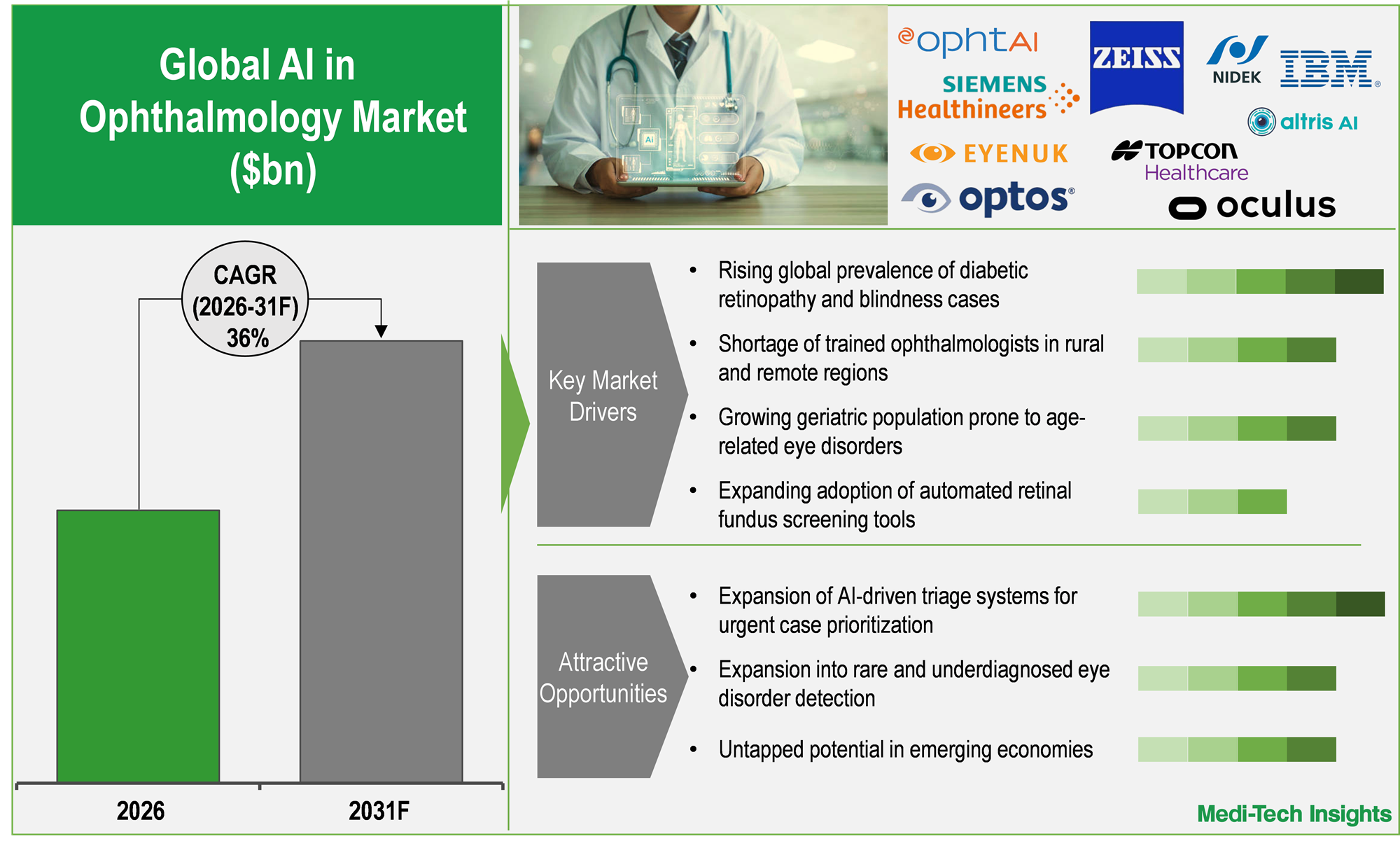
The AI in ophthalmology market is set to witness a growth rate of 36% during the forecast period from 2026 to 2031
What are the key trends defining the market?
Increasing adoption of deep learning for retinal image analysis and growing integration of AI with optical coherence tomography scans are major trends in the AI in ophthalmology market
What are the major factors impacting market growth?
Rising global prevalence of diabetic retinopathy and blindness cases, shortage of trained ophthalmologists in rural and remote regions, growing geriatric population prone to age-related eye disorders, expanding adoption of automated retinal fundus screening tools, and expanding use of optical coherence tomography with AI analytics are some of the key factors driving the AI in ophthalmology market
What are the opportunities prevailing in the market?
Expansion of AI-driven triage systems for urgent case prioritization; expansion into rare and underdiagnosed eye disorder detection; untapped potential in emerging economies; and increasing scope for multilingual, region-specific diagnostic applications offer numerous growth opportunities for companies operating in the AI in ophthalmology market
Which region has the highest share in the global market? Which region is expected to witness the highest growth rate in the next 5 years?
North America held the largest share of the global AI in ophthalmology market in 2025, while Asia-Pacific is projected to grow at the highest CAGR during the forecast period
Who are the major players operating in the market?
Some of the major players operating in the AI in ophthalmology market include OphtAI (France); Eyenuk, Inc. (US); IBM Corporation (US); Optos plc (UK); Zeiss (Germany); Topcon Healthcare (US); Nidek Co., Ltd. (Japan); Altris AI (US); Oculus Maxima Limited (UK); Siemens Healthineers (Germany); and among others
Need a More Tailored Analysis?
- Discuss the market sizing methodology and forecast assumptions with our healthcare analysts.
- Expand the scope with additional countries, market segments, technologies, or competitor profiling.
- Use the insights to support strategic planning, market entry, commercial due diligence, and long-term revenue growth initiatives.