Download FREE Sample


The eye care products include both clinical and non-clinical products aimed at diagnosing, treating, and managing vision-related conditions ranging from common refractive errors to complex eye diseases. The eye care products include corrective ophthalmic lenses (spectacles/contact lenses), advanced intraocular lenses (IOLs), and prescription pharmaceuticals, among others. Further, eye care services have now extended beyond corrective vision and also include disease monitoring, preventive screening, and long-term management of chronic ocular conditions, with a focus on comprehensive eye care. These services encompass routine eye tests, cataract and glaucoma management, retinal care, pediatric ophthalmology, and surgical interventions such as laser vision correction and intraocular procedures. The market spans a wide range of collaborative networks of providers tailored to different patient needs and geographical locations, including hospitals, specialty ophthalmology clinics, ambulatory surgical centers, and optical retail chains offering integrated diagnostic and corrective solutions. Further, the increasing integration of diagnostic imaging, teleconsultation, and minimally invasive surgical techniques has broadened the scope of services offered within this market.
Rising prevalence of vision disorders and aging population
The increasing prevalence of eye disorders is a central factor driving the demand for ophthalmic products and services. Moreover, age-related conditions such as cataracts, glaucoma, and macular degeneration are becoming more common in aging populations. According to an article published by the World Health Organization, it reports that 2.2 billion people suffer from vision impairment, with cataracts being the primary cause of blindness among older adults. These conditions require long-term monitoring and periodic interventions, resulting in sustained service demand over time.
Furthermore, the increased digital screen time has intensified the rise of refractive errors and dry eye syndrome, especially across younger demographics. This has resulted in a strong focus on eye health, which is further driven by public health initiatives and digital campaigns highlighting the importance of regular eye check-ups and preventive care. With this rising awareness, people are seeking solutions for common conditions like myopia, dry eye, and early-stage cataract. Additionally, technological innovations, including minimally invasive glaucoma surgery (MIGS), advanced IOLs (intraocular lenses), and AI-driven imaging technologies (like OCT), have now enabled earlier and more precise diagnoses. These tools have become essential for improving patient outcomes and reducing recovery times. Overall, the cumulative effect of aging demographics, higher disease prevalence, and increased public awareness and screenings creates a constant and sustained demand for both primary and specialized eye care providers.
To learn more about this report, download the PDF brochure
Expansion of digital lifestyles and associated eye strain
The rapid normalization of screen-intensive routines, specifically post-pandemic, has led to a distinct category of vision-related concerns commonly referred to as digital eye strain. Prolonged use of digital devices for work, education, and leisure is increasingly associated with symptoms such as visual fatigue, blurred vision, and tear film instability. Studies indicate that digital eye strain is primarily linked to factors such as reduced blink rates and prolonged near-focus, which has necessitated a more targeted clinical approach that not only focuses on symptom relief but also on habit correction, rather than solely refractive correction.
The shift toward a hybrid work culture and blended digital learning has resulted in a significant rise in daily screen exposure across all demographics, with alarming increases particularly among children and young adults. Further, reduced outdoor activity combined with continuous near work has emerged as a key contributing factor, increasing the prevalence of early-onset myopia and shifting eye care demand toward younger populations.
To address this evolving demand, service delivery models are adapting, with eye care providers increasingly incorporating guidance on screen ergonomics, like the 20-20-20 rule education in routine examinations. Further, there is also a growing focus on managing evaporative dry eye associated with digital use, using tailored treatments, including preservative-free lubricants and specialized anti-reflective lenses. This reflects a broader move toward addressing lifestyle-induced triggers alongside physiological symptoms, thereby shifting toward a more comprehensive -eye wellness- approach.
To learn more about this report, download the PDF brochure
Application Segment Outlook
The eye care product market is segmented by application into cataract, glaucoma, refractive errors, retinal disorders, and others. Among the application segments, cataract treatment accounts for a substantial share of the market due to its high prevalence and the availability of effective surgical solutions. Cataract procedures, including intraocular lens (IOL) implants, are widely performed in aging populations and are one of the vital components of eye care services.
Refractive error or vision correction, including myopia and hyperopia, also represents a significant portion of the global market, driven by increasing awareness, improved accessibility of diagnostic services, and growing demand for products including eyeglasses, contact lenses, and refractive surgeries (LASIK/SMILE). This segment is also expanding due to the increasing and often excessive daily digital screen time among children, adolescents, and young adults. Retinal disorders and glaucoma management are specialized and high-growth segments, requiring advanced diagnostic tools and long-term monitoring. Growth in these areas is supported by improved diagnostic capabilities and increasing incidence linked to aging and conditions such as diabetes.
Regional Outlook: North America leads the global Eye Care Products market with adoption of advanced diagnostic and surgical technologies
North America holds a major share of the global eye care products market, supported by advanced healthcare systems, rising awareness and rapid adoption of advanced diagnostic and surgical technologies, including robotic-assisted surgeries. The region also benefits from a strong presence of specialized clinics, favourable reimbursement policies for eye care services, and a high prevalence of vision-related disorders. Europe follows closely, primarily driven by aging populations and the rising prevalence of chronic eye diseases. Further, the region's growth is supported by structured public healthcare systems, stringent product quality standards, and rising demand for preventive care.
Asia-Pacific is expected to grow at a faster rate during the forecast period. The region's growth is primarily driven by large populations, improving healthcare access, rising disposable income, increasing awareness of vision care and a high prevalence of myopia. Furthermore, increasing screen time and a growing elderly population are boosting demand for both contact lenses and surgical services.
Competitive Landscape Analysis
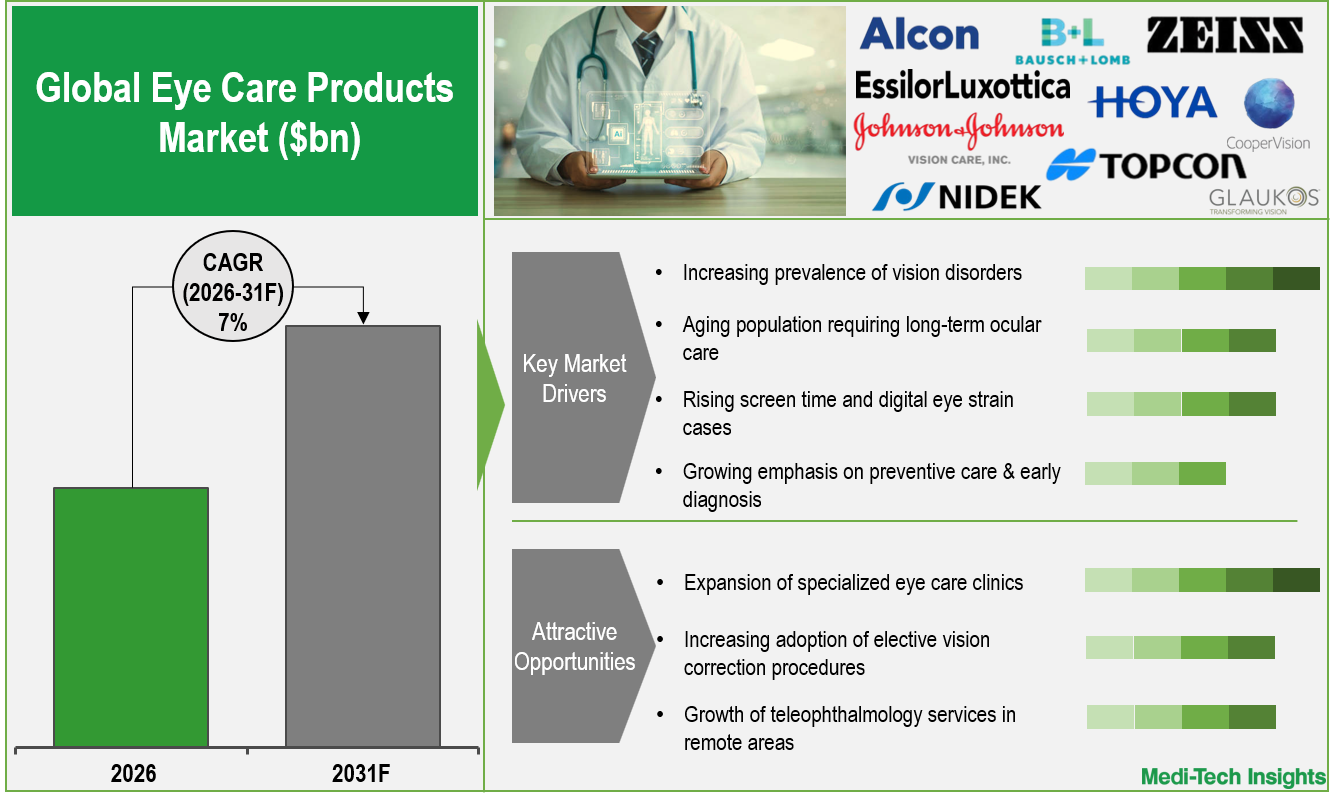
The global eye care products market is marked by the presence of established and emerging market players such as Alcon Inc. (Switzerland), Bausch + Lomb Corporation (Canada), Johnson & Johnson Vision Care Inc. (US), EssilorLuxottica SA (France), Hoya Corporation (Japan), CooperVision (US), Carl Zeiss Meditec AG (Germany), Topcon Corporation (Japan), Nidek Co., Ltd (Japan), and Glaukos Corporation (US) among others.

Get a sample report for competitive landscape analysis
Growth strategies adopted by players to establish their foothold in the market
Players operating in this market are adopting various growth strategies such as new product launches and approvals; acquisitions; expansions; and strategic partnerships, agreements, and collaborations, to garner market share. For instance,
- In July 2025, Alcon announced the US launch of TRYPTYR (acoltremon ophthalmic solution) 0.003%, a first-in-class treatment for dry eye disease designed to rapidly stimulate natural tear production
- In January 2025, ZEISS Vision Care launched four new prescription sun lens tints paired with DuraVision Gold UV coatings, blending style with strong UV and glare protection
- In May 2023, Bausch + Lomb and Novaliq GmbH announced that the US Food and Drug Administration (FDA) approved MIEBO (perfluorohexyloctane ophthalmic solution; formerly NOV03) for the treatment of dry eye disease
Report Scope
Report Metric | Details |
Base Year Considered | 2025 |
Historical Data | 2024 - 2025 |
Forecast Year | 2026 - 2031 |
Growth Rate | 7% |
Segment Scope | Product, Application, and End User |
Regional Scope |
|
Market Drivers |
|
Attractive Opportunities |
|
Key Companies Mapped | Alcon Inc. (Switzerland), Bausch + Lomb Corporation (Canada), Johnson & Johnson Vision Care Inc. (US), EssilorLuxottica SA (France), Hoya Corporation (Japan), CooperVision (US), Carl Zeiss Meditec AG (Germany), Topcon Corporation (Japan), Nidek Co., Ltd (Japan), and Glaukos Corporation (US) among others |
Report Highlights | Market Size & Forecast, Growth Drivers & Restraints, Trends, Competitive Analysis |
Global Eye Care Products Market Segmentation
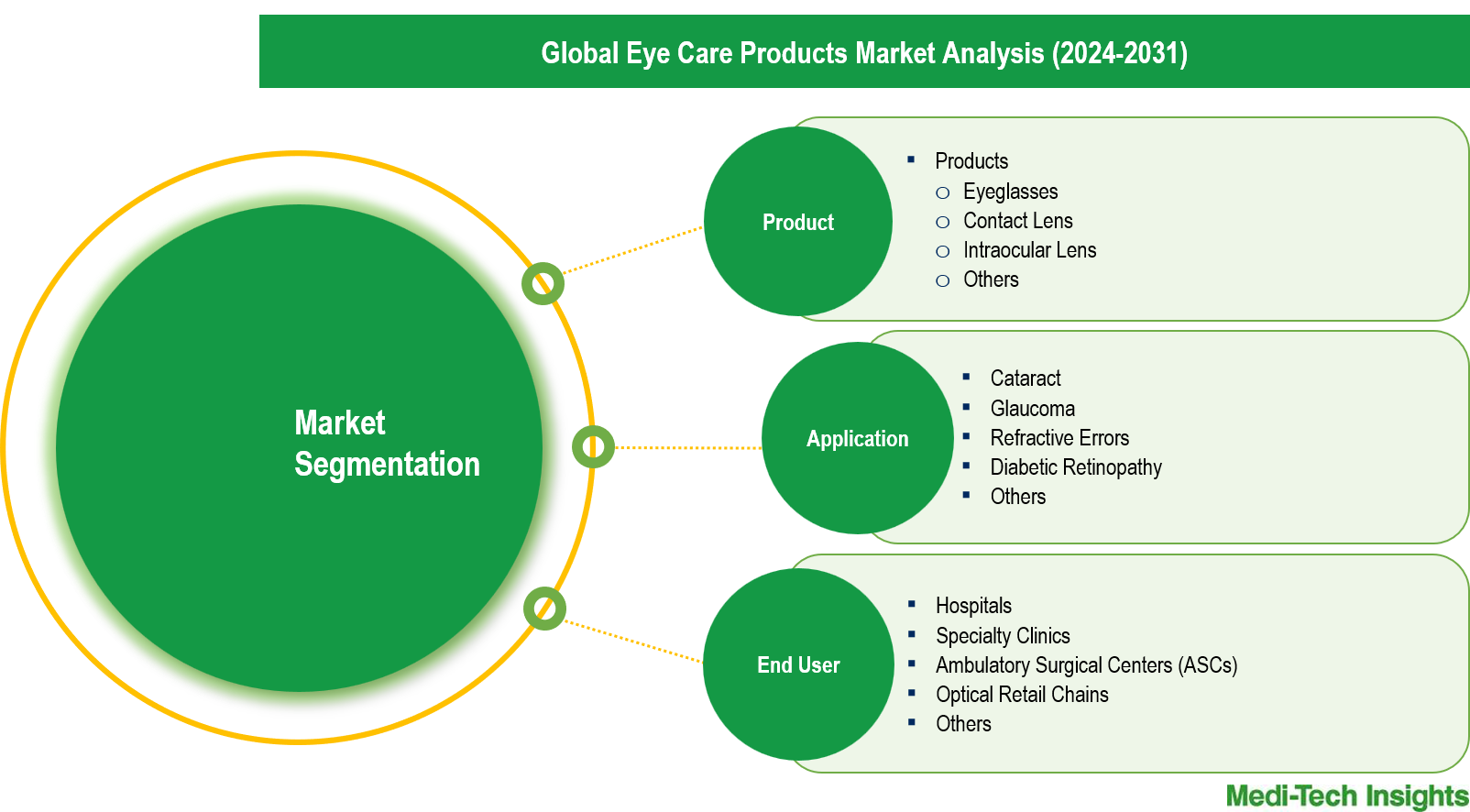
This report by Medi-Tech Insights provides thesize of the global eye care products market at theregional- and country-level from 2024 to 2031. The report further segments the market based on product, application, and end user.
Market Size & Forecast (2024-2031), By Product, USD Billion
- Eyeglasses
- Contact Lens
- Intraocular Lens
- Others
Market Size & Forecast (2024-2031), By Application, USD Billion
- Cataract
- Glaucoma
- Refractive Errors
- Diabetic Retinopathy
- Others
Market Size & Forecast (2024-2031), By End User, USD Billion
- Hospitals
- Specialty Clinics
- Ambulatory Surgical Centers (ASCs)
Market Size & Forecast (2024-2031), By Region, USD Billion
- North America
- US
- Canada
- Europe
- UK
- Germany
- France
- Italy
- Spain
- Rest of Europe
- Asia Pacific
- China
- India
- Japan
- Rest of Asia Pacific
- Latin America
- Middle East & Africa
Frequently Asked Questions About This Report
What is the growth rate of the eye care products market?
The global eye care products market is set to witness a growth rate of 7% during the forecast period from 2026 to 2031
What are the key trends defining the market?
Shift toward minimally invasive and day-care surgical procedures and development of integrated care models combining diagnostics, treatment, and optical retail are major trends in the Eye Care Products market
What are the major factors impacting the market growth?
Increasing prevalence of vision disorders, an aging population requiring long-term ocular care, rising screen time and digital eye strain, a growing emphasis on preventive eye screening and early diagnosis, and technological advancements in diagnostic tests & surgeries are key factors driving the Eye Care Products market
What are the opportunities prevailing in the market?
Expansion of specialized eye care clinics, increasing adoption of elective vision correction procedures, growth of teleophthalmology services in remote areas, and favourable reimbursement policies for ophthalmic procedures in developed markets offer numerous growth opportunities for companies operating in the Eye Care Products market
Who are the major players operating in the market?
Some of the major players operating in the Eye Care Products market include as Alcon Inc. (Switzerland), Bausch + Lomb Corporation (Canada), Johnson & Johnson Vision Care Inc. (US), EssilorLuxottica SA (France), Hoya Corporation (Japan), CooperVision (US), Carl Zeiss Meditec AG (Germany), Topcon Corporation (Japan), Nidek Co., Ltd (Japan), and Glaukos Corporation (US), among others
Need a More Tailored Analysis?
- Discuss the market sizing methodology and forecast assumptions with our healthcare analysts.
- Expand the scope with additional countries, market segments, technologies, or competitor profiling.
- Use the insights to support strategic planning, market entry, commercial due diligence, and long-term revenue growth initiatives.