Download FREE Sample


Report Overview
Clinical alarm management is a collection of technologies and strategies that are focused on monitoring, prioritizing, and filtering out excessive or non-actionable alarms from medical equipment in healthcare environments. These systems assist hospitals in filtering out clinically irrelevant alarms and background noise, reducing the level of distraction for health professionals. The process typically includes alarm standardization, threshold customization, training of staff, and continuous performance auditing. Its value is in enhancing patient safety, minimizing response time, and preventing staff desensitization to alarms-also referred to as alarm fatigue.
To learn more about this report, download the PDF brochure
Rising Alarm Fatigue Drives Hospitals Toward Smarter Alert Solutions
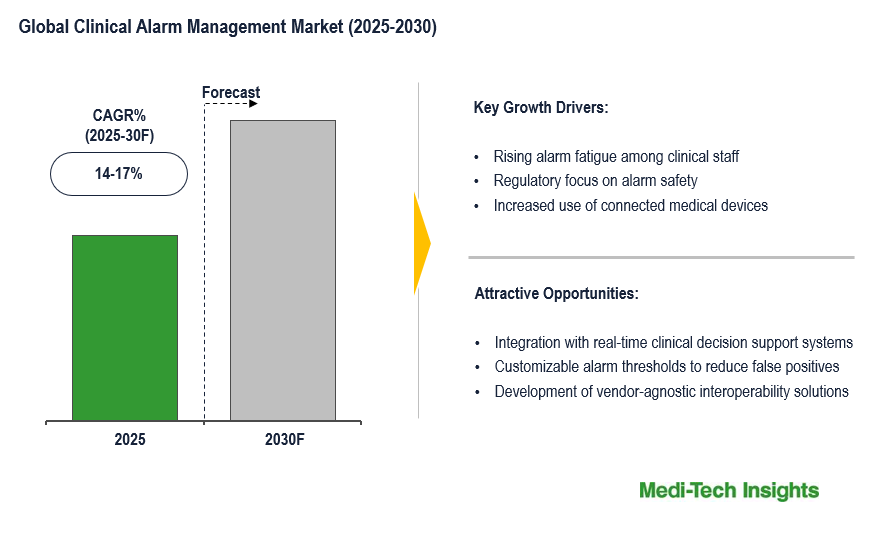
Alarm fatigue occurs when healthcare professionals/caregivers receive an inordinate number of alerts, which can be false or non-urgent, causing them to delay or miss critical alarms. This is the growing concern among clinicians, which is driving the adoption of clinical alarm management solutions. This not only poses a risk for patient safety but also increases workplace stress and contributes to burnout among clinicians. Hospitals are under regulatory pressure to meet patient safety regulations and accreditation standards that specifically target minimizing alarm-related risks. In turn, healthcare practitioners are investing in robust alarm management strategies with suitable alarm escalation channels, alarm analytics, and regular audits. By streamlining the way warnings are issued and directed, clinical staff can more effectively distinguish between emergent and mundane alerts. This change quite dramatically increases operational efficiency, enhances care coordination, and fortifies trust in clinical technologies, all of which further drive the market growth.
Middleware Integration Transforms Clinical Alarm Management Workflow
One of the key developments to improve the clinical alarm management environment is the creation of integrated middleware platforms. Middleware platforms serve as middlemen between bedside equipment and communication devices such as smartphones, pagers, and nurse call systems. Instead of transmitting each alert to each caregiver, middleware software will filter and prioritize alarms by severity, device type, and patient condition. This selective routing decreases the level of noise in clinical settings and ensures that the correct staff receive only the most important notifications. Furthermore, these platforms tend to provide audit trails, which allow administrators to monitor alarm response times and system performance. Middleware also enables remote access, which allows caregivers to evaluate patient status and acknowledge alerts without physically being present. The outcome is a more responsive and integrated care model, particularly valuable in high-acuity departments such as ICUs and emergency departments. This greatly accelerates the adoption of alarm management systems by providing hospitals with a scalable and flexible solution to alarm safety.
To learn more about this report, download the PDF brochure
Competitive Landscape Analysis
The global clinical alarm management market is marked by the presence of established and emerging market players such as Koninklijke Philips N.V.; GE Healthcare; Ascom; Spok, Inc.; Masimo; HILLROM & WELCH ALLYN (Baxter); Vocera Communications (Stryker); Medtronic plc; Dragerwerk AG & Co. KGaA; and West-Com Nurse Call Systems, Inc., among others. Some of the key strategies adopted by market players include new product development, strategic partnerships and collaborations, and geographic expansion.
Report Scope
| Report Metric | Details |
| Base Year Considered | 2024 |
| Historical Data | 2023 - 2024 |
| Forecast Period | 2025 - 2030 |
| Growth | 14-17% |
| Market Drivers |
|
| Attractive Opportunities |
|
| Segment Scope | Component Type, Product Type and End-user |
| Regional Scope |
|
| Key Companies Mapped | Koninklijke Philips N.V.; GE Healthcare; Ascom; Spok, Inc.; Masimo; HILLROM & WELCH ALLYN (Baxter); Vocera Communications (Stryker); Medtronic plc; Dragerwerk AG & Co. KGaA; and West-Com Nurse Call Systems, Inc., among others |
| Report Highlights | Market Size & Forecast, Growth Drivers & Restraints, Trends, Competitive Analysis |
Global Clinical Alarm Management Market Segmentation
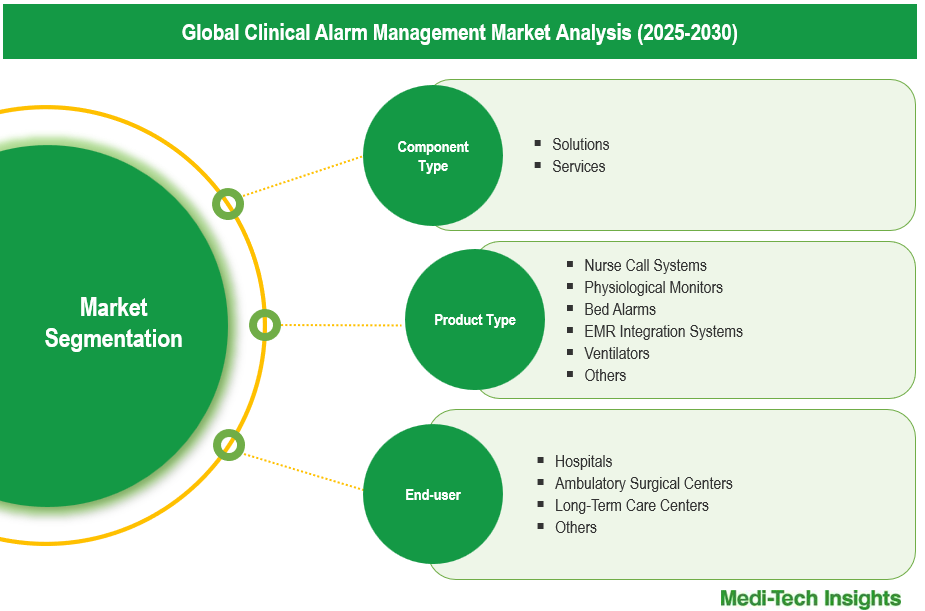
This report by Medi-Tech Insights provides thesize of the global clinical alarm management market at theregional- and country-level from 2023 to 2030. The report further segments the market based on component type, product type and end-user.
Market Size & Forecast (2023-2030), By Component Type, USD Million
- Solutions
- Services
Market Size & Forecast (2023-2030), By Product Type, USD Million
- Nurse Call Systems
- Physiological Monitors
- Bed Alarms
- EMR Integration Systems
- Ventilators
- Others
Market Size & Forecast (2023-2030), By End-user, USD Million
- Hospitals
- Ambulatory Surgical Centers
- Long-Term Care Centers
- Others t Size & Forecast (2023-2030), By Region, USD Million
- North America
- US
- Canada
- Europe
- UK
- Germany
- France
- Italy
- Spain
- Rest of Europe
- Asia Pacific
- China
- India
- Japan
- Rest of Asia Pacific
- Latin America
- Middle East & Africa
- What is the market size & forecast of the clinical alarm management market?
- What are historical, present, and forecasted market shares and growth rates of various segments and sub-segments of the clinical alarm management market?
- What are the key trends defining the market?
- What are the major factors impacting the market?
- What are the opportunities prevailing in the market?
- Which region has the highest share in the global market? Which region is expected to witness the highest growth rate in the next 5 years?
- Who are the major players operating in the market?
- What are the key strategies adopted by players?
Key Strategic Questions Addressed
Need a More Tailored Analysis?
- Discuss the market sizing methodology and forecast assumptions with our healthcare analysts.
- Expand the scope with additional countries, market segments, technologies, or competitor profiling.
- Use the insights to support strategic planning, market entry, commercial due diligence, and long-term revenue growth initiatives.