Download FREE Sample


Interventional oncology is a rapidly evolving subspecialty of interventional radiology that focuses on diagnosing and treating cancer using minimally invasive procedures. It employs advanced imaging techniques such as ultrasound, CT scans, and MRI to guide targeted therapies directly to tumors. Procedures include thermal ablation (radiofrequency and microwave ablation), transarterial chemoembolization (TACE), and selective internal radiation therapy (SIRT). These techniques provide precise treatment while minimizing damage to healthy tissues, resulting in reduced recovery time and fewer complications compared to traditional cancer treatments.
To learn more about this report, download the PDF brochure.
Rising Cancer Incidence and Shifting Focus Toward Patient-Centric Care
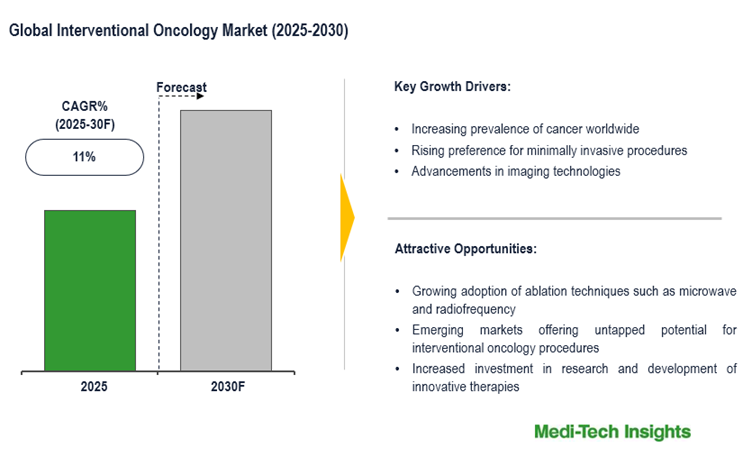
The growing incidence of cancer worldwide is a significant factor driving the interventional oncology market. According to the International Agency for Research on Cancer (IARC), there were close to 20 million new cases of cancer in 2022, alongside 9.7 million deaths from cancer. With millions of new cancer cases diagnosed annually, there is an urgent demand for advanced treatment options that provide effective outcomes while minimizing patient burden. Interventional oncology fulfils this need by offering image-guided, minimally invasive procedures such as thermal ablation and embolization therapies. These approaches reduce surgical trauma, shorten hospital stays, and improve post-treatment quality of life, especially for patients who are elderly or have underlying health conditions. Moreover, healthcare systems are increasingly prioritizing patient-centric care by adopting innovative methods that balance clinical efficacy with cost efficiency. As awareness of these benefits grows among oncologists and patients, the adoption of interventional oncology continues to expand globally.
To learn more about this report, download the PDF brochure.
AI-Driven Precision in Interventional Oncology
The integration of artificial intelligence (AI) into interventional oncology represents a transformative advancement in the field. AI enhances procedural accuracy by improving tumour visualization, segmentation, and monitoring in imaging modalities like CT, MRI, and ultrasound. This allows clinicians to precisely plan and execute minimally invasive treatments, optimizing outcomes for patients. AI-powered tools also assist in predicting treatment responses and customizing therapies based on patient-specific factors, enabling a personalized approach to cancer care. Additionally, automated analysis of imaging data reduces the time required for diagnosis and decision-making, streamlining workflows and improving efficiency for healthcare providers. As these AI applications become more sophisticated, they contribute to higher success rates, fewer complications, and greater accessibility to advanced interventional oncology techniques, positioning AI as a cornerstone of future innovation in cancer treatment.
Competitive Landscape Analysis
The global interventional oncology market is marked by the presence of established and emerging market players such as Medtronic plc; Boston Scientific Corporation; Johnson & Johnson; Cook Medical; Becton, Dickinson and Company; AngioDynamics Inc.; Stryker Corporation; B. Braun Melsungen AG; Terumo Corporation; Siemens Healthineers; and GE Healthcare among others. Some of the key strategies adopted by market players include new product development, strategic partnerships and collaborations, and geographic expansion.
Report Scope
| Report Scope | Details |
| Base Year Considered | 2024 |
| Historical Data | 2023 - 2024 |
| Forecast Period | 2025 - 2030 |
| Growth | 11% |
| Market Drivers |
|
| Attractive Opportunities |
|
| Segment Scope | Technique, Procedure, Application, and End-user |
| Regional Scope |
|
| Key Companies Mapped | Medtronic plc; Boston Scientific Corporation; Johnson & Johnson; Cook Medical; Becton, Dickinson and Company; AngioDynamics Inc.; Stryker Corporation; B. Braun Melsungen AG; Terumo Corporation; Siemens Healthineers; and GE Healthcare among others |
| Report Highlights | Market Size & Forecast, Growth Drivers & Restraints, Trends, Competitive Analysis |
Market Segmentation
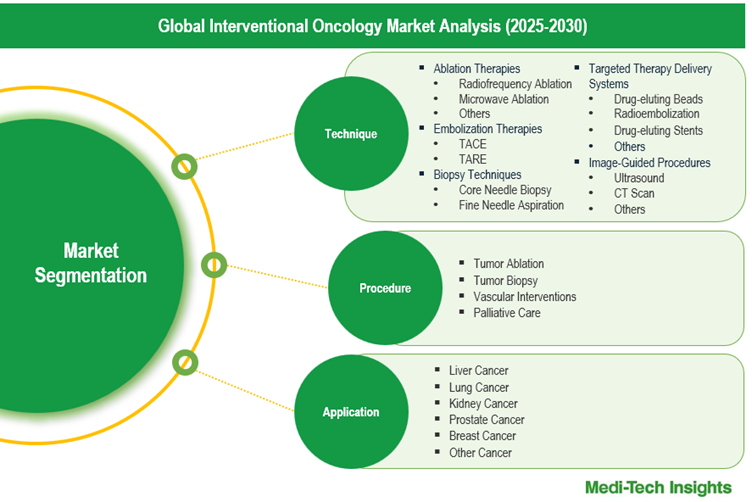
This report by Medi-Tech Insights provides thesize of the global interventional oncology market at theregional- and country-level from 2023 to 2030. The report further segments the market based on technique, procedure, application and end-user.
- Market Size & Forecast (2023-2030), By Technique, USD Million
- Ablation Therapies
- Radiofrequency Ablation (RFA)
- Microwave Ablation (MWA)
- Cryoablation
- Laser Ablation
- Irreversible Electroporation (IRE)
- Embolization Therapies
- Transarterial Chemoembolization (TACE)
- Transarterial Radioembolization (TARE)
- Biopsy Techniques
- Core Needle Biopsy
- Fine Needle Aspiration (FNA)
- Targeted Therapy Delivery Systems
- Drug-eluting Beads
- Radioembolization
- Drug-eluting Stents
- Injectable Hydrogels and Nanoparticles
- Othd Therapy Systems
- Image-Guided Procedures
- Ultrasound Guidance
- CT Scan Guidance
- MRI Guidance
- Fluoroscopy Guidance
- Ablation Therapies
- Market Size & Forecast (2023-2030), By Procedure, USD Million
- Tumor Ablation
- Tumor Biopsy
- Vascular Interventions
- Palliative Care
- Market Size & Forecast (2023-2030), By Application, USD Million
- Liver Cancer
- Lung Cancer
- Kidney Cancer
- Prostate Cancer
- Breast Cancer
- Other Cancer
- Market Size & Forecast (2023-2030), By End-user, USD Million
- Hospitals
- Specialty Centers
- Others
- Market Size & Forecast (2023-2030), By Region, USD Million
- North America
- US
- Canada
- Europe
- UK
- Germany
- Italy
- Spain
- Rest of Europe
- Asia Pacific
- China
- India
- Japan
- Rest of Asia Pacific
- Latin America
- Middle East & Africa
- North America
Frequently Asked Questions About This Report
What is the market size & forecast of the interventional oncology market?
What are historical, present, and forecasted market shares and growth rates of various segments and sub-segments of the interventional oncology market?
What are the key trends defining the market?
What are the major factors impacting the market?
What are the opportunities prevailing in the market?
Need a More Tailored Analysis?
- Discuss the market sizing methodology and forecast assumptions with our healthcare analysts.
- Expand the scope with additional countries, market segments, technologies, or competitor profiling.
- Use the insights to support strategic planning, market entry, commercial due diligence, and long-term revenue growth initiatives.