Download FREE Sample


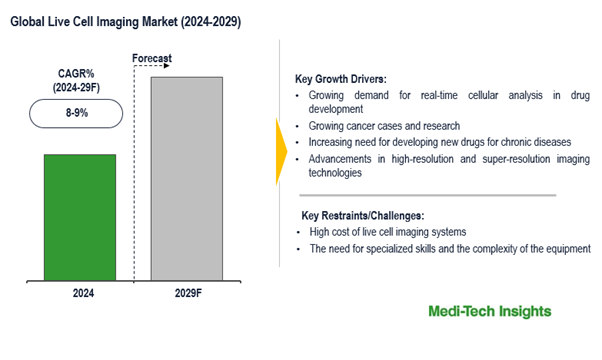
The live cell imaging market encompasses advanced methods and technologies for visualizing and studying cellular processes in real-time. This market includes a range of imaging tools, from fluorescence to confocal and multi-photon microscopy, which are critical in drug discovery, cancer research, and genetic studies. New developments in imaging technologies and software tools are driving enhanced visualization capabilities, enabling detailed cellular analyses with minimal invasiveness, thus improving experimental accuracy and data quality across research institutions globally.
To learn more about the research report, download a sample report.
Rising Demand for Live Cell Imaging in Cancer Research
The increasing focus on real-time, dynamic analysis of cancer cell behavior is a significant driver for the live cell imaging market. Live cell imaging enables researchers to observe cellular processes in real time, offering valuable insights into tumor progression, metastasis, and the cellular response to therapeutics. In 2023, approximately 1.9 million new cancer cases and 609,820 cancer deaths were expected in the U.S. alone, highlighting an ongoing need for effective research tools to study cancer progression and treatment efficacy in real time. The global cancer research field is also seeing substantial investment. The National Cancer Institute (NCI) received a budget allocation of approximately $7.1 billion for fiscal year 2023, including a $216 million addition from the 21st Century Cures Act, known as the "Cancer Moonshot" initiative, which supports advanced cancer research. Additionally, advancements in imaging technologies-such as high-resolution fluorescent microscopy and automated live cell imaging systems-enhance the precision and efficiency of cancer research, further propelling the adoption of live cell imaging. This growth is expected to continue as researchers seek innovative approaches to understand cancer biology and improve therapeutic outcomes.
To learn more about the research report, download a sample report.
The High Cost of Live Cell Imaging Systems Poses a Barrier to Market Growth
The high cost of live cell imaging systems is a significant barrier for broader adoption in research, as these advanced tools often carry price tags that are prohibitive for many institutions. Basic systems start around $20,000 to $50,000, but adding functionalities like fluorescence and confocal imaging can drive costs up to $100,000. High-end models, particularly those with specialized features such as spinning disk confocal technology, multi-laser configurations, and environmental controls for live cell imaging, may range between $100,000 and $400,000. For instance, the ImageXpress Micro Confocal system, equipped with options like automated high-throughput capabilities and environmental control chambers, exemplifies a top-tier model with a substantial price. These advanced systems provide invaluable insights for cellular research but require substantial financial investment, which can limit access for smaller labs and organizations with tighter budgets.
Competitive Landscape Analysis
In the competitive landscape of the live cell imaging market, several prominent players drive innovation and market expansion through strategic investments, partnerships, and technology advancements. Key companies include Danaher Corporation, Carl Zeiss AG, Agilent Technologies, Olympus Corporation, Thermo Fisher Scientific, PerkinElmer, Bruker Corporation, Nikon Corporation, Merck KGaA, and Sartorius AG. These firms focus on enhancing their imaging technology, software solutions, and consumables, and many pursue partnerships and acquisitions to broaden their portfolios and global reach.
Report Scope
|
Report Scope |
Details |
|
Base Year Considered |
2023 |
|
Historical Data |
2022 - 2023 |
|
Forecast Period |
2024 - 2029 |
|
Market Drivers |
|
|
Market Restraints |
|
|
Segment Scope |
Product Type, Application, and Technology |
|
Regional Scope |
|
|
Key Companies Mapped |
Danaher Corporation, Carl Zeiss AG, Olympus Corporation, Thermo Fisher Scientific, PerkinElmer, Bruker Corporation, Nikon Corporation, Merck KGaA, and Sartorius AG; among others |
|
Report Highlights |
Market Size & Forecast, Growth Drivers & Restraints, Trends, Competitive Analysis |
Market Segmentation
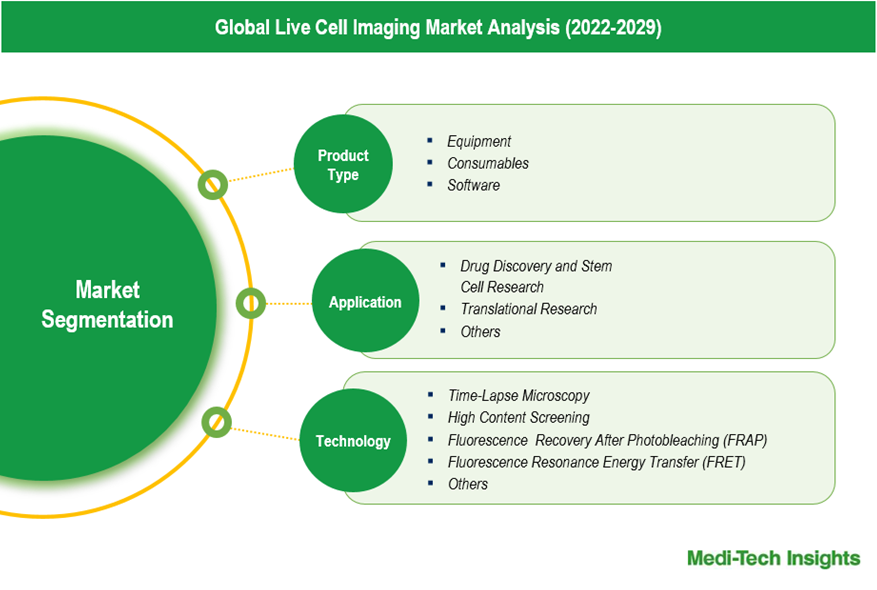
This report by Medi-Tech Insights provides the size of the global live cell imaging market at the regional- and country-level from 2022 to 2029. The report further segments the market based on product type, application, and technology.
- Market Size & Forecast (2022-2029), By Product Type, USD Billion
- Equipment
- Consumables
- Software
- Market Size & Forecast (2022-2029), By Application, USD Billion
- Drug Discovery and Stem Cell Research
- Translational Research
- Others
- Market Size & Forecast (2022-2029), By Technology, USD Billion
- Time-Lapse Microscopy
- High Content Screening
- Fluorescence Recovery After Photobleaching (FRAP)
- Fluorescence Resonance Energy Transfer (FRET)
- Others
- Market Size & Forecast (2022-2029), By Region, USD Billion
- North America
- US
- Canada
- Europe
- Germany
- France
- UK
- Italy
- Spain
- Rest of Europe
- Asia Pacific
- China
- India
- Japan
- Rest of Asia Pacific
- Latin America
- Middle East & Africa
- North America
Frequently Asked Questions About This Report
What is the market size & forecast of the live cell imaging market?
What are the historical, present, and forecasted market shares and growth rates of various segments and sub-segments of the live cell imaging market?
What are the key trends defining the market?
What are the major factors impacting the market?
What are the opportunities prevailing in the market?
Need a More Tailored Analysis?
- Discuss the market sizing methodology and forecast assumptions with our healthcare analysts.
- Expand the scope with additional countries, market segments, technologies, or competitor profiling.
- Use the insights to support strategic planning, market entry, commercial due diligence, and long-term revenue growth initiatives.