Download FREE Sample


Hospital filtration includes the processes, systems, and technology to remove and capture airborne and waterborne contaminants within a healthcare facility to provide a safe, sterile, and infection-controlled environment. This includes, but is not limited to, HVAC filters, HEPA/ULPA units, point-of-use filters, and specialized filtration for specific hospital areas such as, operating rooms, ICUs, isolation rooms, and sterilization/cleaning rooms. Hospital filtration reduces pathogens, particulate matter, chemical pollutants, and a variety of other harmful microorganisms. It is important as part of protecting patients, staff, and visitors and promoting compliance with standards, policies, and/or regulations, while also supporting infection-prevention and air-quality protocols throughout the hospital.
Increasing focus on infection-prevention after COVID-19 pandemic to propel market demand
The rise in infection prevention focus after COVID-19 is one of the more notable drivers of the hospital filtration market. The pandemic revealed critical weaknesses in healthcare ventilation and air quality management, creating a global change in how hospitals understood and managed the spread of airborne pathogens in clinical settings. In response to the emergence of SARS-CoV-2 as an airborne pathogen, hospitals commenced a widespread rollout of HEPA filtration units, improved HVAC system upgrades, and presented portable air purifiers as new control measures to limit transmission of virus particles in the air. This created a fundamental shift in perspective among healthcare settings regarding the role of filtration, making it a crucial part of their infection prevention strategy and plan. Post-pandemic, infection-prevention committees, facility managers, and regulatory bodies have made high-efficiency filtration a strong priority across operating rooms, ICUs, emergency departments, and isolation rooms. Hospitals now set higher internal benchmarks for ventilation rates, pressure control, and air-borne particle reduction, going beyond pre-COVID minimum requirements. Many nations, cities, and hospitals have published updated guidelines that establish requirements for ventilation, air changes per hour (ACH), and high-efficiency filtration systems or HEPA preferably in high-risk areas. Thus, there is now an ongoing demand for improved filtration including terminal HEPA, modular fan filter systems, and point-of-use air-cleaning devices.
The increase in awareness regarding nosocomial infections (tuberculosis, influenza, RSV, and multidrug-resistant organisms) has reinforced the long-term importance of investing in strong filtration infrastructure, in addition to the shorter term, more acute risk identification and mitigation benefits filtration can provide to hospitals. Hospitals are increasingly recognizing filtration as a preventative investment that lessens the risk of outbreaks, prevents patient complications, and reduces staff absenteeism. The health systems are also increasing contingency preparedness, enabling enhanced capacities and readiness for pandemics or surges of airborne infections. This preparedness includes having sufficient portable HEPA units readily available, flexible negative-pressure spaces, and improved central HVAC filtration capacities. Another major driver is the fact that infection prevention is now also linked to operational continuity and public trust. Patients, staff, and accreditation bodies are all placing even higher expectations on indoor air quality. Hospitals that are perceived to have modern filtration systems are now viewed as safer and more resilient.
Overall, the post-COVID shift has transformed hospital filtration from a background facility function to a strategic, heavily funded priority, driving consistent market growth through upgrades, retrofits, replacements, and new installations across all healthcare environments.

To learn more about this report, download the PDF brochure
Growing hospital capacity & healthcare infrastructure expansion is driving the market growth
The increase in hospital capacity and healthcare infrastructure is a significant, tangible driver of the hospital filtration market. As nations invest in new hospitals, outpatient centres, specialty clinics and expanded intensive care units, every new facility needs central HVAC systems, terminal HEPA units, point-of-use water and air filters, and related installation and validation services. Developing markets, driven by increasing disposable income, ageing populations and urbanization, are where this demand is centred as governments and private players enhance capacity to service rising healthcare demand. Specialized clinical areas such as operating theatres, transplant wards, oncology suites, neonatal ICUs and sterile processing departments require higher-grade filtration (HEPA/ULPA), strict pressure differentials and documented air-change rates. When healthcare systems introduce these spaces or add bed capacity, they typically require superior filters, and accordingly, an increase in equipment spend as well as ongoing consumables revenue.
Capacity expansion also stimulates retrofit activity, i.e., older hospitals are renewed with the addition of new units or to meet current infection-control standards. Retrofits elicit fan-filter units, portable HEPA systems, and ductwork enhancement to provide lower-disruption additions as compared with an entirely new HVAC renovation. For manufacturers and service providers, this unique mix of new build and retrofit projects creates diverse revenue streams; capital sales and recurring revenue from replacement filters, validation testing and maintenance contracts. Government funding programs, public-private partnerships, and international grants often link infrastructure financing to infection-control improvements, which speeds up procurement of certified filtration technologies. Simultaneously, private hospital groups and medical tourism centers invest in advanced indoor air quality as a market differentiator to gain accreditation and patient trust, further fueling demand.
Support services like pharmacies, diagnostics labs, and sterile compounding units; often co-locate with increased clinical capacity and create their own strict filtration demand, bundling air and water filtration demand together in single project. While challenges remain, such as capital for projects and a limited labor pool of certified installers in certain areas, the overall net effect is positive, as increased healthcare capacity is created globally, hospital filtration needs grow simultaneously in technological sophistication, scale and recurring installed demand, all of which supports sustainable marketplace growth. This sustained project pipeline translates to hospital filtration being a structurally growing market with predictable long-term demand.
Growth strategies adopted by players to establish their foothold in the market
Players operating in this market are adopting various growth strategies such as new product launches and acquisitions to garner market share. For instance,
- In October 2025, Hengst Filtration acquired UK-based International Filtration Solutions (IFS), strengthening its healthcare filtration capabilities across medical respiratory, anesthesia, and insufflation filters via MFS, and advanced respiratory protection solutions via AFS. The acquisition enhances Hengsts technology portfolio, including HEPAC and antimicrobial media, while giving IFS access to global markets and accelerating innovation in life-protecting filtration solutions
- In September 2025, Camfil expanded its facility in India with a new HEPA and ULPA filter production line to meet EN 1822 and ISO 29463 standards, boosting supply for hospitals, pharma, biotech, and high-containment cleanrooms. The upgrade strengthens their local manufacturing capacity, offering individually scan-tested, globally compliant filters to support growing demand for high-performance clean air solutions in the region
- In June 2024, Rensa Filtration launched the production of high-performance HEPA filters at their heas and manufacturing campus in Illinois, US. This expands Rensas HEPA portfolio to meet rising demand from healthcare and high-tech industries
To learn more about this report, download the PDF brochure
Type Segment Outlook
In hospitals filtration market, inline filters make up the largest share as theyre built directly into plumbing and HVAC systems, allowing continuous, reliable filtration for areas like ICUs, dialysis centers, and central air handling units. Their compatibility with both new facilities and older systems keeps them in wide use. Meanwhile, standalone filtration units are likely to showcase the fastest growth. Hospitals are turning to portable HEPA devices and mobile air-cleaning units to quickly set up or upgrade isolation rooms. Since these units are flexible, easy to deploy, and relatively affordable, theyre becoming a preferred option for strengthening infection-control efforts.
Regional Outlook: North America expected to hold a major share in the hospital filtration market
North America currently holds the largest share of the arket, mainly because of its strong healthcare budgets, strict infection-control regulations, and well-established hospital networks that consistently upgrade filtration systems. In contrast, the AsiaPacific region is expanding the fastest which is attributed to the growing investments in new hospitals, rising healthcare access, and greater awareness of air and water safety; accelerating adoption across countries in this region. Europe shows steady, regulation-driven growth, while Latin America and the Middle East & Africa remain smaller but steadily improving markets as governments modernize facilities and expand public health programs.
Competitive Landscape Analysis
The global hospital filtration market is marked by the presence of established and emerging market players such as Camfil; Veolia; DAIKIN INDUSTRIES, Ltd.; Freudenberg Filtration Technologies GmbH & Co. KG; Pentair; MANN+HUMMEL; Danaher; Parker Hannifin Corp; Merck KGaA; and Sartorius AG; among others. Some of the key strategies adopted by market players include product innovation and development, mergers and acquisitions, strategic partnerships and collaborations, and geographic expansion.

Get a sample report for competitive landscape analysis
Report Scope
| Report Metric | Details |
| Base Year Considered | 2025 |
| Historical Data | 2024 2025 |
| Forecast Period | 2026 2031 |
| Growth | 7% |
| Segment Scope | Type, Process Type, Application |
| Regional Scope |
|
| Market Drivers |
|
| Attractive Opportunities |
|
| Key Companies Mapped | Camfil; Veolia; DAIKIN INDUSTRIES, Ltd.; Freudenberg Filtration Technologies GmbH & Co. KG; Pentair; MANN+HUMMEL; Danaher; Parker Hannifin Corp; Merck KGaA; and Sartorius AG; among others |
| Report Highlights | Market Size & Forecast, Growth Drivers & Restraints, Trends, Competitive Analysis |
Global Hospital Filtration Market Segmentation
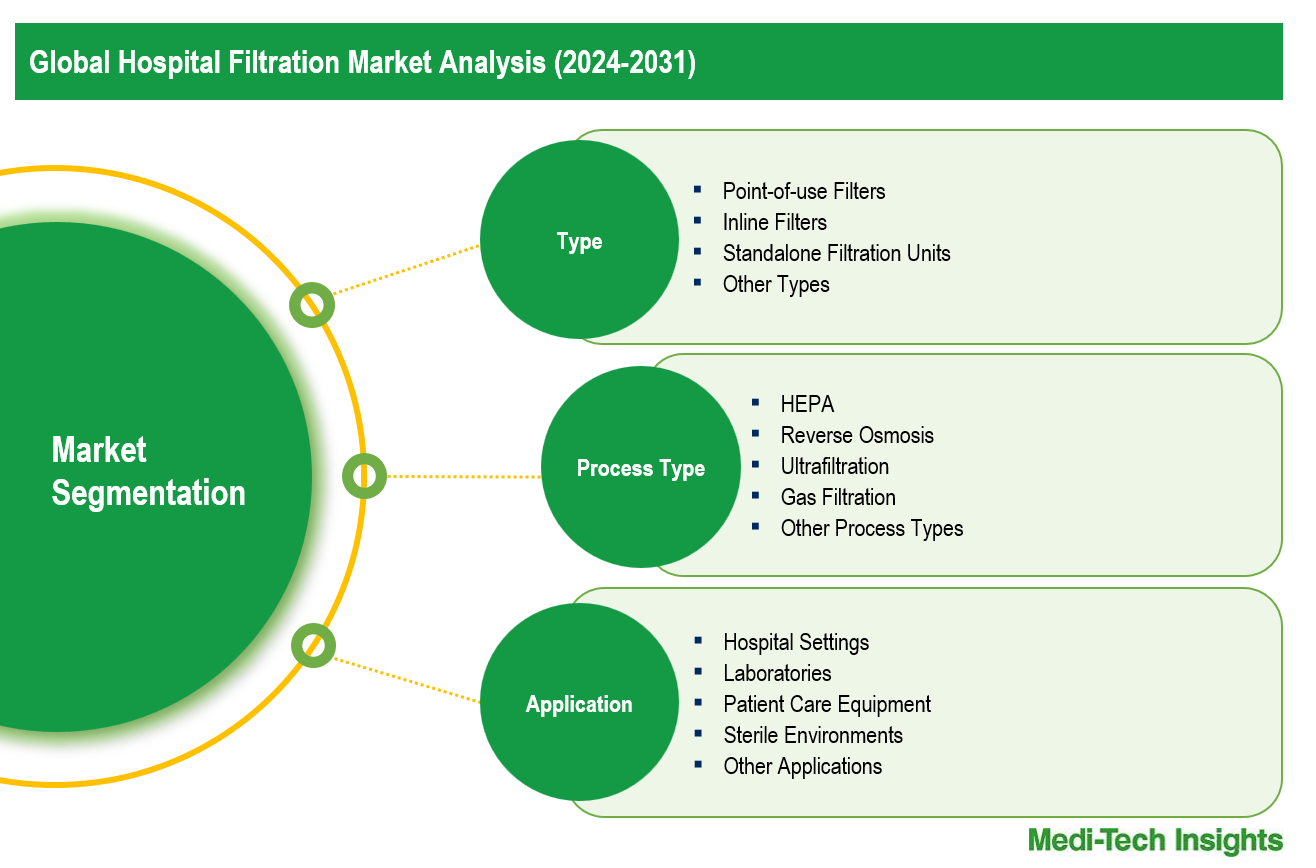
This report by Medi-Tech Insights provides thesize of the global hospital filtration market at theregional- and country-level from 2024 to 2031. The report further segments the market based on type, process type, and application.
Market Size & Forecast (2024-2031), By Type, USD Billion
- Point-of-use Filters
- Inline Filters
- Standalone Filtration Units
- Other Types
Market Size & Forecast (2024-2031), By Process Type, USD Billion
- HEPA
- Reverse Osmosis
- Ultrafiltration
- Gas Filtration
- Other Process Types
Market Size & Forecast (2024-2031), By Application, USD Billion
- Hospital Settings
- Laboratories
- uipment
- Sterile Environments
- Other Applications
Market Size & Forecast (2024-2031), By Region, USD Billion
- North America
- US
- Canada
- Europe
- UK
- Germany
- France
- Italy
- Spain
- Rest of Europe
- Asia Pacific
- China
- India
- Japan
- Rest of Asia Pacific
- Latin America
- Middle East & Africa
Related Reports
Need a More Tailored Analysis?
- Discuss the market sizing methodology and forecast assumptions with our healthcare analysts.
- Expand the scope with additional countries, market segments, technologies, or competitor profiling.
- Use the insights to support strategic planning, market entry, commercial due diligence, and long-term revenue growth initiatives.