Download FREE Sample


Report Overview
The implantable defibrillator market encompasses the production, distribution, and adoption of devices designed to prevent sudden cardiac death by managing life-threatening arrhythmias. It includes different types of implantable defibrillators such as transvenous, subcutaneous, and wearable models, along with supporting technologies. The market addresses a critical need in cardiovascular care, focusing on individuals at risk of ventricular tachycardia or fibrillation. Growing awareness about heart disease management and technological advancements have made implantable defibrillators an essential component of modern healthcare.
To learn more about the research report, download a sample report.
Rising cardiovascular disease burden drives implantable defibrillator market
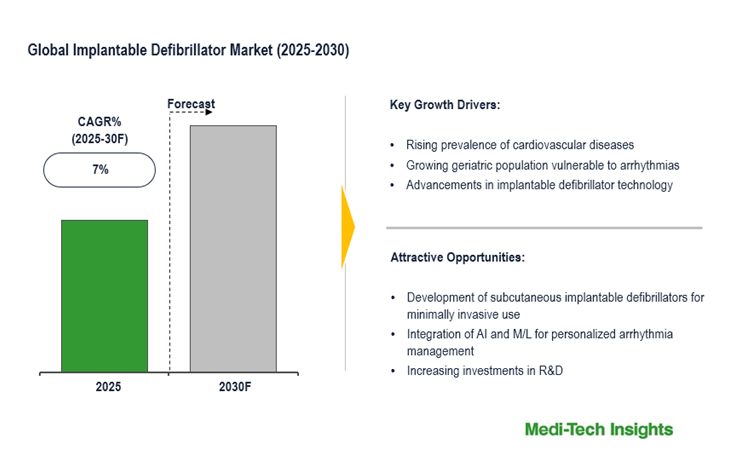
The increasing global prevalence of cardiovascular diseases (CVDs) is a significant driver for the implantable defibrillator market. According to the WHO, an estimated 17.9 million people die each year due to CVDs, accounting for ~32% of all global deaths, with ~85% of these deaths caused by heart attack and stroke. CVDs, including arrhythmias and heart failure, hold the largest share of global mortality, underscoring the urgent need for preventive and therapeutic solutions. Implantable defibrillators are critical in reducing mortality rates by providing real-time monitoring and immediate intervention during life-threatening arrhythmias. Aging populations and lifestyle shifts, such as unhealthy diets, smoking, and physical inactivity, have exacerbated CVD rates. Governments and health organizations are increasingly promoting screening and treatment initiatives, while technological advancements, such as remote monitoring, enhance accessibility and reliability, ensuring sustained growth for this life-saving market.
To learn more about the research report, download a sample report.
Transformative innovations elevating implantable defibrillator technology
Technological innovations significantly enhance implantable defibrillators' functionality and appeal, driving market growth. Modern ICDs are increasingly equipped with wireless connectivity and remote monitoring capabilities, enabling healthcare providers to track patient conditions and device performance in real time. Additionally, advancements in miniaturization have led to smaller, more comfortable devices with longer battery life, improving patient compliance and satisfaction.
A major breakthrough in ICD technology is the Extravascular ICD (EV-ICD), which provides a less invasive alternative to traditional transvenous ICDs (T-ICD) while offering pacing capabilities not available in subcutaneous ICDs (S-ICDs). EV-ICDs place leads outside the bloodstream but closer to the heart than S-ICDs, reducing complications associated with transvenous lead implantation while ensuring effective defibrillation. Clinical trials for EV-ICDs have shown promising safety and efficacy results, positioning them as a next-generation solution in cardiac rhythm management.
Furthermore, companies are also integrating AI-driven analytics into ICD systems to improve arrhythmia detection accuracy and personalize treatment strategies. These advancements not only improve patient outcomes but also expand the adoption of ICDs across broader patient demographics, significantly boosting market growth.
Competitive Landscape Analysis
The global implantable defibrillator market features established and emerging players, including Abbott; Medtronic; BIOTRONIK SE & Co. KG; Boston Scientific Corporation; MicroPort Scientific Corporation; and LivaNova PLC among others. Some of the key strategies adopted by market players include product innovation and development, strategic partnerships and collaborations, and geographic expansion
Report Scope
|
Report Scope |
Details |
|
Base Year Considered |
2024 |
|
Historical Data |
2023 - 2024 |
|
Forecast Period |
2025 - 2030 |
|
Growth rate |
7% |
|
Market Drivers |
|
|
Attractive Opportunities |
|
|
Segment Scope |
Product and End-user |
|
Regional Scope |
|
|
Key Companies Mapped |
Abbott; Medtronic; BIOTRONIK SE & Co. KG; Boston Scientific Corporation; MicroPort Scientific Corporation; and LivaNova PLC among others |
|
Report Highlights |
Market Size & Forecast, Growth Drivers & Restraints, Trends, Competitive Analysis |
Market Segmentation
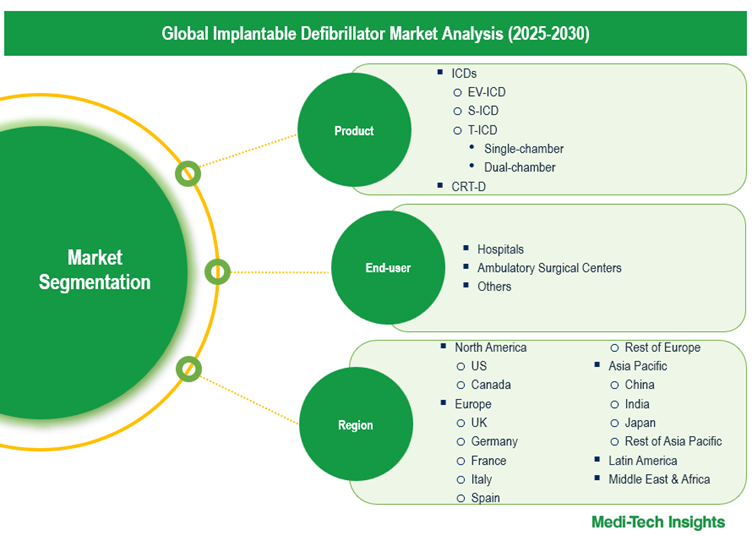
This report by Medi-Tech Insights provides thesize of the global implantable defibrillator market at theregional- and country-level from 2023 to 2030. The report further segments the market based on product and end-user.
- Market Size & Forecast (2023-2030), By Product, USD Million
- ICDs
- EV-ICD
- S-ICD
- T-ICD
- Single-chamber
- Dual-chamber
- CRT-D
- ICDs
- Market Size & Forecast (2023-2030), By End-user, USD Million
- Hospitals
- Ambulatory Surgical Centers
- Others
- Market Size & Forecast (2023-2030), By Region, USD Million
- North America
- US
- Canada
- Europe
- UK
- Germany
- France
- Italy
- Spain
- Rest of Europe
- Asia Pacific
- China
- Indi>Japan
- Rest of Asia Pacific
- Latin America
- Middle East & Africa
- North America
Need a More Tailored Analysis?
- Discuss the market sizing methodology and forecast assumptions with our healthcare analysts.
- Expand the scope with additional countries, market segments, technologies, or competitor profiling.
- Use the insights to support strategic planning, market entry, commercial due diligence, and long-term revenue growth initiatives.