Download FREE Sample


Lung cancer surgery is a medical procedure aimed at removing cancerous tissue from the lungs. It is primarily used to treat early-stage lung cancer, particularly non-small cell lung cancer (NSCLC), and involves various techniques such as lobectomy (removal of a lung lobe), pneumonectomy (removal of an entire lung), and segmentectomy (removal of part of a lobe). Advanced methods like video-assisted thoracoscopic surgery, and robotic-assisted thoracic surgery offer minimally invasive options, reducing recovery time and complications. Lung cancer surgery is often combined with other treatments, including chemotherapy, radiation, or immunotherapy, to improve patient outcomes and reduce recurrence.
To learn more about this report, download the PDF brochure
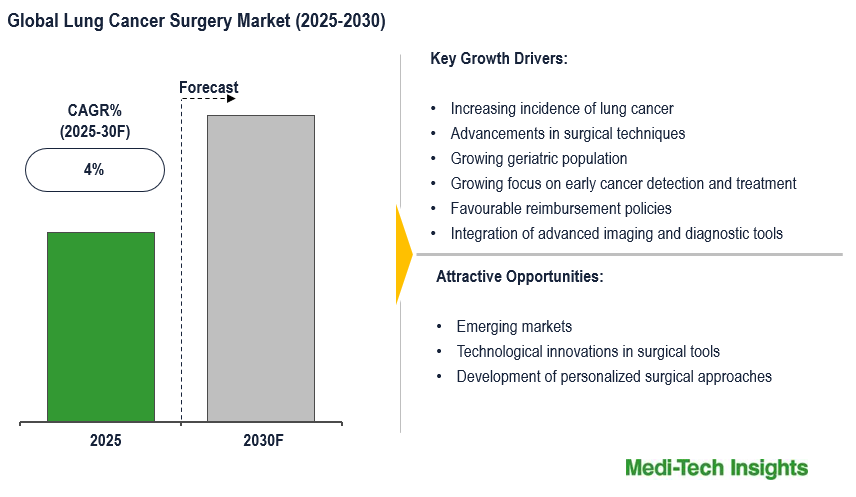
Increasing incidence of lung cancer to propel market demand
The increasing incidence of lung cancer is a major factor driving demand for lung cancer surgery worldwide. According to the International Agency for Research on Cancer (IARC), lung cancer was the most commonly diagnosed cancer globally in 2022, accounting for approximately 2.5 million new cases and 12.4% of all cancer diagnoses. Despite advancements in targeted therapies and immunotherapies, surgical resection remains the standard of care for patients diagnosed with early-stage and localized non-small cell lung cancer (NSCLC), which represents the majority of lung cancer cases. Growing awareness, improved screening initiatives such as low-dose computed tomography (LDCT), and advancements in diagnostic technologies are enabling earlier detection of lung tumors, thereby increasing the number of patients eligible for curative surgical intervention.
Advancements in surgical techniques are driving the market growth
Advancements in surgical techniques are significantly driving the lung cancer surgery market by improving precision, reducing complications, and enhancing patient outcomes. Minimally invasive procedures like video-assisted thoracoscopic surgery and robotic-assisted thoracic surgery enable smaller incisions, faster recovery times, and lower post-operative risks compared to traditional open surgeries. Enhanced imaging technologies, real-time navigation systems, and robotic platforms improve tumor localization and surgical accuracy, leading to better survival rates. Additionally, the adoption of personalized surgical approaches, based on genetic profiling and AI-driven decision-making, is further optimizing treatment, making surgery a preferred option for early-stage lung cancer patients.
To learn more about this report, download the PDF brochure
Competitive Landscape Analysis
The global lung cancer surgery market is marked by the presence of established and emerging market players such as Intuitive Surgical, Medtronic, Johnson & Johnson, Olympus Corporation, Siemens Healthineers, Teleflex Incorporated, Accuray Incorporated, AngioDynamics, KARL STORZ SE & Co. KG, and Richard Wolf GmbH; among others. Some of the key strategies adopted by market players include new product development, strategic partnerships and collaborations, and geographic expansion.
Report Scope
| Report Metric | Details |
| Base Year Considered | 2024 |
| Historical Data | 2023 - 2024 |
| Forecast Period | 2025 - 2030 |
| Growth Rate | 4% |
| Market Drivers |
|
| Attractive Opportunities |
|
| Segment Scope | Product, Application, End User |
| Regional Scope |
|
| Key Companies Mapped | Intuitive Surgical, Medtronic, Johnson & Johnson, Olympus Corporation, Siemens Healthineers, Teleflex Incorporated, Accuray Incorporated, AngioDynamics, KARL STORZ SE & Co. KG, and Richard Wolf GmbH among others |
| Report Highlights | Market Size & Forecast, Growth Drivers & Restraints, Trends, Competitive Analysis |
Global Lung Cancer Surgery Market Segmentation
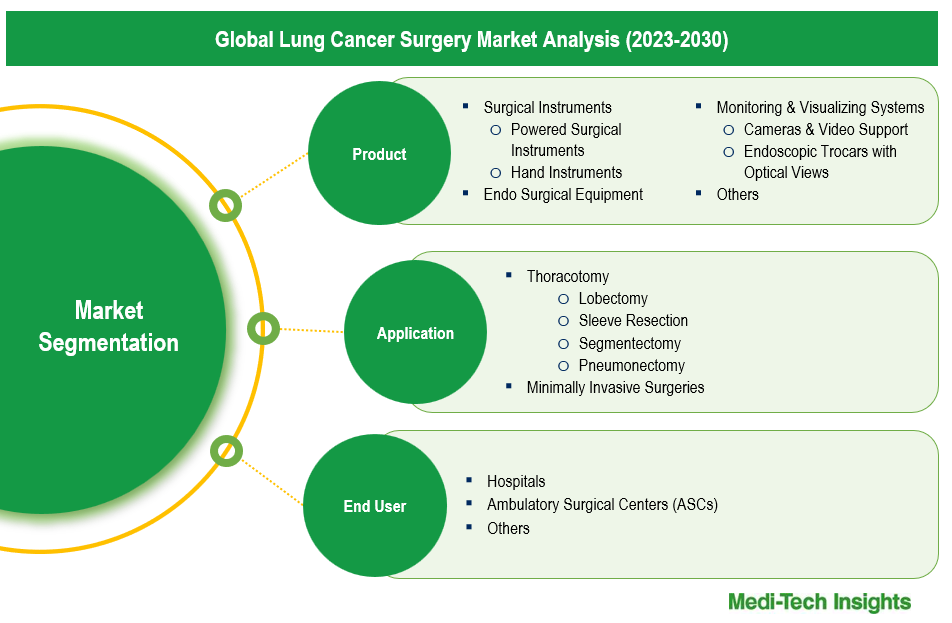
This report by Medi-Tech Insights provides thesize of the global lung cancer surgery market at theregional- and country-level from 2023 to 2030. The report further segments the market based on product, application, end user.
Market Size & Forecast (2023-2030), By Product, USD Million
- Surgical Instruments
- Powered Surgical Instruments
- Hand Instruments
- Monitoring and Visualizing Systems
- Cameras and Video Support
- Endoscopic Trocars with Optical Views
- Endo surgical Equipment
- Others
Market Size & Forecast (2023-2030), By Application, USD Million
- Thoracotomy
- Lobectomy
- Sleeve Resection
- Segmentectomy
- Pneumonectomy
Market Size & Forecast (2023-2030), By End User, USD Million
- Hospitals
- Ambulatory Surgical Centers (ASCs)
- Others
Market Size & Forecast (2023-2030), By Region, USD Million
- North America
- US
- Canada
- Europe
- UK
- Germany
- France
- Italy
- Spain
- Rest of Europe
- Asia Pacific
- China
- India
- Japan
- Rest of Asia Pacific
- Latin America
- Middle East & Africa
Key Strategic Questions Addressed
- What is the market size & forecast of the lung cancer surgery market?
- What are historical, present, and forecasted market shares and growth rates of various segments and sub-segments of the lung cancer surgery market?
- What are the key trends defining the market?
- What are the major factors impacting the market?
- What are the opportunities prevailing in the market?
- Which region has the highest share in the global market? Which region is expected to witness the highest growth rate in the next 5 years?
- Who are the major players operating in the market?
- What are the key strategies adopted by players?
Need a More Tailored Analysis?
- Discuss the market sizing methodology and forecast assumptions with our healthcare analysts.
- Expand the scope with additional countries, market segments, technologies, or competitor profiling.
- Use the insights to support strategic planning, market entry, commercial due diligence, and long-term revenue growth initiatives.