Download FREE Sample


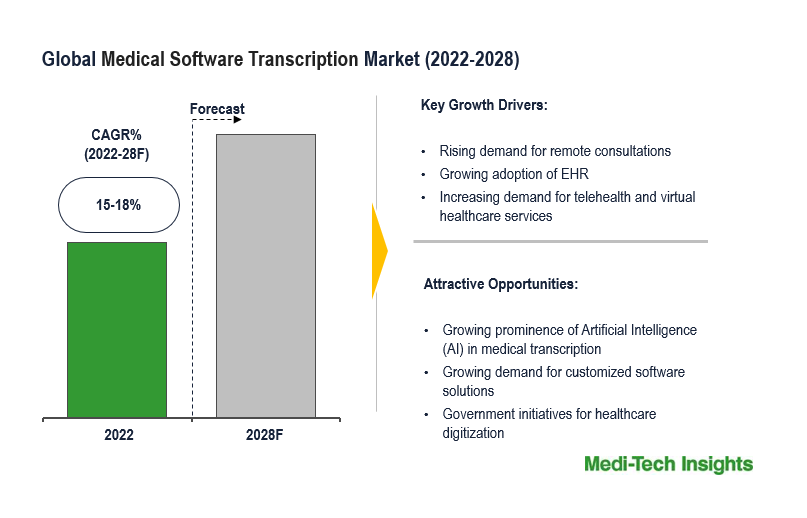
The Global Medical Transcription Software Market is expected
to witness a 15-18% growth rate by 2031. Growing demand for telehealth, remote
consultations, and virtual healthcare, technological advancements such as voice
recognition, widespread adoption of electronic health records (EHRs), increased
emphasis on data security and compliance, and the facilitation of enhanced
collaboration through cloud-based solutions are some of the key factors driving
the market.
Medical transcription software is a specialized technology
that aids healthcare professionals in the conversion of voice-recorded medical
reports into written or electronic text documents. The software automates the
transcription process, enhances efficiency, and ensures precise documentation
of patient information. Key functionalities include the utilization of voice
recognition technology, which automatically transcribes spoken words, reduces
the need for manual typing, and expedites the transcription process. Seamless
integration with electronic health records (EHRs) facilitates the direct
transfer of transcribed documents, maintaining comprehensive and up-to-date
patient records. Security features such as encryption and secure data storage
are integral to protecting patient confidentiality. Editing and review tools,
along with workflow management features, assist in making corrections, ensuring
accuracy, and streamlining collaboration among transcriptionists and healthcare
providers. With the scalability to adapt to varying workloads, medical transcription
software significantly contributes to efficient and accurate medical
documentation, ultimately enhancing patient care and administrative processes.
Surge in Demand for Remote Consultations, Technological
Advancements, and Growing Adoption of EHRs Drive the Market
The surge in remote consultations leads to a higher volume
of virtual patient visits. As healthcare professionals conduct these
consultations using telehealth platforms, there is a growing need for accurate
and timely transcriptions of the conversations. Medical transcription software
becomes essential in converting voice-recorded virtual visits into written or
electronic text documents. Technological advancements, particularly in voice
recognition and natural language processing, are vital in fueling the market
growth. These innovations substantially diminish the need for manual data
entry, leading to cost savings and heightened accuracy in medical
transcriptions.
Another influential factor contributing to the growth of the medical transcription software market is the widespread adoption of electronic health records (EHRs) within healthcare organizations. The efficient management of patient data through the utilization of EHRs amplifies the demand for medical transcription software. This trend underscores the evolving landscape where the seamless integration of technology becomes imperative for efficient healthcare data management, highlighting the increasing reliance on advanced solutions in the modern healthcare environment.
Tech Trends Driving Accuracy and Efficiency in Medical Transcription
Recent trends in the medical transcription software market
include an integration of artificial intelligence (AI) encompassing machine
learning and natural language processing. AI enhances transcription accuracy by
refining language understanding, context recognition, and adaptation to
specific medical specialities. Ongoing advancements in voice recognition
technology contribute to real-time and precise transcriptions, adapting to
diverse accents and dialects. For instance,
In March 2023, Nuance Communications, Inc., now part
of Microsoft, unveiled Dragon Ambient eXperience (DAX-) Express. This
innovative application seamlessly integrates into workflows, offering a fully
automated solution for clinical documentation. DAX- Express stands out as the
pioneering platform to merge established conversational and ambient AI
technologies with the cutting-edge capabilities of OpenAI's latest and most
advanced model, GPT-4.
The growing adoption of cloud-based solutions in the medical
transcription software market is reshaping the industry landscape. This trend
offers healthcare professionals enhanced accessibility, allowing them to
conduct transcription tasks from anywhere. The cloud platforms provide
scalability and flexibility, enabling healthcare organizations to adjust to
varying workloads efficiently. The cost efficiency of cloud-based models, often
operating on a subscription basis, reduces upfront infrastructure investments.
Collaboration is impal-time document access, and automatic updates ensure the
latest features and security measures. Cloud solutions contribute to data
security and compliance, offering disaster recovery and business continuity
features. Additionally, the shift to cloud-based solutions reduces the IT
management burden, allowing healthcare professionals to concentrate on patient
care. The adaptability of cloud platforms aligns well with the integration of
medical transcription services into telehealth platforms, supporting the
evolving landscape of healthcare IT
The development of mobile applications enables healthcare
professionals to conduct on-the-go medical transcriptions, enhancing
flexibility and convenience. Improved interoperability with electronic health
records (EHR) systems is a key trend, streamlining workflows and enhancing
overall efficiency. Data security and compliance receive heightened attention,
with providers prioritizing robust features to safeguard sensitive patient
information. Some software solutions now offer automatic summarization for
quick extraction of key information and a trend towards structured data output.
The integration of adaptive learning systems enables transcription software to
learn and adapt to individual user speech patterns, enhancing accuracy over time.
Additionally, the growth of telehealth services has led to increased
integration of medical transcription software into telehealth platforms for
accurate documentation of virtual patient visits.
Medical Transcription Software Market - Key Constraints/Challenges
Challenges in the medical transcription software market include security and privacy concerns due to sensitive patient information, necessitating compliance with healthcare regulations, and the need for seamless integration with electronic health records (EHRs). Additionally, ensuring high accuracy in transcriptions, keeping up with rapid technological advancements, and managing the costs associated with implementation and training pose obstacles for both vendors and healthcare organizations.
North America Accounts for the Largest Share of the Global Market
The market size exhibits variation among regions, with more
established services commonly found in developed countries. North America and
Europe are notable leaders, representing two of the largest markets in the
global medical transcription market. Historically, North America has been a
significant contributor to the medical transcription market, driven by the
presence of a well-established healthcare infrastructure, high technology
adoption, and stringent healthcare regulations. The United States, in
particular, is a major market for medical transcription, with factors such as
the widespread use of electronic health records (EHRs) influencing the demand
for transcription solutions. The Asia-Pacific region presents opportunities for
market growth due to the increasing focus on improving healthcare
infrastructure, rising awareness of the benefits of healthcare IT solutions,
and the expansion of the outsourcing industry in countries like India and other
Asian countries.
Medical Transcription Software Market - Competitive Landscape
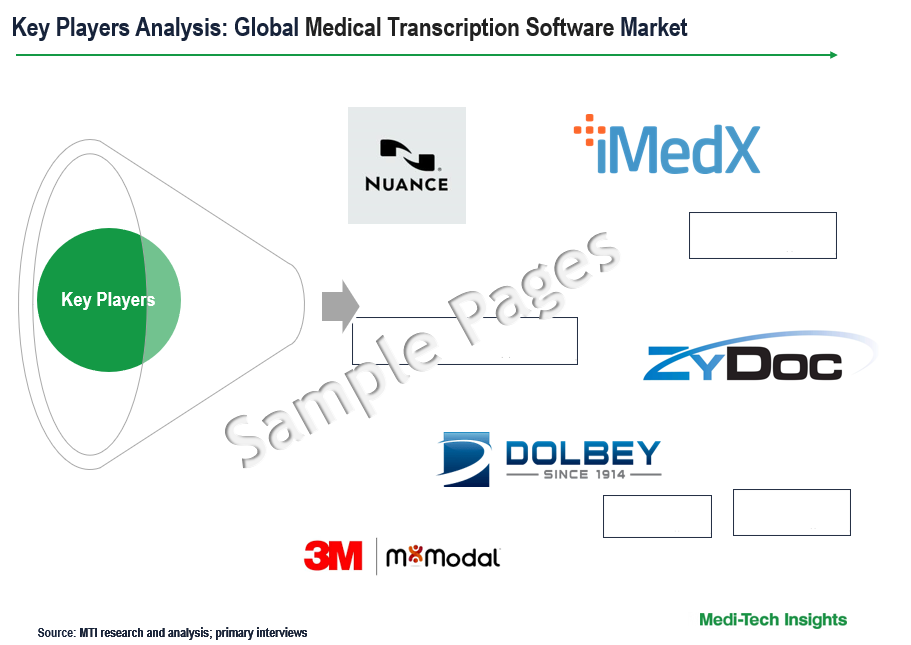
Some key players in the medical transcription software market include Microsoft Corporation (Nuance Communications, Inc.), Global Medical Transcription, ZyDoc Medical Transcription, SMARTMD, DeepScribe, Inc., Dolbey System, Inc., 3M Health Information Systems (MModal), iMedX, and Aquity Solutions among others.
Organic and Inorganic Growth Strategies Adopted by
Players to Establish Their Foothold in the Market
Players operating in this market are adopting both organic
and inorganic growth strategies such as collaborations, and acquisitions to
garner market share. For instance,
In March 2022, Microsoft Corp announced the
completion of its acquisition of Nuance Communications Inc., a prominent player
in conversational AI and ambient intelligence across various sectors such as
healthcare, financial services, retail, and telecommunications
The market is expected to continue to grow due to the rising
demand for remote consultations, technological innovations, government
initiatives for healthcare digitization, and aggressive organic and inorganic
growth strategies followed by the players.
Medical Transcription Software Market Scope
|
Report Metric |
Details |
|
Growth Rate |
15-18% |
|
Historical
data |
2018 – 2022 |
|
Forecast
period |
2023-2028 |
|
Base year |
2023 |
|
Key Drivers |
Surge in
demand for remote consultations Technological
advancements (voice recognition, AI, ML, NLP) Widespread
adoption of electronic health records (EHRs) Emphasis on
data security and compliance Facilitation
of enhanced collaboration through cloud-based solutions |
|
Key
Functionalities |
Voice
recognition technology Seamless integration with EHRs Security
features (encryption, secure data storage) Editing and
review tools, workflow management Scalability
for varying workloads |
|
Key Players |
Microsoft
Corporation (Nuance Communications, Inc.), Global Medical Transcription,
ZyDoc Medical Transcription, SMARTMD, DeepScribe, Inc., Dolbey System, Inc.,
3M Health Information Systems (MModal), iMedX, and Aquity Solutions |
Frequently Asked Questions About This Report
What is the market size & forecast for the Global Medical Transcription Software Market?
What are the historical, present, and forecasted market shares and growth rates of various segments and sub-segments of the Global Medical Transcription Software Market?
How has COVID-19 impacted the Global Medical Transcription Software Market?
What are the major growth drivers, restraints/challenges impacting the market?
What are the opportunities prevailing in the market?
Need a More Tailored Analysis?
- Discuss the market sizing methodology and forecast assumptions with our healthcare analysts.
- Expand the scope with additional countries, market segments, technologies, or competitor profiling.
- Use the insights to support strategic planning, market entry, commercial due diligence, and long-term revenue growth initiatives.