Download FREE Sample


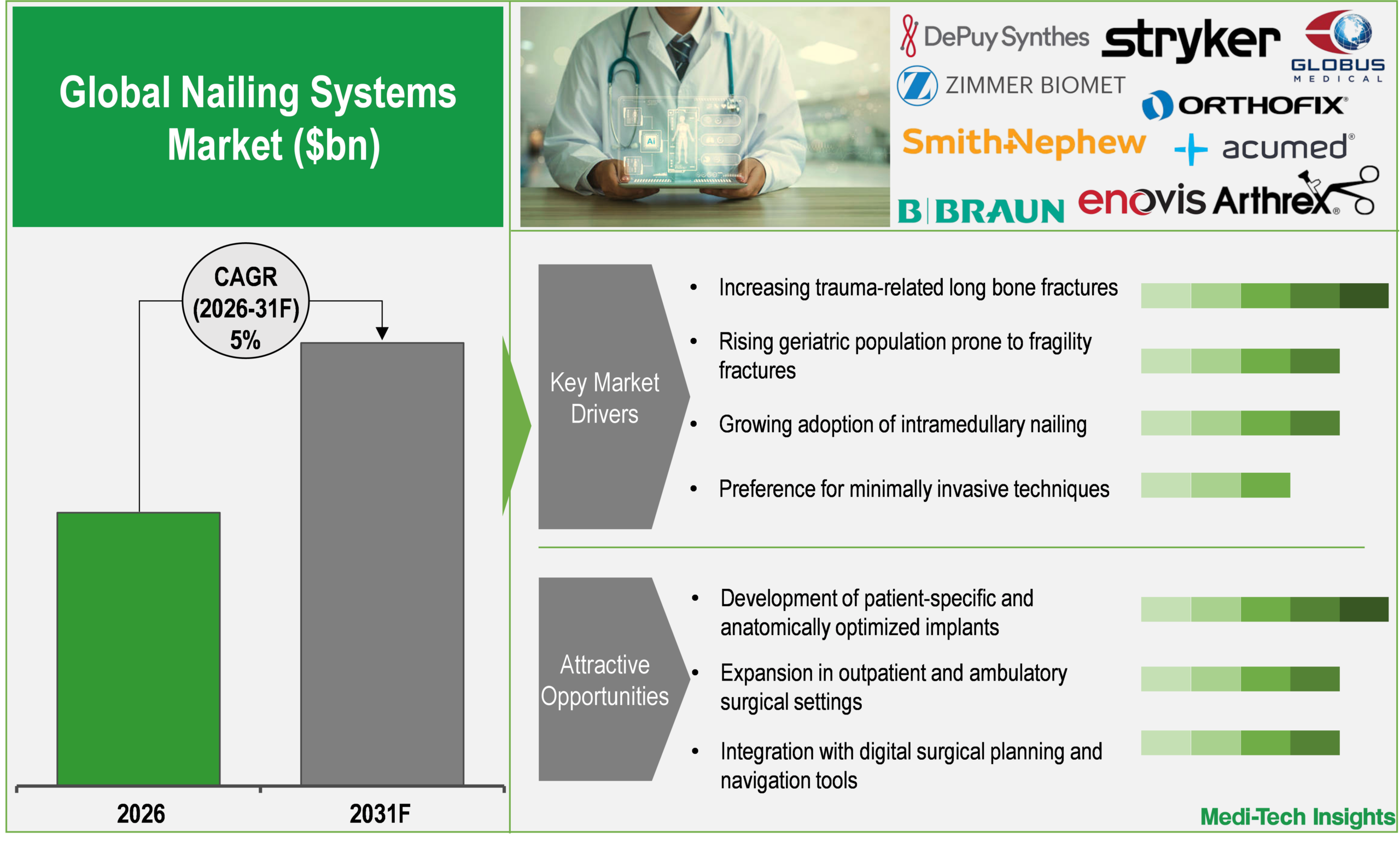
The global nailing systems market size is set to witness a growth rate of 5% in the next 5 years. Increasing trauma-related long bone fractures, rising geriatric population prone to fragility fractures, growing adoption of intramedullary nailing, preference for minimally invasive techniques, advancements in implant design and materials, and a growing number of orthopedic surgical procedures are some of the key factors driving the nailing systems market.
Nailing Systems or intramedullary fixation devices are used in orthopedic surgery, primarily to stabilize and align fractured long bones such as the femur, tibia, and humerus. These systems consist of metal nails, locking screws, and insertion tools that provide internal support during bone healing. The nailing systems are inserted into the medullary canal and are widely used in trauma care, reconstructive procedures, and corrective orthopedic surgeries. Compared to traditional methods, intramedullary nails are often preferred due to their minimally invasive nature and superior biomechanical stability. Further, these intramedullary nails support load sharing, maintain anatomical alignment, which facilitates rapid union and early patient mobilization.
The surge in trauma and fragility fractures is driving demand for advanced nailing systems
The surge in the number of fractures linked to both trauma and low bone density conditions is a central factor contributing to the rising demand for nailing systems. The rising aging populations, coupled witha high prevalence of low bone density conditions such as osteoporosis, are more susceptible to fragility fractures, which has led to a significant increasein the number of hip and long bone fractures.
Simultaneously, a rise in the number of trauma fractures resulting from road accidents, intense sports activities, and accidental falls, among others, hasfurther increased the demand for advanced stabilization solutions. Additionally, broade orthopedic device utilization has increased in parallel with rising musculoskeletal disorder prevalence globally, reinforcing the need for effective fracture fixation solutions.
Intramedullary nailing is a widely used standard surgical technique for treating fractures in long, load-bearing bones such as the femur and tibia. The primary reason for its high adoption rate is its ability to provide stable internal load-sharing fixation, allowing patients to begin early mobilization, often within days of surgery, rather than weeks, as required with traditional plating or casting methods. This early mobilization, specifically among elderly patients, not only reduces patient discomfort but also mitigates joint stiffness and enhances blood flow, facilitating the bone healing process, thereby resulting in better functional outcomes. To conclude, advanced intramedullary nailing systems are transforming modern orthopedic care by providing superior mechanical stability, facilitating rapid recovery, and reducing long-term complications in complex fracture management.
To learn more about this report, download the PDF brochure
Shift toward minimally invasive orthopedic procedures to fuel the nailing systems market growth
Modern orthopedic care is witnessing a significant shift from traditional open procedures to less invasive procedures that minimize tissue disruption, reduce postoperative pain and shorten hospital stays. The advanced intramedullary nailing systems align well with this transformation, which can be inserted via smaller incisions using advanced image-guided techniques. The growing preference toward minimally invasive orthopedic procedures is driven by global healthcare systems, which are not only aiming to reduce hospitalization time but also procedural costs, along with improving patient throughput.
Additionally, minimally invasive techniques offer advantages including reduced intraoperative blood loss, lower infection risk at the surgical site, and shorter rehabilitation periods. Due to such advantages, these nailing systems are increasingly being adopted not only for simple fractures but also for complex and multi-fragmentary injuries. Moreover, the compatibility of these nailing systems with advanced surgical tools, including targeting devices, intraoperative imaging systems, and robotic-assisted navigation, is enhancing precision and supports their integration into contemporary digitally driven surgical workflows. Lastly, the integration of AI, smart implants with embedded sensors and novel biomaterials is elevating fracture fixation from standardized repair to personalized, patient-specific care, ensuring optimal union rates and improved patient outcomes.

To learn more about this report, download the PDF brochure
Product Segment Outlook
The nailing systems market, by product, is segmented into femoral intramedullary, tibial intramedullary, humeral intramedullary, and other nails, with femoral intramedullary nails holding the largest share of the market. The demand for femoral nails is driven by the increasing number of fractures in weight-bearing bones, which require stable internal fixation to restore mobility and function. Additionally, femoral nails are frequently used in hip or thigh fractures, particularly among the aging population. Followed by femoral nails, the tibial nails segment is expected to show the highest growth rate during the forecast period, driven by rising trauma cases involving lower leg fractures. Humeral nails are gaining traction due to increasing upper limb fracture cases and advancements in minimally invasive techniques.
Regional Outlook: High prevalence of fracturesrising aging population makes North America to hold a major share in the nailing systems market
North America holds the largest share of the nailing systems market, supported by the high prevalence of fractures, a rising aging population more prone to fractures, advanced healthcare infrastructure, and rapid adoption of new orthopedic technologies. The region also benefits from the presence of established key players and favourable reimbursement surgical policies. Europe follows closely, driven by a rapidly aging population, increasing osteoporotic fracture cases, high adoption of minimally invasive trauma surgeries and a strong focus on surgical standardization and patient outcomes. However, the Asia-Pacific is expected to experience faster growth during the forecast period. The growth is mainly driven by increasing healthcare investments, rising orthopedic trauma cases from road accidents, and improving healthcare infrastructure.
Competitive Landscape Analysis
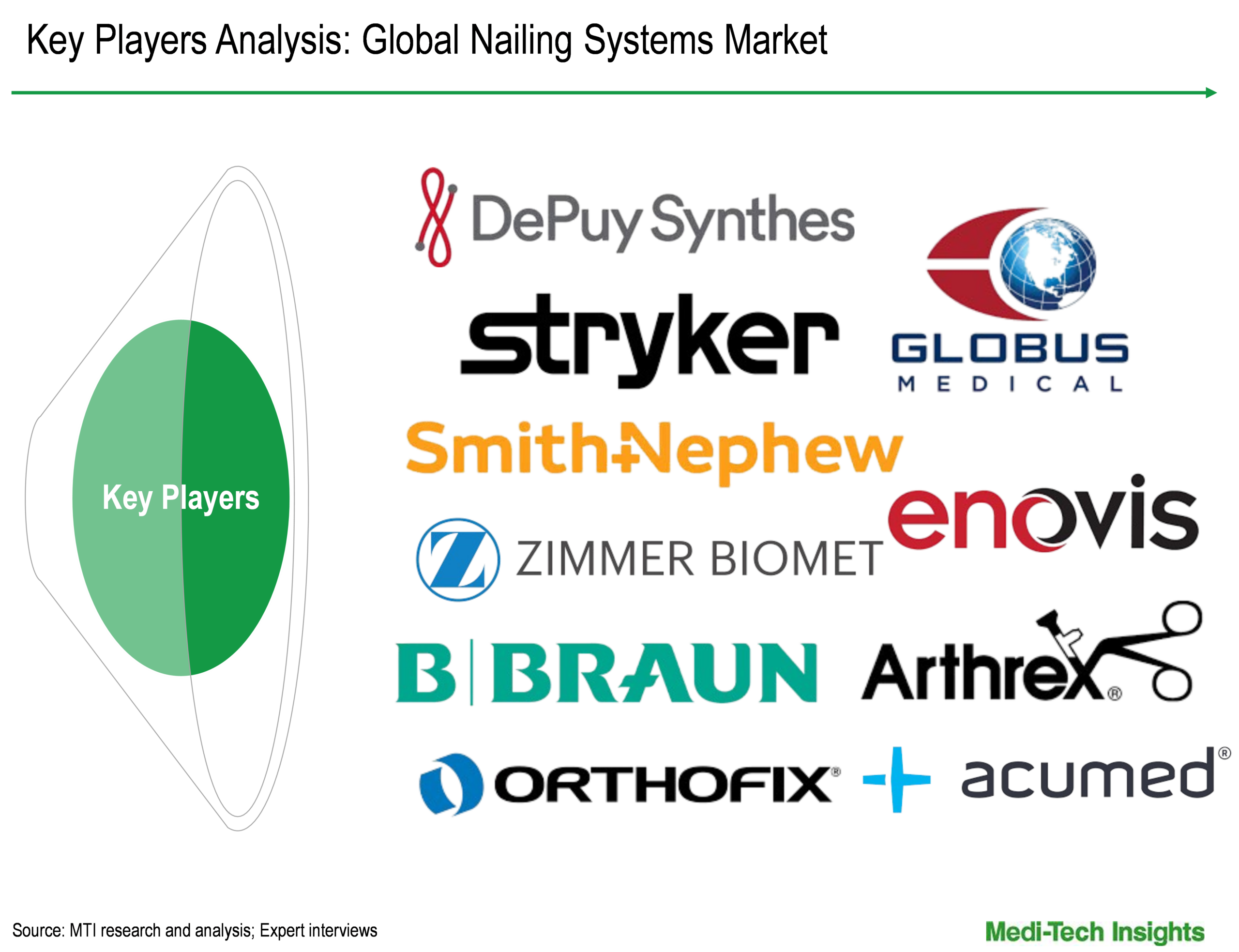
The global nailing systems market is marked by the presence of established and emerging market players such as Johnson & Johnson MedTech (DePuy Synthes)(US);"https://www.stryker.com/">Stryker Corporation(US); Zimmer Biomet(US); Smith & Nephew (UK)"https://orthofix.com/">Orthofix Medical Inc (US); Globus Medical (US); B. Braun Medical Inc. (Germany); Enovis (US); Arthrex, Inc. (US); and Acumed LLC (US) among others.
Get a sample report for competitive landscape analysis
Growth strategies adopted by players to establish their foothold in the market
Players operating in this market are adopting various growth strategies such as new product launches and approvals; acquisitions; expansions; and strategic partnerships, agreements, and collaborations, to garner market share. For instance,
- In February 2026, Zimmer Biomet announced the commercial launch of the Phantom Curved TTC Nail System, a next-generation solution engineered around the true circular arc of hindfoot anatomy, designed to provide fixation strength, alignment reproducibility, and soft-tissue preservation in tibiotalocalcaneal arthrodesis
- In February 2026, Stryker announced the launch of the T2 Alpha Humerus Nailing System, offering a streamlined approach to humeral fracture fixation, featuring SOMA-informed nail design, multiplanar screw fixation, and guided targeting to enhance anatomical fixation stability, and procedural efficiency
- In October 2025, Zimmer Biomet announced the commercial launch of the Phantom TTC Trauma Nail and the Gorilla Pilon System, expanding its foot and ankle trauma portfolio with solutions designed to enable surgeons to treat complex fractures and address challenging trauma cases with greater precision
- In June 2025, Smith+Nephew announced the launch of the TRIGEN MAX Tibia Nailing System, designed for stable and unstable tibial fractures, featuring side-specific nails for anatomic screw trajectories, modular instrumentation, and lag screw technology that enables fracture compression in a single insertion step to streamline surgical workflow
- In July 2024, Orthofix announced the 510(k) clearance and first US implant of the Fitbone Transport and Lengthening System, an intramedullary nail used to treat large bone defects in the femur and tibia due to trauma, infectious or malignant conditions, and designed to transport or lengthen the bone through a single surgery
Report Scope
|
Report Metric |
Details |
|
|
Base Year Considered |
2025 |
|
|
Historical Data |
2024 2025 |
|
|
Forecast Perioda |
2026 2031 |
|
|
Growth rate |
5% |
|
|
Segment Scope |
Product, Material, Application, and End User |
|
|
Regional Scope |
|
|
|
Market Drivers |
|
|
|
Attractive Opportunities |
|
|
|
Key Companies Mapped |
Johnson & Johnson MedTech (DePuy Synthes)(US);Stryker Corporation(US); Zimmer Biomet(US); Smith & Nephew (UK); Orthofix Medical Inc (US); Globus Medical (US); B. Braun Medical Inc. (Germany); Enovis (US); Arthrex, Inc. (US); and Acumed LLC (US), among others |
Market Size & Forecast, Growth Drivers & Restraints, Trends, Competitive Analysis |
Global Nailing Systems Market Segmentation
This report by Medi-Tech Insights provides thesize of the global nailing systems market at theregional- and country-level from 2024 to 2031. The report further segments the market based on product, material, application, and end user.
Market Size & Forecast (2024-2031), By Product, USD Billion
- Femoral Intramedullary Nails
- Tibial Intramedullary Nails
- Humeral Intramedullary Nails
- Others
Market Size & Forecast (2024-2031), By Material, USD Billion
- Stainless Steel
- Titanium
- Others
Market Size & Forecast (2024-2031), By Indication, USD Billion
- Femoral Fractures
- Tibial Fractures
- Humeral Fractures
- Hi>
- Others
Market Size & Forecast (2024-2031), By End User, USD Billion
- Hospitals
- Specialty Clinics
- Ambulatory Surgical Centers (ASCs)
- Others
Market Size & Forecast (2024-2031), By Region, USD Billion
- North America
- US
- Canada
- Europe
- UK
- Germany
- France
- Italy
- Spain
- Rest of Europe
- Asia Pacific
- China
- India
- Japan
- Rest of Asia Pacific
- Latin America
- Middle East & Africa
Need a More Tailored Analysis?
- Discuss the market sizing methodology and forecast assumptions with our healthcare analysts.
- Expand the scope with additional countries, market segments, technologies, or competitor profiling.
- Use the insights to support strategic planning, market entry, commercial due diligence, and long-term revenue growth initiatives.