Download FREE Sample


Report Overview
Optical imaging is a non-invasive imaging technique that uses light, typically in the visible, ultraviolet, or near-infrared spectrum, to capture detailed images of tissues, cells, and organs. It enables high-resolution visualization of both structural and functional aspects of biological tissues, making it valuable in medical diagnostics and research. Techniques such as optical coherence tomography (OCT), fluorescence imaging, and bioluminescence imaging are commonly used. Optical imaging is especially useful in ophthalmology, oncology, and dermatology among others due to its ability to provide real-time imaging without the risks associated with ionizing radiation, offering safer alternatives for frequent diagnostic monitoring.
To learn more about this report, download the PDF brochure
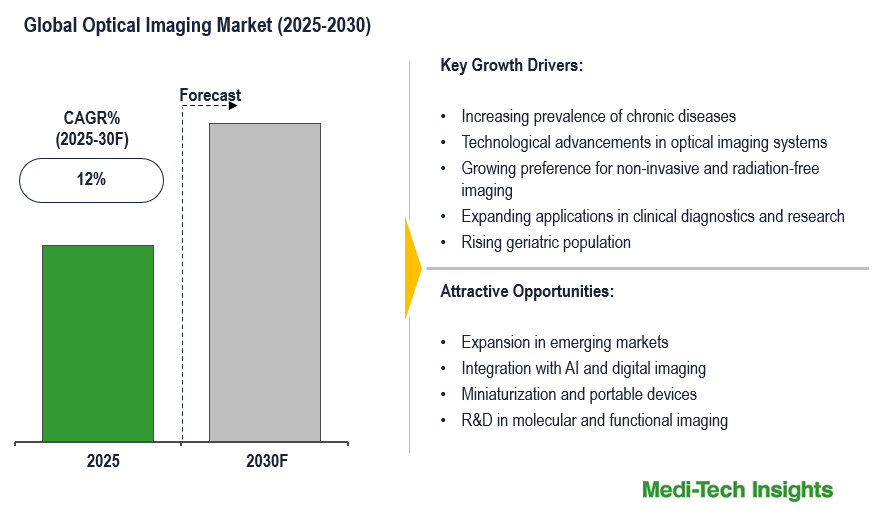
Increasing prevalence of chronic diseases to propel market demand
The increasing prevalence of chronic diseases such as cancer, cardiovascular disorders, and neurological conditions is a major driver of the optical imaging market. These diseases often require early and accurate diagnosis, continuous monitoring, and non-invasive imaging solutions, all of which optical imaging effectively provides. Optical imaging techniques offer high-resolution, real-time visualization, making them ideal for detecting pathological changes at early stages. As the global burden of chronic illnesses continues to rise due to aging populations and lifestyle factors, the demand for advanced diagnostic tools like optical imaging is growing, fueling investments and innovations in this field to improve clinical outcomes.
Technological advancements in optical imaging systems to drive market growth
Technological advancements in optical imaging systems are significantly driving market growth by improving imaging precision, speed, and diagnostic capabilities. Innovations such as optical coherence tomography (OCT), near-infrared spectroscopy (NIRS), and diffuse optical tomography (DOT) enable high-resolution, real-time visualization of tissues without radiation exposure. These technologies enhance early disease detection and monitoring, especially in ophthalmology, oncology, and cardiology. Additionally, integration with digital platforms and AI-based image analysis is streamlining workflows and boosting diagnostic accuracy. As these systems become more compact, user-friendly, and affordable, their adoption across hospitals, clinics, and research institutions is accelerating, fueling overall market expansion.
To learn more about this report, download the PDF brochure
Competitive Landscape Analysis
The global optical imaging market is marked by the presence of established and emerging market players such as Carl Zeiss Meditec AG, Abbott, Canon Medical Systems Corporation, Topcon Corporation, PerkinElmer Inc., Koninklijke Philips N.V., Agfa-Gevaert Group, Hamamatsu Photonics K.K., Headwall Photonics, Inc., and Heidelberg Engineering Inc.; among others. Some of the key strategies adopted by market players include new product development, strategic partnerships and collaborations, and geographic expansion.
Report Scope
| Report Metric | Details |
| Base Year Considered | 2024 |
| Historical Data | 2023 - 2024 |
| Forecast Period | 2025 - 2030 |
| Growth | 12% |
| Market Drivers |
|
| Attractive Opportunities |
|
| Segment Scope | Product, Technique, Application, Therapeutic Area, End User |
| Regional Scope |
|
| Key Companies Mapped | Carl Zeiss Meditec AG, Abbott, Canon Medical Systems Corporation, Topcon Corporation, PerkinElmer Inc., Koninklijke Philips N.V., Agfa-Gevaert Group, Hamamatsu Photonics K.K., Headwall Photonics, Inc., and Heidelberg Engineering Inc. among others |
| Report Highlights | Market Size & Forecast, Growth Drivers & Restraints, Trends, Competitive Analysis |
Global Optical Imaging Market Segmentation
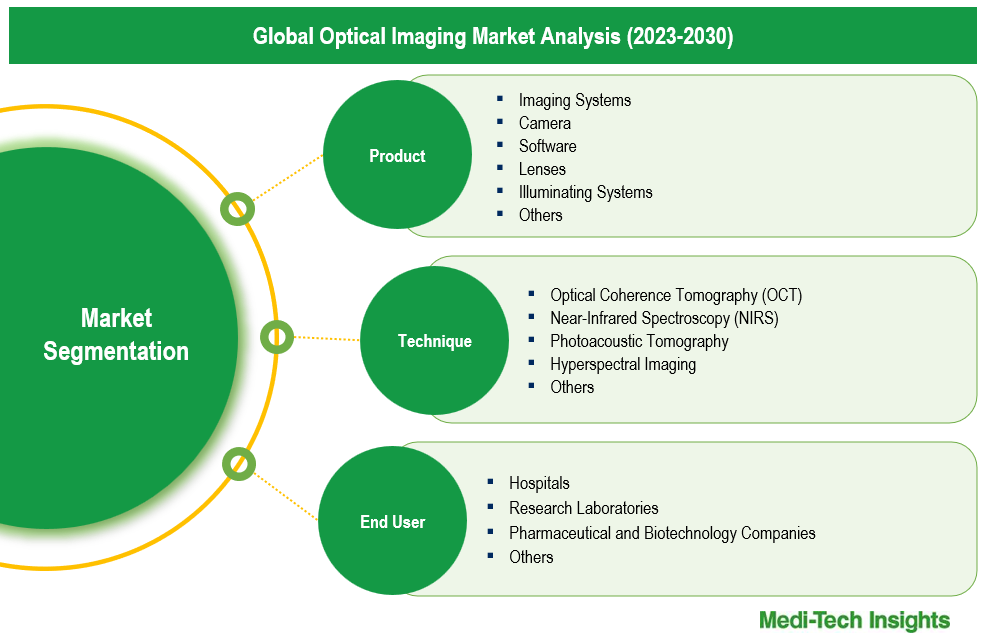
This report by Medi-Tech Insights provides thesize of the global optical imaging market at theregional- and country-level from 2023 to 2030. The report further segments the market based on product, technique, application, therapeutic area, end user.
Market Size & Forecast (2023-2030), By Product, USD Million
- Imaging Systems
- Camera
- Software
- Lenses
- Illuminating Systems
- Others
Market Size & Forecast (2023-2030), By Technique, USD Million
- Optical Coherence Tomography (OCT)
- Near-Infrared Spectroscopy (NIRS)
- Photoacoustic Tomography
- Hyperspectral Imaging
- Others
Market Size & Forecast (2023-2030), By Application, USD Million
- Pathololi>
- Intraoperative Imaging
Market Size & Forecast (2023-2030), By Therapeutic Area, USD Million
- Ophthalmology
- Oncology
- Cardiology
- Dermatology
- Neurology
- Others
Market Size & Forecast (2023-2030), By End User, USD Million
- Hospitals
- Research Laboratories
- Pharmaceutical and Biotechnology Companies
- Others
Market Size & Forecast (2023-2030), By Region, USD Million
- North America
- US
- Canada
- Europe
- UK
- Germany
- France
- Italy
- Spain
- Rest of Europe
- Asia Pacific
- China
- India
- Japan
- Rest of Asia Pacific
- Latin America
- Middle East & Africa
Need a More Tailored Analysis?
- Discuss the market sizing methodology and forecast assumptions with our healthcare analysts.
- Expand the scope with additional countries, market segments, technologies, or competitor profiling.
- Use the insights to support strategic planning, market entry, commercial due diligence, and long-term revenue growth initiatives.