Download FREE Sample


Overview
Prescription lenses refer to optical lenses designed to correct vision problems by adjusting the refraction of light to ensure it properly focuses on the retina. These lenses are prescribed by eye care professionals (Ophthalmologists and Optometrists) after a detailed eye test and are used to treat refractive errors. Prescription lenses play an important role in restoring clear vision and improving visual comfort for individuals with various vision problems. Some common types of prescription lenses include Single Vision Lenses, Bifocal Lenses, Progressive Lenses, High-Index Lenses, Photochromic Lenses and Blue-Light Filtering Lenses. Overall, prescription lenses are essential tools for preventing further eye strain and long-term complications by providing targeted visual correction.

To learn more about this report, download the PDF brochure
Rising vision disorders fuel the demand for prescription lenses
A major factor driving demand for prescription lenses is the rising number of people with vision problems. Conditions such as myopia (nearsightedness), hyperopia/hypermetropia (farsightedness), and astigmatism are becoming more common globally. These refractive errors occur due to the prolonged use of digital devices like smartphones and computers, along with sedentary indoor lifestyles. The surge in screen time across all age groups has led to digital eye strain and the early onset of vision issues among young adults and children. For instance, an article published by the World Health Organization reported that 2.2billion people globally experience near or distant vision impairment, with at least 1billion cases being preventable or untreated. Refractive errors and cataracts remain the leading causes, highlighting a significant need for ace care and diagnostics.
With increasing awareness about eye health and preventive care, more people are opting for regular eye checkups, leading to a steady rise in the number of people being prescribed with corrective lenses. Organizations like Sightsavers are also active in many countries to help detect and treat refractive errors, especially in underserved communities. Also, in April 2025, the International Agency for the Prevention of Blindness (IAPB), in collaboration with 13 global health and education groups, issued a policy alert warning of a -growing crisis in children-s eye health' across Europe, linked to increased screen time and less outdoor activity. The coalition projected that up to 50% of European school dropouts could be myopic by 2035. As a result, rising cases of vision disorders are driving demand for prescription lenses, including customized and specialized types of lenses.
Prescription lenses with blue light protection gain
One of the most significant trends seen in the prescription lens market is the growing preference for blue light filtering and digital eye strain protection. As digital devices have become an indispensable part of our daily lives, including work, education, and entertainment, people are spending more time in front of screens. The prolonged exposure to screens that emit blue light is leading to the increased number of issues like dry eyes, headaches, and blurred vision.
Blue light, when absorbed in excess, results in visual fatigue and may disrupt the circadian rhythms by suppressing melatonin production, affecting sleep and long-term eye health. To address this growing concern, lens manufacturers are now offering prescription lenses with integrated blue light filters. These lenses filter out a significant amount of harmful blue light emitted by digital screens. Some lenses also come with anti-reflective coatings and UV protection, which further enhances the visual comfort and reduces glare. This innovation has gained popularity among working professionals, students, and children, who spend more time on digital devices. Especially, post-pandemic lifestyle changes like remote work and online learning have increased screen time for all age groups. Additionally, people are now opting for prescription lenses that combine both vision correction and blue light protection in a single product. For Instance,
- In January 2025, ZEISS Vision Care launched four new prescription sun lens tints paired with DuraVision Gold UV coatings, blending style with strong UV and glare protection
- In March 2024, Transitions Optical introduced its GEN-S light-adaptive lenses, which block 100% of UVA and UVB rays, filter up to 32% of blue-violet light indoors and up to 85% when darkened, providing fast-switching photochromic performance
To learn more about this report, download the PDF brochure
Competitive Landscape Analysis
The global prescription lens market comprises of several well-established and emerging players, including EssilorLuxottica; Carl Zeiss AG; Rodenstock GmbH; Seiko Optical Products Co. Ltd.; Shamir Optical Industry Ltd.; Vision Ease (HOYA Corporation); Corning Incorporated; Tokai Optical Co., Ltd.; Prive Revaux and Vision Rx Lab; among others. Key strategies adopted by these players include the development of advanced lens technologies (such as blue light filtering and photochromic lenses), mergers and acquisitions, and investment in R&D to enhance vision correction solutions and meet growing global demand.
Report Scope
| Report Metric | Details |
| Base Year Considered | 2024 |
| Historical Data | 2023 - 2024 |
| Forecast Period | 2025 - 2030 |
| Growth rate | 5% |
| Market Drivers |
|
| Attractive Opportunities |
|
| Segment Scope | Lens Type, Lens Coating, and Application |
| Regional Scope |
|
| Key Companies Mapped | EssilorLuxottica; Carl Zeiss AG; Rodenstock GmbH; Seiko Optical Products Co. Ltd.; Shamir Optical Industry Ltd.; Vision Ease (HOYA Corporation); Corning Incorporated; Tokai Optical Co., Ltd.; Prive Revaux and Vision Rx Lab; among others |
| Report Highlights | Market Size & Forecast, Growth Drivers & Restraints, Trends, Competitive Analysis |
Global Prescription Lens Market Segmentation
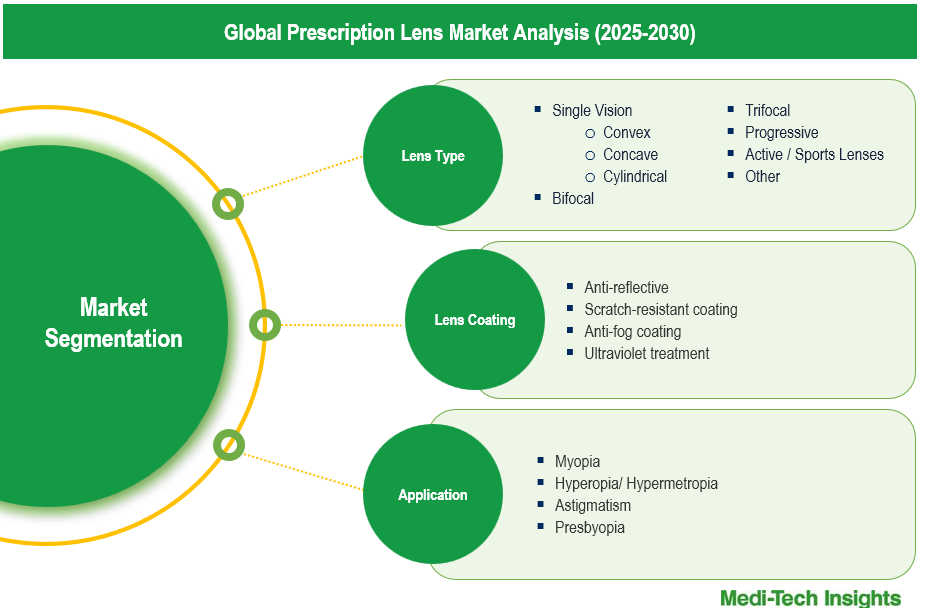
This report by Medi-Tech Insights provides thesize of the global prescription lens market at theregional- and country-level from 2023 to 2030. The report further segments the market based on lens type, lens coating, and application.
Market Size & Forecast (2023-2030), By Lens Type, USD Million
"list-style-type: none">- Single Vision
- Convex
- Concave
- Cylindrical
- Bifocal
- Trifocal
- Progressive
- Active / Sports Lenses
- Others
Market Size & Forecast (2023-2030), By Lens Coating, USD Million
-
- Anti-reflective
- Scratch-resistant coating
- Anti-fog coating
- Ultraviolet treatment
Market Size & Forecast (2023-2030), By Application, USD Million
-
- Myopia
- Hyperopia/ Hypermetropia
- Astigmatism
- Presbyopia
Market Size & Forecast (2023-2030), By Region, USD Million
- North America
- US
- Canada
- Europe
- UK
- Germany
- France
- Italy
- Spain
- Rest of Europe
- Asia Pacific
- China
- India
- Japan
- Rest of Asia Pacific
- Latin America
- Middle East & Africa
Need a More Tailored Analysis?
- Discuss the market sizing methodology and forecast assumptions with our healthcare analysts.
- Expand the scope with additional countries, market segments, technologies, or competitor profiling.
- Use the insights to support strategic planning, market entry, commercial due diligence, and long-term revenue growth initiatives.