Download FREE Sample


Report Overview
Urology ultrasound devices are advanced imaging tools designed to evaluate and diagnose conditions affecting the urinary tract and male reproductive organs. These devices utilize high-frequency sound waves to produce real-time images of the kidneys, bladder, ureters, and prostate gland, aiding in the assessment of conditions such as kidney stones, prostate cancer, and bladder dysfunctions. Modern urology ultrasound systems incorporate microbubble contrast agents for enhanced lesion detection and high-frequency transrectal probes for more detailed prostate imaging. These innovations, along with the increasing use of automated 3D volumetric imaging, are enhancing diagnostic accuracy and improving clinical outcomes.
To learn more about this report, download the PDF brochure
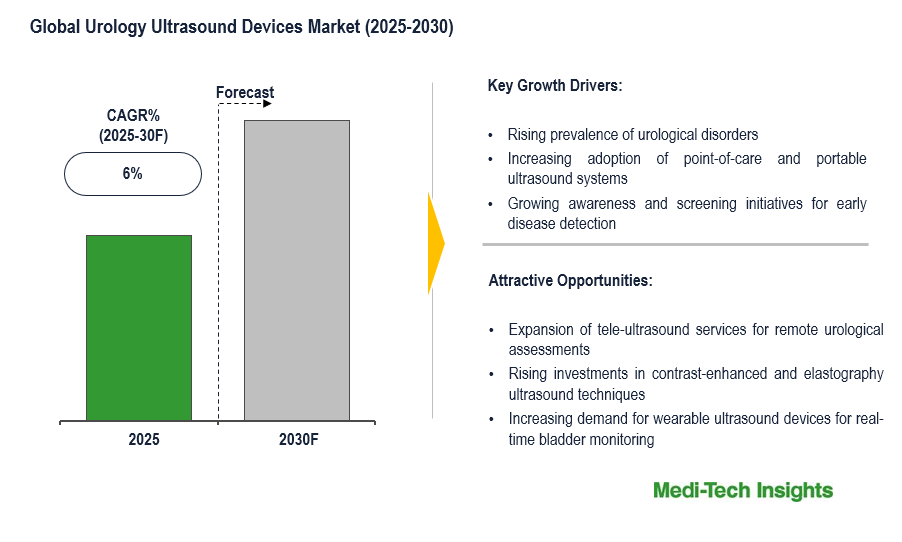
Increasing Prevalence of Urological Disorders Driving Demand
The increasing prevalence of urological diseases is a key factor driving demand for urology ultrasound devices. Conditions such as kidney disorders, prostate cancer, and bladder dysfunctions are becoming more common due to aging populations, sedentary lifestyles, and rising incidences of diabetes and hypertension. Among these, benign prostatic hyperplasia (BPH) and chronic kidney disease (CKD) are particularly widespread among older adults, highlighting the need for effective diagnostic tools. Early detection is essential for managing these conditions, and ultrasound has become a primary imaging modality due to its ability to provide detailed, real-time visualisation without radiation exposure. Additionally, growing awareness about urological health encourages more individuals to undergo routine screenings, further increasing ultrasound adoption. Compared to CT scans and MRIs, ultrasound offers a safer, more cost-effective, and non-invasive alternative, making it a preferred choice in hospitals, diagnostic centers, and outpatient clinics for rapid and accurate urological assessments.
Technological Advancements Enhancing Market Growth
Advancements in ultrasound technology are significantly transforming urological diagnostics, improving accuracy and accessibility. AI-powered ultrasound systems are enhancing image analysis, reducing diagnostic errors, and aiding in the early detection of conditions like prostate cancer and bladder tumors. Additionally, the rise of handheld and portable ultrasound devices has expanded point-of-care imaging, particularly benefiting remote and resource-limited areas. Wearable ultrasound technology is also emerging as a breakthrough, enabling continuous monitoring of urological parameters such as bladder volume. These flexible, real-time monitoring systems improve patient comfort, optimize clinical workflows, and reduce the need for frequent hospital visits. Meanwhile, 3D and 4D imaging provide enhanced anatomical visualization for complex evaluations, while contrast-enhanced ultrasound (CEUS) offers improved differentiation of soft tissue abnormalities. These innovations, combined with growing investments in ultrasound research, are driving market growth by making diagnostics more efficient, patient-friendly, and widely accessible across various healthcare settings.
To learn more about this report, download the PDF brochure
Competitive Landscape Analysis
The global urology ultrasound devices market is marked by the presence of established and emerging market players such as Koninklijke Philips N.V.; GE Healthcare; Siemens Healthineers AG; Esaote; Canon Medical Systems; Samsung Medison Co., Ltd.; FUJIFILM SonoSite, Inc.; Mindray Medical International Limited and Konica Minolta Inc. among others. Some of the key strategies adopted by market players include new product development, strategic partnerships and collaborations, and geographic expansion.
Report Scope
| Report Metric | Details |
| Base Year Considered | 2024 |
| Historical Data | 2023 - 2024 |
| Forecast Period | 2025 - 2030 |
| Growth | 6% |
| Market Drivers |
Technological advancements in ultrasound imaging |
| Attractive Opportunities |
|
| Segment Scope | Type, Application, Disease, and End-user |
| Regional Scope |
|
| Key Companies Mapped | Koninklijke Philips N.V.; GE Healthcare; Siemens Healthineers AG; Esaote; Canon Medical Systems; Samsung Medison Co., Ltd.; FUJIFILM SonoSite, Inc.; Mindray Medical International Limited and Konica Minolta Inc among others |
| Report Highlights | Market Size & Forecast, Growth Drivers & Restraints, Trends, Competitive Analysis |
Global Urology Ultrasound Devices Market Segmentation
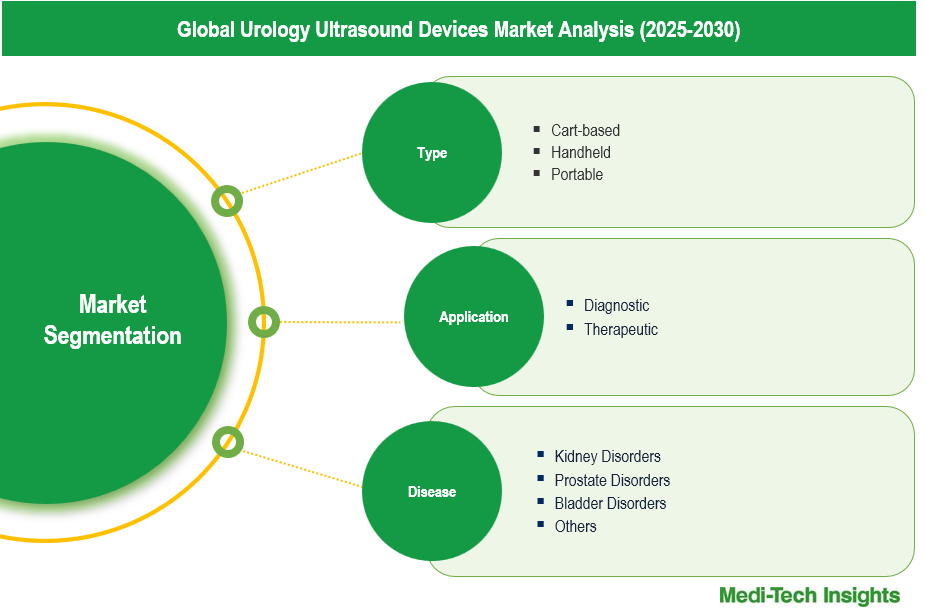
This report by Medi-Tech Insights provides thesize of the global urology ultrasound devices market at theregional- and country-level from 2023 to 2030. The report further segments the market based on type, application, disease, and end-user.
Market Size & Forecast (2023-2030), By Type, USD Million
- Cart-based
- Handheld
- Portable
Market Size & Forecast (2023-2030), By Application, USD Million
- Diagnostic
- Therapeutic
Market Size & Forecast (2023-2030), By Disease, USD Million
- Kidney Disorders
- Prostate Disorders
- Bladder Disorders
- Others
Market Size & Forecast (2023-2030), By End-user, USD Million
- Hospitals
- cs
- Diagnostic Centers
- Others
Market Size & Forecast (2023-2030), By Region, USD Million
- North America
- US
- Canada
- Europe
- UK
- Germany
- France
- Italy
- Spain
- Rest of Europe
- Asia Pacific
- China
- India
- Japan
- Rest of Asia Pacific
- Latin America
- Middle East & Africa
Key Strategic Questions Addressed
- What is the market size & forecast of the urology ultrasound devices market?
- What are historical, present, and forecasted market shares and growth rates of various segments and sub-segments of the urology ultrasound devices market?
- What are the key trends defining the market?
- What are the major factors impacting the market?
- What are the opportunities prevailing in the market?
- Which region has the highest share in the global market? Which region is expected to witness the highest growth rate in the next 5 years?
- Who are the major players operating in the market?
- What are the key strategies adopted by players?
Need a More Tailored Analysis?
- Discuss the market sizing methodology and forecast assumptions with our healthcare analysts.
- Expand the scope with additional countries, market segments, technologies, or competitor profiling.
- Use the insights to support strategic planning, market entry, commercial due diligence, and long-term revenue growth initiatives.