Download FREE Sample


3D bioprinting is an advanced technology that creates complex, tissue-like structures by layering bio-compatible materials, such as cells and biomolecules, using specialized 3D printers. It employs bioinks, a blend of living cells and supportive materials, to build structures that mimic natural tissues, including skin, bone, and organ models. This method allows for precision in arranging cells in patterns that closely replicate natural anatomy and function. 3D bioprinting has applications in regenerative medicine, drug testing, and disease modeling, as it enables personalized, patient-specific tissue development, reduces the need for animal testing, and offers potential for future organ transplants and custom therapies.
To learn more about this report, download the PDF brochure
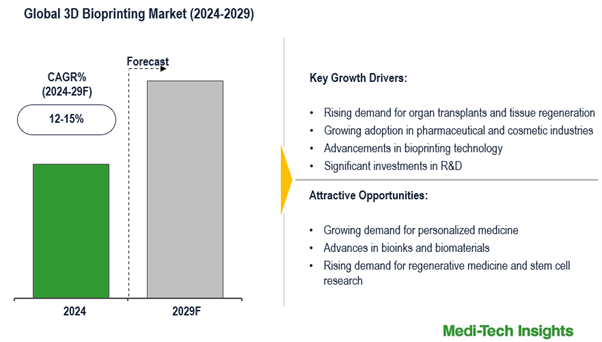
Growing adoption in pharmaceutical and cosmetic industries to propel market demand
The pharmaceutical and cosmetic industries are increasingly adopting 3D bioprinting to enhance product testing and development, driving market growth. In pharmaceuticals, 3D bioprinted tissues enable more accurate drug testing, reducing reliance on animal models and improving predictions of human responses, which accelerates drug discovery and lowers costs. Similarly, cosmetics companies use bioprinted skin tissues for testing, supporting ethical practices by minimizing animal testing while ensuring product safety. This adoption not only supports regulatory compliance but also aligns with consumer demand for cruelty-free products, fostering innovation and investment in bioprinting technologies across both industries.
Advancements in bioprinting technology is driving the market growth
Advancements in bioprinting technology, such as enhanced bioinks, improved printer precision, and faster printing speeds, are significantly driving market growth. Innovations allow for the creation of more complex and functional tissues, making 3D bioprinting viable for broader applications in regenerative medicine, drug testing, and tissue engineering. Improved bioprinters can now accurately replicate the intricate structures of human tissues, including vascularized systems, which enhances tissue viability and functionality. These technological leaps not only expand the potential for creating fully functional, biocompatible tissues but also attract greater investment and research, accelerating the commercialization of bioprinted products across healthcare sectors.
To learn more about this report, download the PDF brochure
Competitive Landscape Analysis
The global 3D bioprinting market is marked by the presence of established and emerging market players such as 3D Systems, Inc., Merck KGaA, Organovo Holdings Inc., CollPlant Biotechnologies Ltd., Envisiontec US LLC, Poietis, Aspect Biosystems Ltd., Advanced Solutions Life Sciences, LLC, Brinter, and Inventia Life Science Pty Ltd among others. Some of the key strategies adopted by market players include new product development, strategic partnerships and collaborations, and geographic expansion.
Report Scope
| Report Scope | Details |
| Base Year Considered | 2023 |
| Historical Data | 2022 - 2023 |
| Forecast Period | 2024 - 2029 |
| Growth Rate | CAGR of 12-15% |
| Market Drivers |
|
| Attractive Opportunities |
|
| Segment Scope | Product, Application, End User |
| Regional Scope |
|
| Key Companies Mapped | 3D Systems, Inc., Merck KGaA, Organovo Holdings Inc., CollPlant Biotechnologies Ltd., Envisiontec US LLC, Poietis, Aspect Biosystems Ltd., Advanced Solutions Life Sciences, LLC, Brinter, and Inventia Life Science Pty Ltd. among others |
| Report Highlights | Market Size & Forecast, Growth Drivers & Restraints, Trends, Competitive Analysis |
Market Segmentation
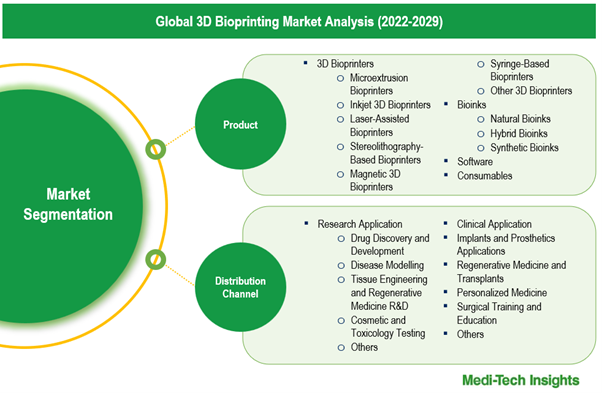
This report by Medi-Tech Insights provides thesize of the global 3D bioprinting market at theregional- and country-level from 2022 to 2029. The report further segments the market based on product, application, and end user.
- Market Size & Forecast (2022-2029), By Product, USD Million
- 3D Bioprinters
- Microextrusion Bioprinters
- Inkjet 3D Bioprinters
- Laser-Assisted Bioprinters
- Stereolithography-Based Bioprinters
- Magnetic 3D Bioprinters
- Syringe-Based Bioprinters
- Other 3D Bioprinters
- Bioinks
- Natural Bioinks
- Hybrid Bioinks
- Synthetic Bioinks
- Software
- Consumables
- 3D Bioprinters
- Market Size & Forecast (2022-2029), By Application, USD Million
- Research Application
- Drug Discovery and Development
- Disease Modelling
- Tisering and Regenerative Medicine R&D
- Cosmetic and Toxicology Testing
- Others
- Clinical Application
- Implants and Prosthetics
- Bone and Cartilage
- Dental Applications
- Regenerative Medicine and Transplants
- Skin Grafts
- Organ Regeneration
- Personalized Medicine
- Patient-Specific Models
- Bioprinted Drug Delivery Systems
- Surgical Training and Education
- Others
- Implants and Prosthetics
- Market Size & Forecast (2022-2029), By End User, USD Million
- Academic and Research Institutions
- Pharmaceutical and Biotechnology Companies
- Others
- Market Size & Forecast (2022-2029), By Region, USD Million
- North America
- US
- Canada
- Europe
- UK
- Germany
- France
- Italy
- Spain
- Rest of Europe
- Asia Pacific
- China
- India
- Japan
- Rest of Asia Pacific
- Latin America
- Middle East & Africa
- North America
- Research Application
Frequently Asked Questions About This Report
What is the market size & forecast of the 3D bioprinting market?
What are historical, present, and forecasted market shares and growth rates of various segments and sub-segments of the 3D bioprinting market?
What are the key trends defining the market?
What are the major factors impacting the market?
What are the opportunities prevailing in the market?
Need a More Tailored Analysis?
- Discuss the market sizing methodology and forecast assumptions with our healthcare analysts.
- Expand the scope with additional countries, market segments, technologies, or competitor profiling.
- Use the insights to support strategic planning, market entry, commercial due diligence, and long-term revenue growth initiatives.