Download FREE Sample


Report Overview
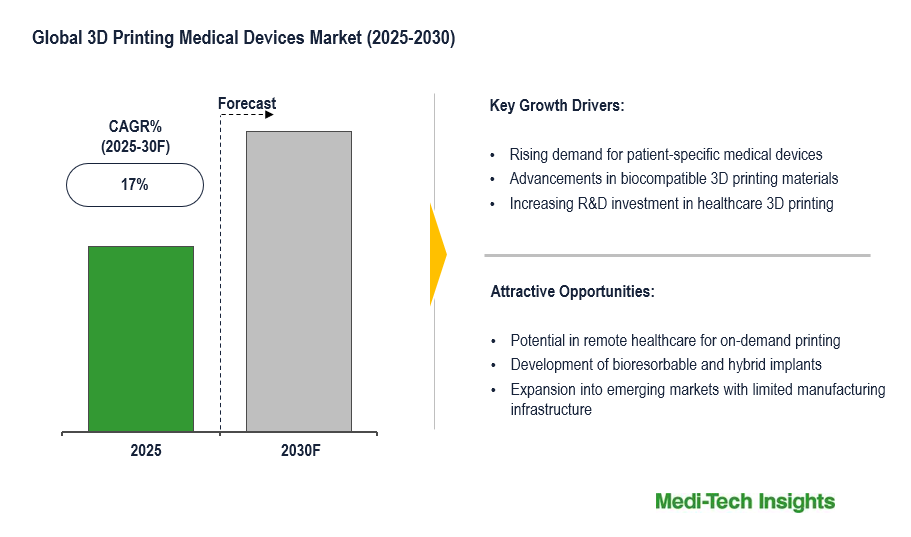
3D printing medical devices is the process in which customized prosthetics, surgical instruments, implants and other healthcare tools are made using additive manufacturing technology. The method entails layering of materials such as metals, ceramics or polymers based on a digital 3D model to build the final product with high precision. This process will enhance the production of devices, customized/tailored as per individual anatomical requirements, thereby improving the overall patient outcomes. The method not only enhances the surgical planning but also reduces operation time, and thereby facilitating the rapid production of complex structures which were difficult to achieve with traditional manufacturing.
To learn more about this report, download the PDF brochure
Rising demand for personalized healthcare solutions to drive market growth
The growing demand for personalized healthcare solutions is one of the key factors propelling the growth of the 3D printing medical devices market. Further, the rising prevalence of chronic disease, the aging population, and the widespread adoption of customised treatments among patients and healthcare professionals to meet each patient's unique anatomical and physiological demand has made 3D printing an attractive and scalable solution for modern healthcare systems.
Unlike traditional methods, 3D printing has enabled the faster fabrication of surgical instruments, implants, and prosthetics as per patient-specific images/ scans, enhancing patient comfort, clinical outcomes and lowering the risk of issues or device rejection. Additionally, the process allows quick surgical planning and shorter lead times, which is especially advantageous for trauma and reconstructive surgeries. For instance, in February 2025, the Stratasys Direct facility in Tucson, Arizona has received ISO 13485 certification, meeting key regulatory standards for medical device manufacturing. This certification enhances the credibility of its 3D-printed components, supporting scalable production and improved patient outcomes
Technological advancements such as multi-material 3d printing to fuel market demand
Multi-material 3D printing is a new technology, advancing the field of 3D printed medical devices, which allows the simultaneous use of different materials in a single process. This is essential for creating devices that require rigid and flexible components or need to replicate the intricate characteristics of human tissues.
For instance, in September 2024, 3D Systems received clearance from the FDA for its multi-material, monolithic jetted denture solution, underscoring a regulatory milestone and providing enhanced aesth along with better patient outcomes. Additionally, it can directly incorporate antimicrobial coatings or drug-eluting characteristics into the device or implant, thereby improving its functionality. This breakthrough streamlines production and expands the applications of 3D printed medical devices, increasing their clinical value and efficiency.
To learn more about this report, download the PDF brochure
Competitive Landscape Analysis
The global 3D printing medical devices market is marked by the presence of established and emerging market players such as Stratasys Ltd.;EnvisionTEC;3D Systems, Inc.; Desktop Metal Inc.; Materialise;3T Additive Manufacturing Ltd.;GENERAL ELECTRIC COMPANY; Carbon, Inc.;Prodways Group;Organovo Holdings Inc.; EOS; CELLINK;and Formalabs; among others. Some of the key strategies adopted by market players include new product development, strategic partnerships and collaborations, and geographic expansion.
Report Scope
| Report Metric | Details |
| Base Year Considered | 2024 |
| Historical Data | 2023 - 2024 |
| Forecast period | 2025 - 2030 |
| Growth rate | 17% |
| Market Drivers |
|
| Attractive Opportunities |
|
| Segment Scope | Component, Technology, and Application |
| Regional Scope |
|
| Key Companies Mapped | Stratasys Ltd.; EnvisionTEC; 3D Systems, Inc.; Desktop Metal Inc.; Materialise; 3T Additive Manufacturing Ltd.; GENERAL ELECTRIC COMPANY; Carbon, Inc.; Prodways Group; Organovo Holdings Inc.; EOS; Renishaw plc; CELLINK; and Formalabs; among others |
| Report Highlights | Market Size & Forecast, Growth Drivers & Restraints, Trends, Competitive Analysis |
Global 3D Printing Medical Devices Market Segmentation
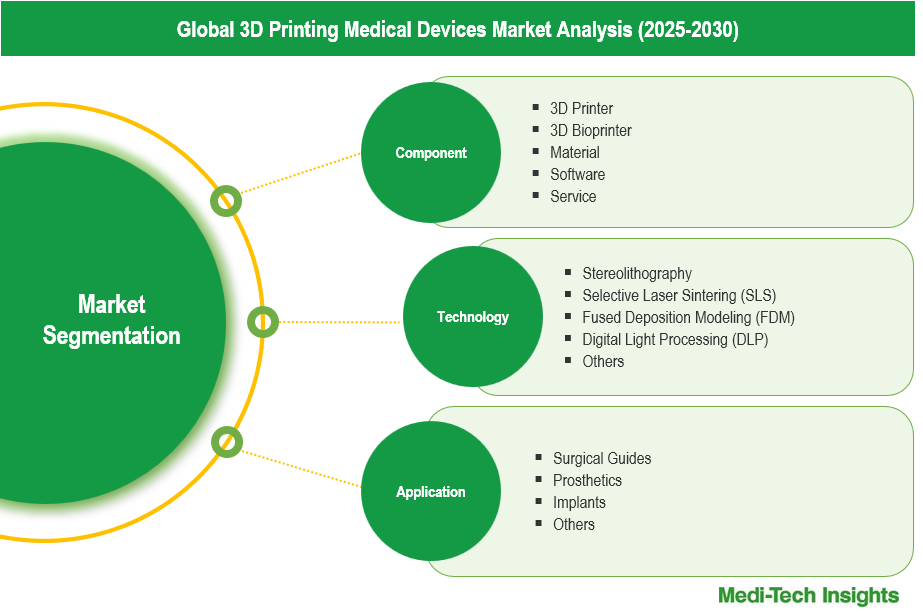
This report by Medi-Tech Insights provides thesize of the global 3D printing medical devices market at theregional- and country-level from 2023 to 2030. The report further segments the market based on component, technology, and application.
Market Size & Forecast (2023-2030), By Component, USD Million
- 3D Printer
- 3D Bioprinter
- Material
- Software
- Service
Market Size & Forecast (2023-2030), By Technology, USD Million
- Stereolithography
- Selective Laser Sintering (SLS)
- Fused Deposition Modeling (FDM)
- Digital Light Processing (DLP)
- Others
Market Size & Forecast (2023-2030), By Application, USD Million
- uides
- Prosthetics
- Implants
- Others
Market Size & Forecast (2023-2030), By Region, USD Million
- North America
- US
- Canada
- Europe
- UK
- Germany
- France
- Italy
- Spain
- Rest of Europe
- Asia Pacific
- China
- India
- Japan
- Rest of Asia Pacific
- Latin America
- Middle East & Africa
Need a More Tailored Analysis?
- Discuss the market sizing methodology and forecast assumptions with our healthcare analysts.
- Expand the scope with additional countries, market segments, technologies, or competitor profiling.
- Use the insights to support strategic planning, market entry, commercial due diligence, and long-term revenue growth initiatives.