Download FREE Sample


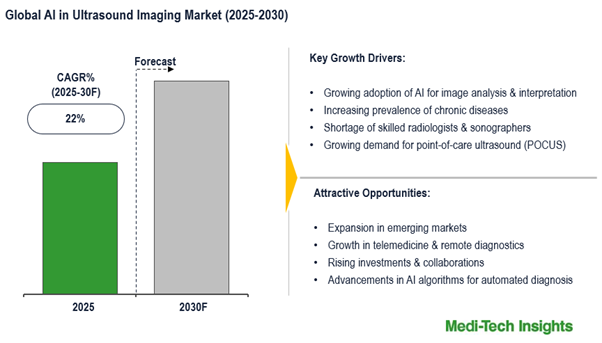
AI in ultrasound refers to the integration of artificial intelligence, including machine learning and deep learning, to enhance image acquisition, interpretation, and diagnostics. AI algorithms automate image segmentation, anomaly detection, and workflow optimization, improving accuracy and efficiency. It aids in real-time decision-making, reduces dependence on highly skilled radiologists, and enhances point-of-care applications. AI-powered ultrasound is widely used in cardiology, obstetrics, oncology, and musculoskeletal imaging. By integrating cloud and edge computing, AI enables remote diagnostics and telemedicine applications, making ultrasound more accessible and effective in diverse healthcare settings.
To learn more about the research report, download a sample report.
Growing adoption of AI for image analysis & interpretation to propel market demand
The growing adoption of AI for image analysis and interpretation is a major driver of the AI in ultrasound market. AI enhances image acquisition, automates segmentation, and improves anomaly detection, leading to faster and more accurate diagnoses. Deep learning algorithms reduce human errors and assist less experienced clinicians in making precise assessments. AI-powered ultrasound streamlines workflows, reducing scan time and improving efficiency in hospitals and clinics. Additionally, AI-driven real-time analysis supports early disease detection in cardiology, oncology, and obstetrics. As demand for improved diagnostic accuracy rises, AI-integrated ultrasound systems are increasingly adopted, fueling market growth.
To learn more about the research report, download a sample report.
Growing demand for point-of-care ultrasound (POCUS) is driving the market growth
The growing demand for point-of-care ultrasound (POCUS) is significantly driving the AI in ultrasound market. POCUS is widely used in emergency care, intensive care units, and remote settings for rapid, bedside diagnostics. AI enhances POCUS by automating image acquisition, interpretation, and anomaly detection, enabling faster and more accurate decision-making. AI-powered handheld ultrasound devices improve accessibility, especially in rural areas with limited radiologists. Additionally, AI-driven real-time guidance helps less-experienced clinicians perform scans with higher precision. As healthcare systems prioritize efficiency and accessibility, AI-integrated POCUS devices are increasingly adopted, boosting market growth and expanding ultrasound applications.
Competitive Landscape Analysis
The global AI in ultrasound imaging market is marked by the presence of established and emerging market players such as Koninklijke Philips N.V., Siemens Healthineers, GE Healthcare, Canon Medical Systems Corporation, Mindray Medical International Limited, Butterfly Network, Inc, Fujifilm Holdings, Ultrasound AI Inc., Clarius, and MedSol AI Solutions; among others. Some of the key strategies adopted by market players include new product development, strategic partnerships and collaborations, and geographic expansion.
Report Scope
|
Report Scope |
Details |
|
Base Year Considered |
2024 |
|
Historical Data |
2023 - 2024 |
|
Forecast Period |
2025 - 2030 |
|
Growth Rate |
22% |
|
Market Drivers |
|
|
Attractive Opportunities |
|
|
Segment Scope |
Product, Application, End User |
|
Regional Scope |
|
|
Key Companies Mapped |
Koninklijke Philips N.V., Siemens Healthineers, GE Healthcare, Canon Medical Systems Corporation, Mindray Medical International Limited, Butterfly Network, Inc, Fujifilm Holdings, Ultrasound AI Inc., Clarius, and MedSol AI Solutions among others |
|
Report Highlights |
Market Size & Forecast, Growth Drivers & Restraints, Trends, Competitive Analysis |
Market Segmentation
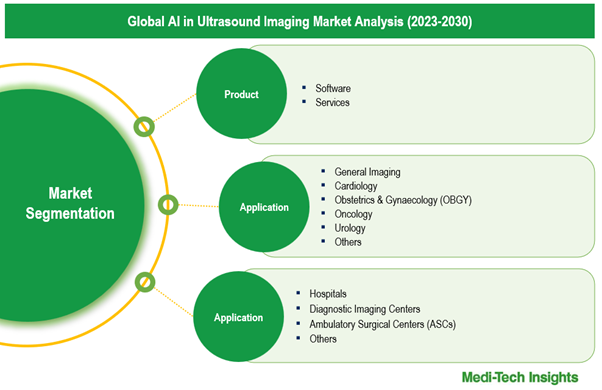
This report by Medi-Tech Insights provides thesize of the global AI in ultrasound imaging market at theregional- and country-level from 2023 to 2030. The report further segments the market based on product, application, end user.
- Market Size & Forecast (2023-2030), By Product, USD Million
- Software
- Service
- Market Size & Forecast (2023-2030), By Application, USD Million
- General imaging
- Cardiology
- Obstetrics & Gynaecology (OBGY)
- Oncology
- Urology
- Others
- Market Size & Forecast (2023-2030), By End User, USD Million
- Hospitals
- Diagnostic Imaging Centers
- Ambulatory Surgical Centers (ASCs)
- Others
- Market Size & Forecast (2023-2030), By Region, USD Million
- North America
- US
- Canada
- Europe
- UK
- Germany
- France
- Italy
- Spain
- Rest of Europe
- Asia Pacific
- China
- India
- Japan
- Rest of Asia Pacific
- Latin America
- Middle East & Africa
Key Strategic Questions Addressed
- What is the market size & forecast of the AI in ultrasound imaging market?
- What are historical, present, and forecasted market shares and growth rates of various segments and sub-segments of the AI in ultrasound imaging market?
- What are the key trends defining the market?
- What are the major factors impacting the market?
- What are the opportunities prevailing in the market?
- Which region has the highest share in the global market? Which region is expected to witness the highest growth rate in the next 5 years?
- Who are the major players operating in the market?
- What are the key strategies adopted by players?
- North America
Need a More Tailored Analysis?
- Discuss the market sizing methodology and forecast assumptions with our healthcare analysts.
- Expand the scope with additional countries, market segments, technologies, or competitor profiling.
- Use the insights to support strategic planning, market entry, commercial due diligence, and long-term revenue growth initiatives.