Download FREE Sample


Report Overview
Analytical and scientific instruments are a broad category of devices and systems used to measure, analyze, and quantify physical, biological, and chemical properties. These instruments are crucial to fields including environmental science, biotechnology, medicine, and food safety because they enable precise data collection and validation. Scientists can use techniques like chromatography, spectroscopy, and electrophoresis to discover pollutants, assess the composition of materials, and produce new products. Their importance goes beyond making sure safety regulations are followed, increasing the effectiveness of R&D, and raising the calibre of scientific findings.
To learn more about this report, download the PDF brochure
Rising Demand for Precision in Pharmaceutical and Biotech R&D
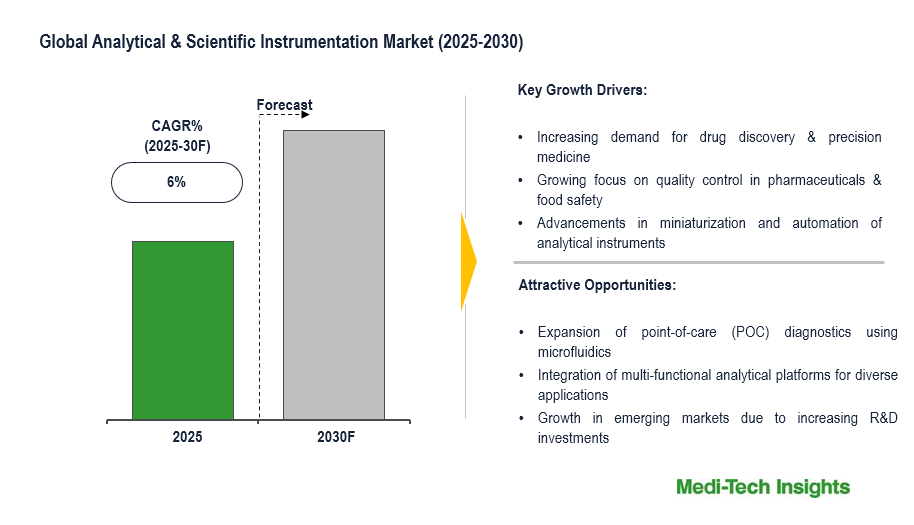
The analytical and scientific equipment market growth is driven by the rising demand for drug discovery & development, precision medicine, and quality control, and to meet these needs, laboratories and research institutes require more advanced and reliable tools. For example, techniques like mass spectrometry & chromatography are crucial in pharmacokinetics and biomarker investigations to make sure that drug formulations meet safety and efficacy standards. Additionally, the regulatory push for stricter validation and compliance has necessitated the use of more sophisticated analytical techniques. Furthermore, companies are investing heavily in high-throughput screening techniques in an attempt to expedite drug development, which is driving increased demand for advanced tools. Also, due to the growing demand for biosimilars and complex biologics, there is an increasing need for specialized analytical tools for their structural characterization and stability testing. This is trending in personalized medicine, where analytical and scientific instruments are significant for genetic and molecular profiling, further propelling the market growth.
Advancements in Microfluidics for High-Throughput Analysis
The adoption of microfluidics in analytical and scientific instruments has improved accuracy and efficiency in various applications. The key benefit of microfluidics is its capacity to combine several analytical processes, such as sample preparation, reaction, and detection, onto an automated platform, which reduces human error and boosts throughput. Microfluidics has reduced analysis times while increasing sensitivity and repeatability in clinical diagnostics, pharmaceutical research and development, and other medical fields. With the use of microchannels, this technology has made it possible to manipulate small fluid volumes, enabling quick chemical and biological tests with minimal use of reagents. Additionally, there is a growing adoption of microfluidic-based lab-on-a-chip devices in POC diagnostics as they provide cost-effective and compact real-time analysis options. All these developments have streamlined intricate processes, encouraging downsizing trends and creating highly accurate scientific and analytical tools.
To learn more about this report, download the PDF brochure
Competitive Landscape Analysis
The global analytical and scientific instrumentation market is marked by the presence of established and emerging market players such as Thermo Fisher Scientific, Inc.; Shimadzu Corp.; Danaher Corp.; Agilent Technologies, Inc.; PerkinElmer, Inc.; Mettler Toledo; Bio-Rad Laboratories, Inc.; Illumina, Inc.; Eppendorf SE; F. Hoffmann-La Roche AG; Sartorius AG; Waters Corp.; and Avantor, Inc among others. Some of the key strategies adopted by market players include new product development, strategic partnerships and collaborations, and geographic expansion.
Report Scope
| Report Metric | Details |
| Base Year Considered | 2024 |
| Historical Data | 2023 - 2024 |
| Forecast Period | 2025 - 2030 |
| Growth | 6% |
| Market Drivers |
|
| Attractive Opportunities |
|
| Segment Scope | Product Type, Technology, and End-user |
| Regional Scope |
|
| Key Companies Mapped | Thermo Fisher Scientific, Inc.; Shimadzu Corp.; Danaher Corp.; Agilent Technologies, Inc.; PerkinElmer, Inc.; Mettler Toledo; Bio-Rad Laboratories, Inc.; Illumina, Inc.; Eppendorf SE; F. Hoffmann-La Roche AG; Sartorius AG; Waters Corp.; and Avantor, Inc among others |
| Report Highlights | Market Size & Forecast, Growth Drivers & Restraints, Trends, Competitive Analysis |
Global Analytical and Scientific Instrumentation Market Segmentation
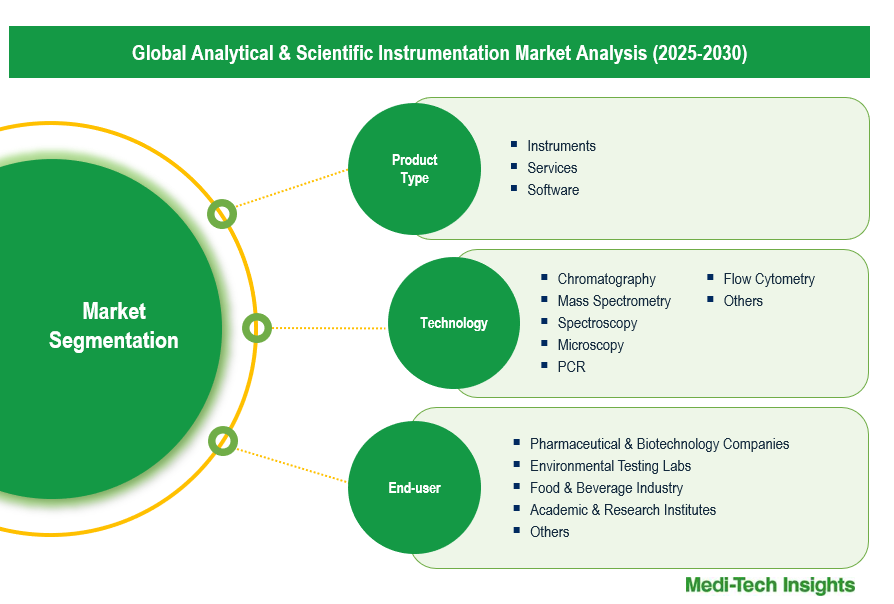
This report by Medi-Tech Insights provides thesize of the global analytical and scientific instrumentation market at theregional- and country-level from 2023 to 2030. The report further segments the market based on product type, technology and end-user.
Market Size & Forecast (2023-2030), By Product Type, USD Million
- Instruments
- Services
- Software
Market Size & Forecast (2023-2030), By Technology, USD Million
- Chromatography
- Mass Spectrometry
- Spectroscopy
- Microscopy
- PCR
- Flow Cytometry
- Others
Market Size & Forecast (2023-2030), By End-user, USD Million
- Pharmaceutical & Biotechnology Companies
- Environmental Testing Labs
- Food & Beverage Industry
- Academic & Research Institutes
- Others
Market Size & Forecast (2023-2030), By Region, USD Million
- North America
- US
- Canada
- Europe
- UK
- Germany
- France
- Italy
- Spain
- Rest of Europe
- Asia Pacific
- China
- India
- Japan
- Rest of Asia Pacific
- Latin America
- Middle East & Africa
Key Strategic Questions Addressed
- What is the market size & forecast of the analytical and scientific instrumentation market?
- What are the historical, present, and forecasted market shares and growth rates of various segments and sub-segments of the analytical and scientific instrumentation market?
- What are the key trends defining the market?
- What are the major factors impacting the market?
- What are the opportunities prevailing in the market?
- Which region has the highest share in the global market? Which region is expected to witness the highest growth rate in the next 5 years?
- Who are the major players operating in the market?
- What are the key strategies adopted by players?
Need a More Tailored Analysis?
- Discuss the market sizing methodology and forecast assumptions with our healthcare analysts.
- Expand the scope with additional countries, market segments, technologies, or competitor profiling.
- Use the insights to support strategic planning, market entry, commercial due diligence, and long-term revenue growth initiatives.