Download FREE Sample


Antibody-drug conjugates or ADCs are a novel class of highly potent biopharmaceuticals consisting of a monoclonal antibody chemically linked to a biologically active drug or cytotoxic compound. These targeted therapies harness the precise targeting capabilities of antibodies, enabling accurate differentiation between healthy and cancerous tissues, while delivering the cell-killing effects of cytotoxic agents. An ideal ADC has:
- A highly selective monoclonal antibody (mAb) for a tumor-associated antigen that has restricted or no expression on normal (healthy) cells
- A potent cytotoxic agent (generally a small molecule drug with high systemic toxicity) designed to induce target cell death after being internalized in the tumor cell and released
- A linker that is stable in circulation, but releases the cytotoxic agent in target cells
To learn more about this report, download the PDF brochure
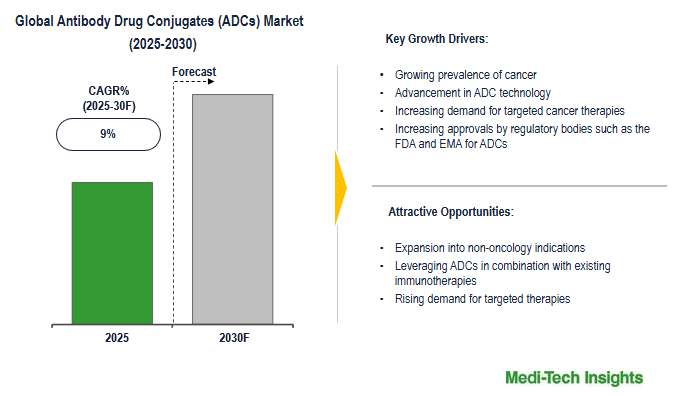
Growing prevalence of cancer is expected to drive market growth
Cancer remains one of the leading causes of death globally. According to GLOBOCAN 2024, in 2022, nearly 20 million new cancer cases were reported, alongside 9.7 million cancer-related deaths worldwide. Therapeutic approaches for treating cancer or tumors include chemotherapy, immunotherapy, radiation therapy, stem cell therapy, laser treatment, hyperthermia, surgery, and photodynamic therapy, among others. Among these, chemotherapy remains the primary treatment method.
However, antibody-drug conjugates (ADCs) are rapidly gaining attention due to their unique capability to combine targeted therapy with potent cytotoxic agents while leaving healthy cells unharmed. This innovative approach provides a promising solution for treating various types of cancers, including those resistant to conventional therapies. To date, 14 ADCs have received market approval for the treatment of different cancers, with over 200 currently undergoing clinical development. Further, ADCs are revolutionizing cancer treatment by offering a highly specific mechanism of action, delivering targeted and effective therapy, and bringing new hope to cancer patients worldwide.
Technological advancements in antibody-drug conjugate (ADC) technology to propel market growth
Continuous advancements in the design and development of antibody-drug conjugates (ADCs) have significantly improved their efficacy and safety, making them increasingly attractive as treatment options. These innovations span several critical areas, including antibody engineering, linker technology, cytotoxic payloads, and manufacturing processes.
One breakthrough is the adoption of site-specific conjugation techniques, which provide precise control over the drug-to-antibody ratio, enhancing the consistency and therapeutic performance of ADCs. Another key innovation is the development of novel linkers that respond to specific conditions, such as the low pH in the tumor microenvironment, enabling targeted drug release and reducing off-target toxicity. Additionally, advances in antibody engineering and selection have led to the creation of antibodies with enhanced binding specificity, affinity, and pharmacokinetics, further boosting the potency and effectiveness of ADCs. Improvements in manufacturing technologies, such as the integration of single-use systems, have addressed some of the production challenges, increasing efficiency and scalability. As research in ADCs continues to progress, even more sophisticated and effective technologies are expected to emerge, broadening the scope of their applications.
To learn more about this report, download the PDF brochure
Competitive Landscape Analysis
The global antibody drug conjugates (ADCs) market is marked by the presence of established and emerging market players such as Takeda Pharmaceutical Company Ltd.; AstraZeneca PLC; F. Hoffmann-La Roche Ltd.; Pfizer, Inc.; AbbVie-s; Gilead Sciences, Inc.; Merck & Co.; ADC Therapeutics SA; Bolt Biotherapeutics; Mersana Therapeutics; and Daiichi Sankyo Company Ltd.; among others. Some of the key strategies adopted by market players include new product development, strategic partnerships and collaborations, and investments.
Report Scope
| Report Metric | Details |
| Base Year Considered | 2024 |
| Historical Data | 2023 - 2024 |
| Forecast Period | 2025 - 2030 |
| Growth Rate | 9% |
| Market Drivers |
|
| Attractive Opportunities |
|
| Segment Scope | Product, Application, Target, and Technology |
| Regional Scope |
|
| Key Companies Mapped | Takeda Pharmaceutical Company Ltd.; AstraZeneca PLC; F. Hoffmann-La Roche Ltd.; Pfizer, Inc.; AbbVie-s; Gilead Sciences, Inc.; Merck & Co.; ADC Therapeutics SA; Bolt Biotherapeutics; Mersana Therapeutics; and Daiichi Sankyo Company Ltd. |
| Report Highlights | Market Size & Forecast, Growth Drivers & Restraints, Trends, Competitive Analysis |
Global Antibody Drug Conjugates (ADCs) Market Segmentation
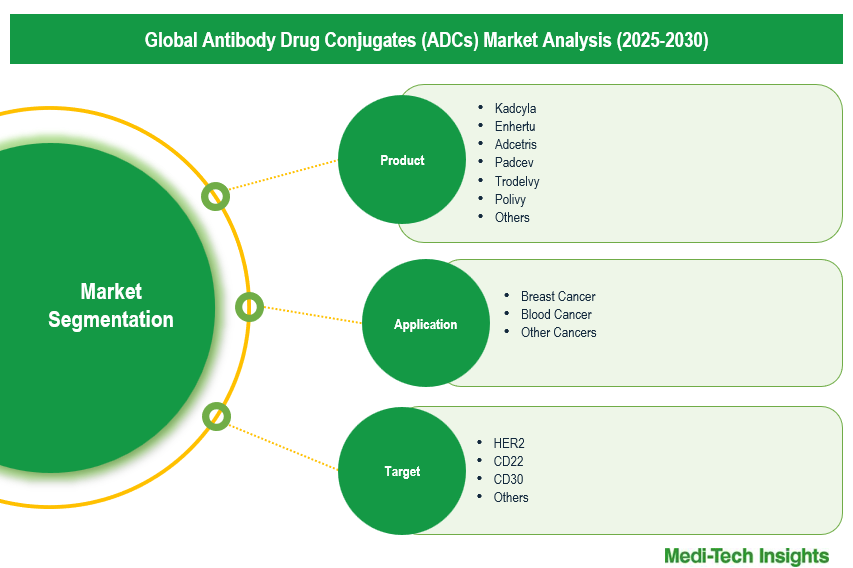
This report by Medi-Tech Insights provides thesize of the global antibody drug conjugates (ADCs) market at theregional- and country-level from 2023 to 2030. The report further segments the market based on product, application, target, and technology.
Market Size & Forecast (2023-2030), By Product, USD Million
- Kadcyla
- Enhertu
- Adcetris
- Padcev
- Trodelvy
- Polivy
- Others
Market Size & Forecast (2023-2030), By Application, USD Million
- Breast Cancer
- Blood Cancer
- Other Cancers
Market Size & Forecast (2023-2030), By Target, USD Million
- HER2
- CD22
- CD30
- Others
Market Size & Forecast (2023-2logy USD Million
- Linker Type
- Cleavable Linker
- Non-cleavable Linker
- Linker less
- Payload Technology
- MMAE/ Auristatin
- Maytansinoids
- Camptothecin
- Others
Market Size & Forecast (2023-2030), By Region, USD Million
- North America
- US
- Canada
- Europe
- UK
- Germany
- Italy
- Spain
- Rest of Europe
- Asia Pacific
- China
- India
- Japan
- Rest of Asia Pacific
- Latin America
- Middle East & Africa
Frequently Asked Questions About This Report
What is the market size & forecast of the antibody drug conjugates (ADCs) market?
What are the key trends defining the market?
What are the major factors impacting the market?
What are the opportunities prevailing in the market?
Which region has the highest share in the global market? Which region is expected to witness the highest growth rate in the next 5 years?
Need a More Tailored Analysis?
- Discuss the market sizing methodology and forecast assumptions with our healthcare analysts.
- Expand the scope with additional countries, market segments, technologies, or competitor profiling.
- Use the insights to support strategic planning, market entry, commercial due diligence, and long-term revenue growth initiatives.