Download FREE Sample


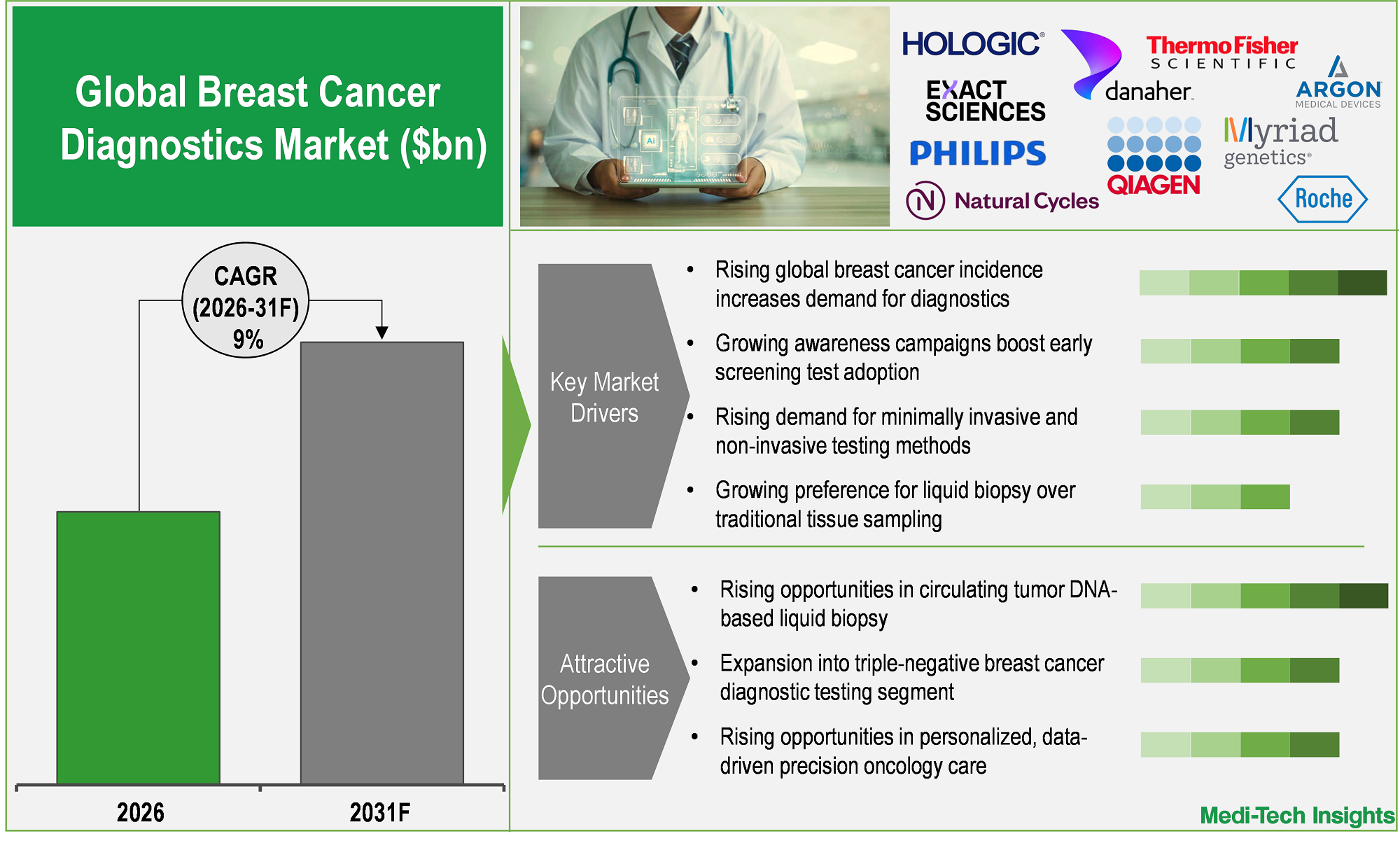
The global breast cancer diagnostic market size is set to grow at a CAGR of 9% over the next 5 years. Key drivers include the rising global breast cancer incidence, growing awareness campaigns boosting early screening test adoption, rising demand for minimally invasive and non-invasive testing methods, growing preference for liquid biopsy over traditional tissue sampling, and expansion of population-based mammography screening programs worldwide. However, factors such as limited clinical validation restricting confidence in novel biomarkers; high cost of advanced molecular diagnostic platforms; and heterogeneity of breast cancer subtypes complicating test validation, impact the market growth.
The breast cancer diagnostics market refers to the development, manufacturing, and use of medical devices, imaging systems, and laboratory-based tests designed to detect, confirm, and monitor breast cancer in patients. This encompasses technologies such as mammography, ultrasound (USG), magnetic resonance imaging (MRI), breast biopsy devices, immunohistochemistry, and molecular & genomic testing methods, including liquid biopsy and next-generation sequencing (NGS). These diagnostic tools enable healthcare professionals to identify abnormal breast tissue, determine tumor characteristics such as hormone receptor and genetic status, and assess disease progression to support accurate clinical decision-making. The market caters to hospitals, diagnostic imaging centers, and clinical laboratories, serving both women undergoing routine screening and patients requiring further confirmatory or monitoring tests, thereby playing a critical role in enabling timely diagnosis, guiding appropriate treatment pathways, and improving overall patient outcomes
Rising demand for minimally invasive and non-invasive testing methods to drive breast cancer diagnostics market
Growing patient preference for minimally
invasive and non-invasive testing methods
is significantly reshaping the breast cancer diagnostics market, as both
clinicians and patients increasingly favor approaches that reduce discomfort,
procedural risk, and recovery time compared to conventional tissue-based
biopsies. Traditional core-needle and surgical biopsies, while diagnostically
reliable, are often associated with patient anxiety, potential complications,
and longer turnaround times, prompting healthcare providers to adopt
alternatives such as vacuum-assisted biopsy devices, stereotactic
imaging-guided sampling, and blood-based liquid
biopsy technologies.
This trend is further supported by organizations such as the American Cancer Society, which continues to emphasize early and less burdensome detection methods to improve screening compliance among women. Non-invasive imaging modalities, including digital breast tomosynthesis and advanced ultrasound techniques, are also being adopted more widely as they offer improved lesion visualization while minimizing patient discomfort. Additionally, diagnostic companies such as Guardant Health and Hologic are investing in technologies that combine molecular precision with reduced procedural invasiveness, aligning with broader healthcare goals of enhancing patient compliance and satisfaction. As health systems worldwide prioritize patient-centric care models, the shift toward minimally invasive and non-invasive testing is expected to remain a key growth driver, supporting earlier diagnosis, better treatment planning, and improved long-term clinical outcomes across diverse patient populations.
Circulating tumor DNA-based liquid biopsy, key opportunity for market growth
Circulating
tumor DNA (ctDNA)-based liquid biopsy is emerging as a significant growth
opportunity within the breast cancer diagnostics market, offering a
non-invasive alternative to conventional tissue biopsy. By analyzing small DNA
fragments shed by tumor cells into the bloodstream, this technology enables
clinicians to detect genetic mutations, monitor treatment response, and
identify early signs of disease recurrence without repeated surgical sampling.
Organizations such as Guardant Health have advanced ctDNA-based assays that
support real-time, personalized treatment monitoring, reflecting the sector's
shift toward precision oncology.
Regulatory bodies, including the US FDA, have also acknowledged ctDNA as a valuable tool in supporting early-stage drug development and clinical decision-making, reinforcing confidence in its clinical utility. Additionally, rising demand for minimal residual disease monitoring, with reference laboratories expected to witness accelerated adoption in the coming years. As healthcare systems increasingly prioritize minimally invasive, real-time diagnostic solutions, ctDNA-based liquid biopsy is well-positioned to reduce dependency on traditional tissue-based testing, creating substantial revenue potential for diagnostic companies while enabling more timely, personalized, and effective breast cancer management strategies globally.
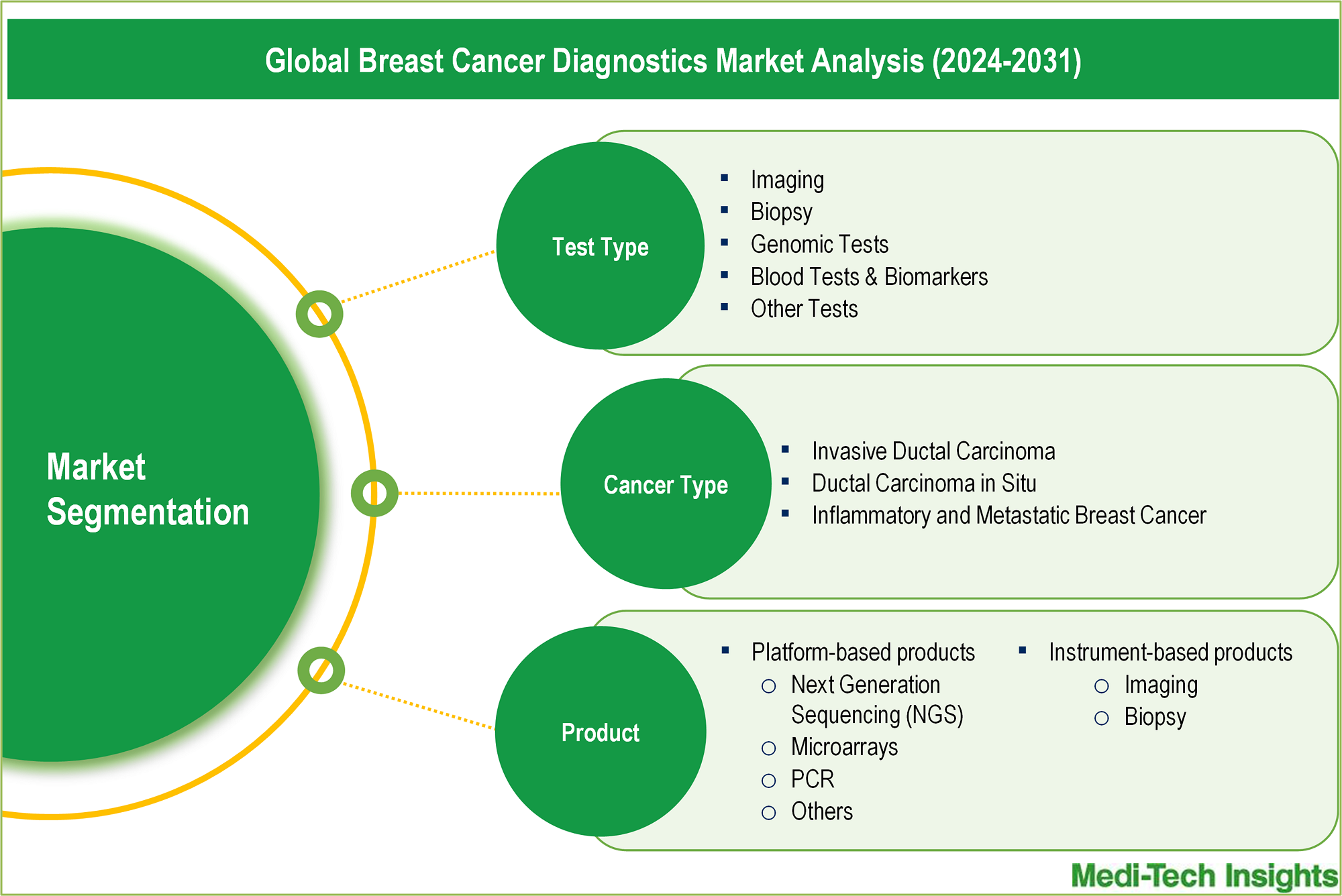
Cancer Type Segment Outlook
By
cancer type, the breast cancer diagnostics market is segmented into invasive
ductal carcinoma, ductal carcinoma in situ, and inflammatory & metastatic
breast cancer. Invasive ductal carcinoma accounts for the largest market share,
as it represents the majority of diagnosed breast cancer cases globally,
according to the American Cancer Society. This high prevalence drives strong
demand for imaging, biopsy, and genomic testing tools used in confirmatory
diagnosis and treatment planning.
Ductal carcinoma in situ is also a significant segment, given its non-invasive nature and potential to progress into invasive disease if left undetected, making early and accurate diagnosis essential. Growing screening initiatives and FDA-recognized tests, such as PreludeDx's DCISionRT, are supporting personalized management of this segment. Inflammatory and metastatic breast cancer, though comparatively smaller in share, represent a critical diagnostic segment due to their aggressive nature and poorer prognosis. Rising adoption of advanced molecular and liquid biopsy techniques is improving early detection and real-time monitoring of disease progression, particularly for metastatic cases, thereby supporting timely therapeutic intervention and better patient outcomes across healthcare settings.
Regional Outlook: North America maintains its leading position in the breast cancer diagnostics market
North
America holds a leading share in the breast cancer diagnostics market,
supported by advanced healthcare infrastructure, high awareness levels, and
strong government-backed screening programs. The region's large share is
further reinforced by rising adoption of AI-assisted imaging analysis, growing
integration of genomic and molecular profiling technologies, and the strong
presence of key diagnostic companies driving continuous innovation. Europe
holds the second-largest share, backed by well-established reimbursement
frameworks, increasing investment in precision diagnostics, and growing
emphasis on early detection through national screening initiatives. Rising
collaborations between diagnostic firms and research institutions further
strengthen the region's market position.
Asia-Pacific is projected to witness the fastest growth, fueled by a large patient population, expanding healthcare infrastructure, and increasing government initiatives to improve cancer screening accessibility. Rising awareness, growing disposable income, and improving access to advanced diagnostic technologies are further accelerating market expansion across emerging economies in the region.
Competitive Landscape Analysis
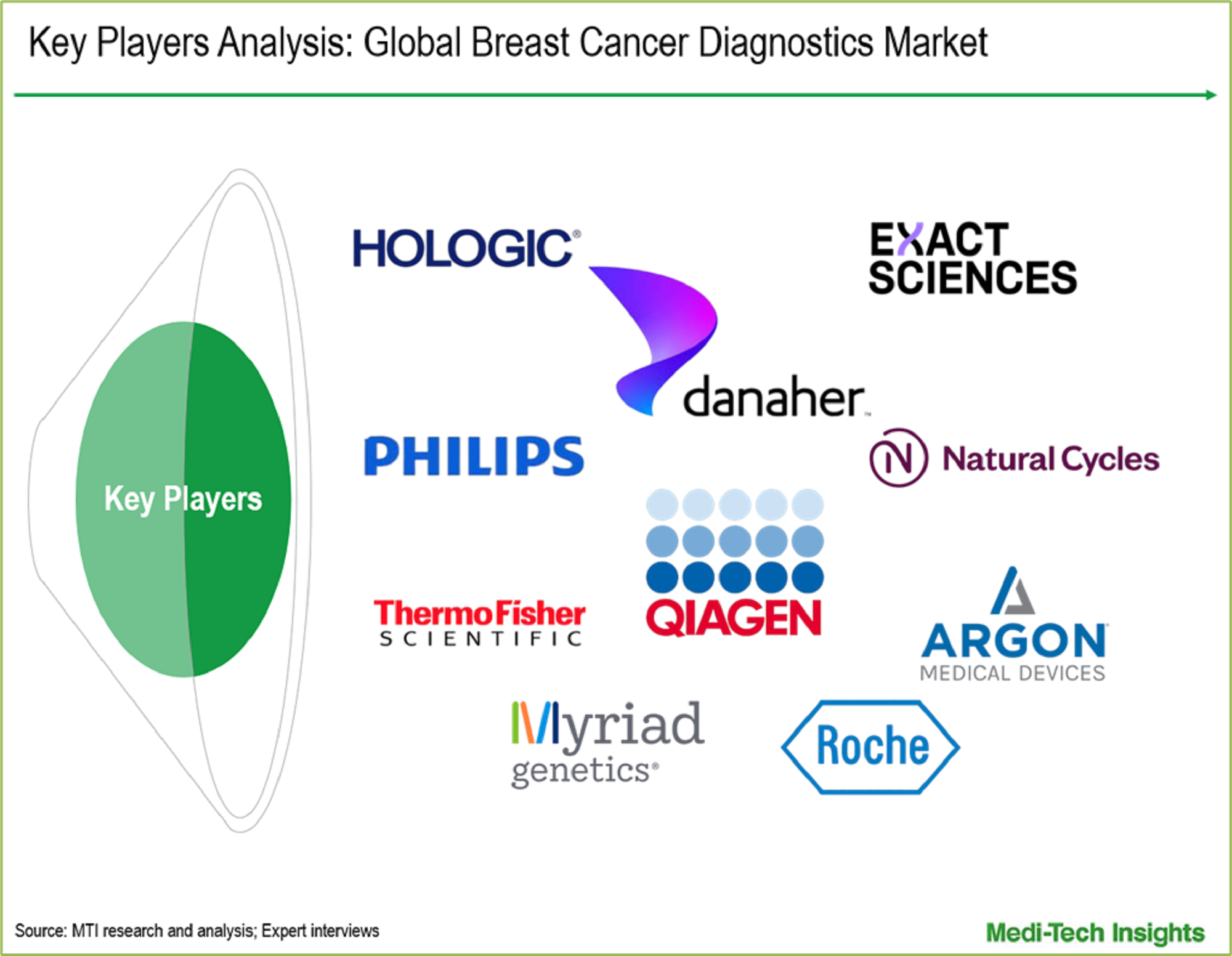
The global breast cancer diagnostics market
is marked by the presence of established and emerging market players such as-
- Hologic Inc. (US)
- Exact Sciences (US)
- Danaher (US)
- Koninklijke Philips N.V. (Netherlands)
- Natural Cycles (Sweden)
- QIAGEN (Germany)
- Thermo Fisher Scientific
Inc. (US)
- Argon Medical Devices, Inc.
(US)
- Myriad Genetics (US)
- Roche Ltd. (Switzerland)
Growth strategies adopted by players to establish their foothold in the breast cancer diagnostic market
Players operating in this market are adopting various growth strategies such as new product launches and approvals, acquisitions, expansions, and strategic partnerships, agreements, and collaborations, to garner market share. For instance,
- In June 2026, the US FDA approved FoundationOne CDx as a companion diagnostic for Itovebi (inavolisib), to identify patients with hormone receptor-positive, HER2-negative breast cancer carrying a PIK3CA mutation
- In September 2025, Stratipath and Visopharm announced a strategic partnership to advance the implementation of AI-powered breast cancer diagnostics, presented at the European Congress of Pathology in Vienna
- In February 2025, QIAGEN announced a collaboration with Tracer Biotechnologies and Foresight Diagnostics to expand its oncology diagnostics portfolio, supporting advancement of minimal residual disease and biomarker-based testing
- In September 2023, Hologic and Bayer announced an international partnership to deliver a comprehensive contrast-enhanced mammography package, combining Hologic's mammography systems with Bayer's approved contrast injection technology, across Europe, Canada, and Asia Pacific
|
Report
Metric |
Details |
|
Base
Year Considered |
2025 |
|
Historical
Data |
2024
– 2025 |
|
Forecast
Period |
2026
– 2031 |
|
Growth
Rate |
8% |
|
Segment
Scope |
Disease Type, Treatment Type, and Sales
Channel |
|
Regional
Scope |
|
|
Market
Drivers |
|
|
Attractive
Opportunities |
|
|
Key
Companies Mapped |
Hologic
Inc. (US); Exact Sciences (US); Danaher (US); Koninklijke Philips N.V.
(Netherlands); Natural Cycles (Sweden); QIAGEN (Germany); Thermo Fisher
Scientific Inc. (US); Argon Medical Devices, Inc. (US); Myriad Genetics (US);
Roche Ltd. (Switzerland); and among others |
|
Report
Highlights |
Market
Size & Forecast, Growth Drivers & Restraints, Trends, Competitive
Analysis |
Global Breast Cancer Diagnostic Market Segmentation
This report by Medi-Tech Insights provides the size of the global breast cancer diagnostics market at the regional and country-level from 2024 to 2031. The report further segments the market by test type, cancer type, product, application, and end user.
Market Size
& Forecast (2024-2031), By Test Type, USD Billion
o
Imaging
o
Biopsy
o
Genomic
Tests
o
Blood Test
& Biomarkers
o Other Tests
Market Size
& Forecast (2024-2031), By Cancer Type, USD Billion
o
Invasive Ductal Carcinoma
o
Ductal Carcinoma
in Situ
o Inflammatory and Metastatic Breast Cancer
Market Size & Forecast (2024-2031), By Product, USD Billion
o
Platform-based
products
- Next Generation Sequencing
- Microarrays
- PCR
- Others
o
Instrument-based
products
- Imaging
- Biopsy
Market Size
& Forecast (2024-2031), By Application, USD Billion
o
Screening
o
Diagnostic
& Predictive
o
Prognostic
o Research
Market Size
& Forecast (2024-2031), By End User, USD Billion
o
Hospitals
and Clinics
o
Diagnostic
Centres & Medical Labs
o Other End Users
Market Size
& Forecast (2024-2031), By Region, USD Billion
o
North
America
- US
- Canada
o
Europe
- UK
- Germany
- France
- Italy
- Spain
- Rest of Europe
o Asia Pacific
- China
- India
- Japan
- Rest of Asia Pacific
o
Latin
America
o Middle East & Africa
Related reports for reference-
Frequently Asked Questions About This Report
What is the growth rate of the breast cancer diagnostics market?
The breast cancer diagnostics market is set to witness a growth rate of 9% during the forecast period from 2026 to 2031
What are the key trends defining the market?
Increasing adoption of AI-assisted imaging analysis and diagnostics and rising integration of genomic and molecular profiling technologies are major trends in the breast cancer diagnostics market
What are the major factors impacting the market growth?
Rising global breast cancer incidence increases demand for diagnostics, growing awareness campaigns boost early screening test adoption, rising demand for minimally invasive and non-invasive testing methods, growing preference for liquid biopsy over traditional tissue sampling, and expansion of population-based mammography screening programs worldwide are some of the key factors driving the breast cancer diagnostics market
What are the opportunities prevailing in the market?
Circulating tumor DNA-based liquid biopsy; expansion into triple-negative breast cancer diagnostic testing segment; untapped potential in emerging economies; and personalized, data-driven precision oncology care offer numerous growth opportunities for companies operating in the breast cancer diagnostics market
Which region has the highest share in the global market? Which region is expected to witness the highest growth rate in the next 5 years?
North America held the largest share of the global breast cancer diagnostics market in 2025, while Asia-Pacific is projected to grow at the highest CAGR during the forecast period
Who are the major players operating in the market?
Some of the major players operating in the breast cancer diagnostics market include Flo Health Inc. Hologic Inc. (US); Exact Sciences (US); Danaher (US); Koninklijke Philips N.V. (Netherlands); Natural Cycles (Sweden); QIAGEN (Germany); Thermo Fisher Scientific Inc. (US); Argon Medical Devices, Inc. (US); Myriad Genetics (US); Roche Ltd. (Switzerland); and among others
What are the key strategies adopted by players?
Key players in the breast cancer diagnostics market are adopting strategies such as new product launch, acquisitions, collaborations, and strategic alliances to expand their market presence
Need a More Tailored Analysis?
- Discuss the market sizing methodology and forecast assumptions with our healthcare analysts.
- Expand the scope with additional countries, market segments, technologies, or competitor profiling.
- Use the insights to support strategic planning, market entry, commercial due diligence, and long-term revenue growth initiatives.