Download FREE Sample


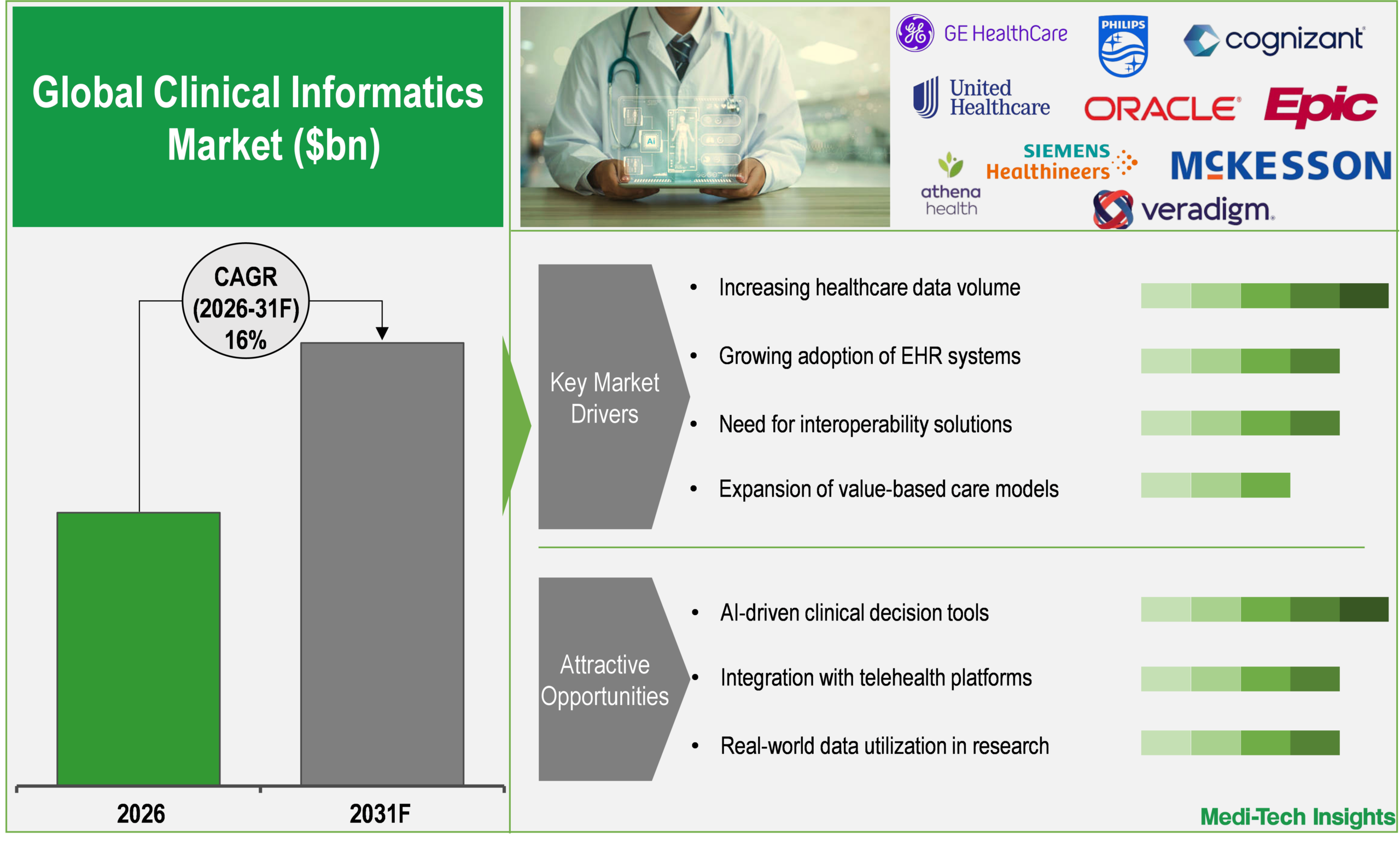
The global clinical informatics market size is projected to grow at a CAGR of 16% over the next 5 years. Increasing healthcare data volume, growing adoption of EHR systems, need for interoperability solutions, expansion of value-based care models, rising chronic disease burden, and government support for digital health are some of the key factors driving the clinical informatics market.
Clinical informatics isa healthcare discipline which leverages technology, data analytics and interoperability standards to optimize patient care and manage information across different healthcare systems. By integrating tools such as Electronic Health Records (EHRs),Clinical Decision Support Systems(CDSS), andComputerized Physician Order Entry(CPOE), these systems enhance decision-making, patient safety, and operational efficiency. The market for these technologies includes software solutions, AI-driven diagnostics, patient-generated health data (wearables) and integrated platforms that aid in transforming fragmented data into actionable insights. The systems facilitate evidence-based medicine, streamlining workflows and improving patient outcomes, while ensuring regulatory compliance and advancing the future of data-driven, personalized healthcare.
Rising complexity of clinical data and the need for structured management
With the surge in the of clinical data generated from imaging modalities, laboratory systems, connected devices, and longitudinal patient records, it has become difficult for healthcare organizations to process this large amount of data manually. This complexity increases the likelihood of inconsistencies and delays in clinical decision-making. Furthermore, with thousands of data points generated per patient daily, especially in intensive care, data-driven informatics has become essential. Clinical informatics systems address these challenges by providing standardized data capture and integration across different settings, thereby improving data usability.
This transition is further supported by the integration of EHR into healthcare systems, which provides real-time access to patient information and facilitates seamless communication between healthcare stakeholders, thereby ensuring that clinical histories, diagnostic data, and treatment pathways are readily accessible across departments. Additionally, regulatory bodies are also promoting digitization and encouraging standardized record-keeping, which has further accelerated structured data adoption. These developments reduce data fragmentation and improve interoperability across different departments, healthcare facilities and care settings, without creating duplicate records.
Lastly, structured data environments give patient information in standardized, coded formats, which are essential for modern healthcare, for transforming raw data into actionable insights. This organized data has not only enabled healthcare providers to get comprehensive patient views but also facilitated AI-driven decision support. As healthcare providers increasingly adopt integrated delivery models, standardized, interoperable infrastructures are crucial, supporting both individual patient care and broader population health management objectives.
To learn more about this report, download the PDF brochure
Transition toward value-based and outcome-oriented healthcare models
Healthcare delivery is shifting towards value-based models, which prioritizes patient outcomes over volume of care. Clinical informatics platforms utilize real-time patient data to provide continuous, tailored, and patient-centric treatment. These systems (EHRs, AI analytics) track quality metrics, optimize care coordination and reduce unnecessary hospitalizations, making healthcare more efficient and effective.
Another significant factor supporting this transition is the rise of patient-centric care models. These models focus on the patient's history and preferences, rather than generic protocols. Additionally, these systems provide continuous access to patient real-time data, along with history, thereby enabling timely, informed clinician decisions. Further, digital tools such as patient portals, secure messaging, and interoperable systems create a unified longitudinal patient record, facilitating care coordination that follows the patient across specialists, primary care, and home care, thereby reducing the likelihood of fragmented care and significantly improving patient outcomes.
These platforms also enhance population health management capabilities by enabling risk stratification, predictive modelling, and long-term patient tracking. Providers can proactively identify high-risk groups, intervene earlier, and refine treatment pathways to reduce hospital readmissions. Moreover, digital hospital management solutions improve operational efficiency through better scheduling and increased billing transparency, which strengthens overall outcome-driven care.
To learn more about this report, download the PDF brochure
Deployment Type Segment Outlook
The clinical informatics market, by deployment type, is segmented intocloud-based, on-premise, and hybrid models. Thecloud-baseddeployment segment is expected to witness strong growth due to its scalability, lower infrastructure costs, and improved accessibility for remote monitoring telehealth. This cloud -based segment has also enabled seamless integration of emerging tools, including AI and data analytics, thereby enabling more efficient data processing and real-time insights.
However, theon-premisemodel continues to hold a significant market share among large hospital networks and research institutions that prioritize data control, system customization, and internal security management. Key drivers for both models include the rising need for interoperability to comply with regulations and the shift toward the value-based care model, which demands robust data management. Furthermore, thehybridmodel is also gaining traction, blending on-premise security with cloud flexibility, allowing organizations to keep sensitive data on-site while utilizing cloud capacity for data-intensive functions like analytics or AI-driven applications.
Regional Outlook: Rapid adoption of advanced technologies drives North Ammatics market
North America is expected to lead the global clinical informatics market due to rapid adoption of advanced technologies such as AI and big data analytics, the presence of leading players, and strong regulatory support for interoperability. Following North America, Europe maintains a significant share, driven by national-level digital health initiatives, stringent GDPR compliance for data security and a growing focus on integrated healthcare models. Further, the Asia Pacific region is projected to witness the highest growth rate during the forecast period, driven by rising patient population, rapid healthcare infrastructure development, increasing investment from both public and private sectors and rising demand for digital healthcare solutions like telehealth and mHealth apps.
Competitive Landscape Analysis
The global clinical informatics market is marked by the presence of established and emerging market players such as UnitedHealth Group (US), Koninklijke Philips NV (Netherlands), GEHealthCare(US), Cognizant Technology Solutions (US), Oracle Corporation (US), Epic Systems Corporation (US); McKesson Corporation (US); Siemens Healthineers (Germany); Athenahealth Inc. (US); IQVIA Inc. (US) and Veradigm LLC (US) among others.
Growth strategies adopted by players to establish their foothold in the global clinical informatics market
Players operating in this market are adopting various growth strategies such as new product launches and approvals; acquisitions; expansions; and strategic partnerships, agreements, and collaborations, to garner market share. For instance,
- In September 2025, Siemens Healthineers partnered with Aiforia to expand AI-powered digital pathology solutions across Europe, enabling integration of advanced image analysis tools into clinical diagnostic workflows and supporting data-driven decision-making
- In February 2025, Philips partnered with Mass General Brigham to develop an AI-powered data infrastructure enabling integration and analysis of real-time patient data across multiple clinical systems
- In October 2024, Oracle Corporation unveiled a next-generation cloud-based elect health record (EHR) platform featuring embedded AI capabilities such as conversational search, voice-enabled navigation, and real-time clinical data access to support improved workflows and decision-making
- In July 2024, GE HealthCare announced a strategic collaboration with Amazon Web Services (AWS) to develop and deploy generative AI-enabled clinical applications and foundation models aimed at enhancing medical data analysis, improving workflow efficiency, and advancing patient care through secure cloud infrastructure
Report Scope
|
Report Metric |
Details |
|
Base Year Considered |
2025 |
|
Historical Data |
2024 2025 |
|
Forecast Period |
2026 2031 |
|
Growth |
16% |
|
Segment Scope |
Function Type, Component, Deployment, Application, and End User |
|
Regional Scope |
|
|
Market Drivers |
|
|
Attractive Opportunities |
|
|
Key Companies Mapped |
UnitedHealth Group (US), Koninklijke Philips NV (Netherlands), GEHealthCare(US), Cognizant Technology Solutions (US), Oracle Corporation (US), Epic Systems Corporation (US); McKesson Corporation (US); Siemens Healthineers (Germany); Athenahealth Inc. (US); IQVIA Inc. (US) and Veradigm LLC (US) among others |
|
Market Size & Forecast, Growth Drivers & Restraints, Trends, Competitive Analysis |
Global Clinical Informatics Market Segmentation
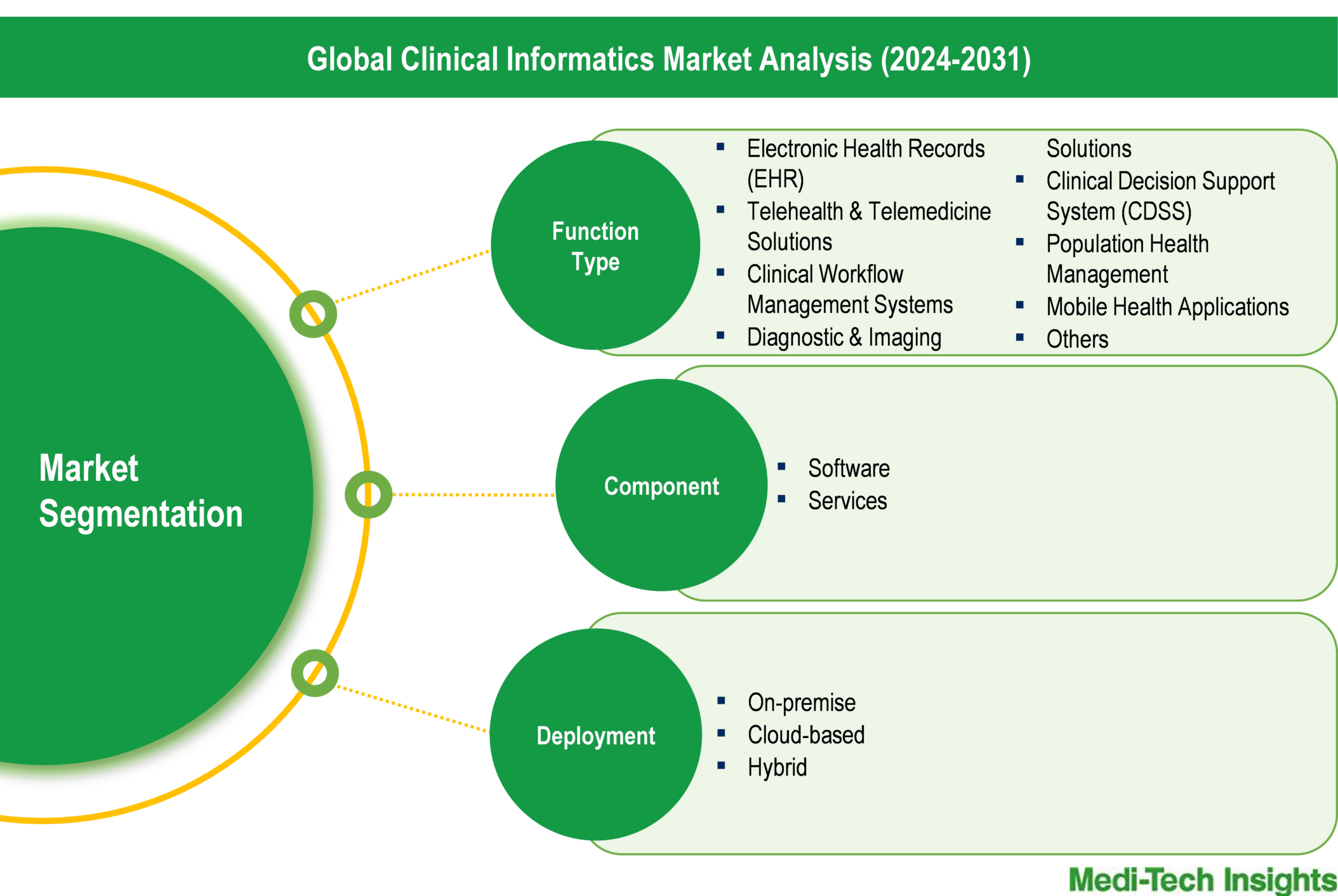
This report by Medi-Tech Insights provides thesize of the global clinical informatics market at theregional- and country-level from 2024 to 2031. The report further segments the market based on function type, component, deployment, application, and end user.
Market Size & Forecast (2024-2031), By Function Type, USD Billion
- Electronic Health Records (EHR)
- Telehealth & Telemedicine Solutions
- Clinical Workflow Management Systems
- Diagnostic & Imaging Solutions
- Clinical Decision Support System (CDSS)
- Population Health Management
- Clinical Trial Management Systems (CTMS)
- Mobile Health Applications
- Others
Market Size & Forecast (2024onent, USD Billion
- Software
- Services
Market Size & Forecast (2024-2031), By Deployment, USD Billion
- On-premise
- Cloud-based
- Hybrid
Market Size & Forecast (2024-2031), By Application, USD Billion
- Oncology
- Cardiology
- Neurology
- Respiratory Diseases
- Immunology
- Others
Market Size & Forecast (2024-2031), By End User, USD Billion
- Hospitals
- Specialty Clinics
- Ambulatory Care Centers
- Home Healthcare Settings
- Long-term Care Facilities
- Pharmacies
- Diagnostic Centers
- Others
Market Size & Forecast (2024-2031), By Region, USD Billion
- North America
- US
- Canada
- Europe
- UK
- Germany
- France
- Italy
- Spain
- Rest of Europe
- Asia Pacific
- China
- India
- Japan
- Rest of Asia Pacific
- Latin America
- Middle East & Africa
Need a More Tailored Analysis?
- Discuss the market sizing methodology and forecast assumptions with our healthcare analysts.
- Expand the scope with additional countries, market segments, technologies, or competitor profiling.
- Use the insights to support strategic planning, market entry, commercial due diligence, and long-term revenue growth initiatives.