Download FREE Sample


Report Overview
Critical care diagnostics refers to a specialized segment of medical diagnostics focused on identifying, monitoring, and managing life-threatening conditions in critically ill patients. These diagnostics provide rapid, accurate results to aid clinical decision-making in emergency rooms, intensive care units (ICUs), and other critical care settings. Key applications include detecting sepsis, acute respiratory distress syndrome (ARDS), trauma, and cardiovascular emergencies. Critical care diagnostics utilize advanced technologies such as point-of-care testing, molecular diagnostics, and imaging systems to ensure timely interventions. Their primary goal is to improve patient outcomes by enabling prompt diagnosis and treatment of severe, time-sensitive medical conditions.
To learn more about the research report, download a sample report.
Increasing prevalence of chronic and acute diseases to propel market demand
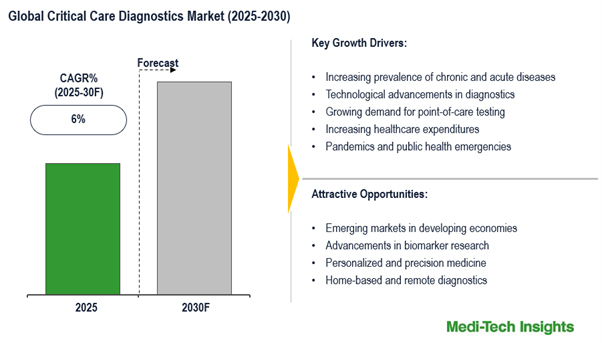
The increasing prevalence of chronic and acute diseases, such as cardiovascular disorders, diabetes, respiratory infections, and sepsis, is a major driver of the critical care diagnostics market. These conditions often require rapid and accurate diagnostic tools to enable timely interventions and improve patient outcomes in critical care settings. The growing global burden of aging population, lifestyle-related disorders, and infectious disease outbreaks like COVID-19 has heightened the demand for advanced diagnostic technologies. Hospitals and intensive care units increasingly rely on point-of-care testing, biomarker assays, and molecular diagnostics to detect and monitor these life-threatening conditions, fueling market growth.
To learn more about the research report, download a sample report.
Technological advancements in diagnostics are driving the market growth
Technological advancements in diagnostics are significantly driving the growth of the critical care diagnostics market by improving the speed, accuracy, and efficiency of disease detection. Innovations such as point-of-care testing (POCT), molecular diagnostics, and AI-powered tools enable rapid and precise identification of critical conditions like sepsis, cardiac disorders, and respiratory infections. Integration of advanced biomarkers and multiplex testing platforms allows simultaneous detection of multiple parameters, reducing diagnostic time in emergency settings. Additionally, automation and digital connectivity in diagnostic systems streamline workflows and enhance decision-making in critical care units, meeting the rising demand for faster and more reliable diagnostic solutions.
Competitive Landscape Analysis
The global critical care diagnostics market is marked by the presence of established and emerging market players such as Abbott; F. Hoffmann-La Roche Ltd.; Becton, Dickinson and Company; bioMrieux; Danaher Corporation; EKF Diagnostics Holdings plc; QuidelOrtho Corporation; Chembio Diagnostics, Inc.; Bio-Rad Laboratories, Inc.; and Bayer AG; among others. Some of the key strategies adopted by market players include new product development, strategic partnerships and collaborations, and geographic expansion.
Report Scope
|
Report Scope |
Details |
|
Base Year Considered |
2024 |
|
Historical Data |
2023 - 2024 |
|
Forecast Perid |
2025 - 2030 |
|
Growth rate |
6% |
|
Market Drivers |
|
|
Attractive Opportunities |
|
|
Segment Scope |
Test Type, Application, End User |
|
Regional Scope |
|
|
Key Companies Mapped |
Abbott; F. Hoffmann-La Roche Ltd.; Becton, Dickinson and Company; bioMrieux; Danaher Corporation; EKF Diagnostics Holdings plc; QuidelOrtho Corporation; Chembio Diagnostics, Inc.; Bio-Rad Laboratories, Inc.; and Bayer AG; among others |
|
Report Highlights |
Market Size & Forecast, Growth Drivers & Restraints, Trends, Competitive Analysis |
Market Segmentation
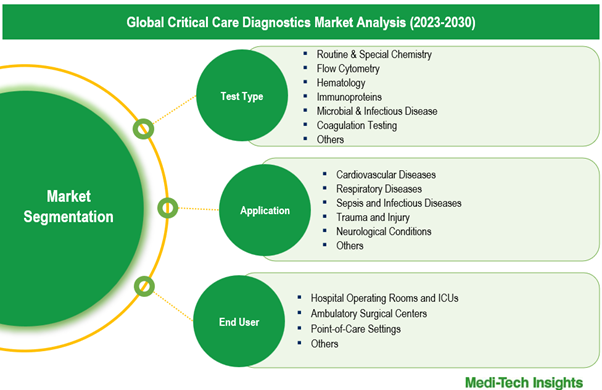
This report by Medi-Tech Insights provides thesize of the global critical care diagnostics market at theregional- and country-level from 2023 to 2030. The report further segments the market based on product, test type, application, and end user.
- Market Size & Forecast (2023-2030), By Test Type, USD Million
- Routine & Special Chemistry
- Flow Cytometry
- Hematology
- Immunoproteins
- Microbial & Infectious Disease
- Coagulation Testing
- Others
- Market Size & Forecast (2023-2030), By Application, USD Million
- Cardiovascular Diseases
- Respiratory Diseases
- Sepsis and Infectious Diseases
- Trauma and Injury
- Neurological Conditions
- Others
- Market Size & Forecast (2023-2030), By End User, USD Million
- Hospital Operating Rooms and ICUs tory Surgical Centers
- Point-of-Care Settings
- Others
- Market Size & Forecast (2023-2030), By Region, USD Million
- North America
- US
- Canada
- Europe
- UK
- Germany
- France
- Italy
- Spain
- Rest of Europe
- Asia Pacific
- China
- India
- Japan
- Rest of Asia Pacific
- Latin America
- Middle East & Africa
- North America
Need a More Tailored Analysis?
- Discuss the market sizing methodology and forecast assumptions with our healthcare analysts.
- Expand the scope with additional countries, market segments, technologies, or competitor profiling.
- Use the insights to support strategic planning, market entry, commercial due diligence, and long-term revenue growth initiatives.