Download FREE Sample


The digital behavioral/mental health market is expected to grow at a CAGR of 18-20% during the forecast period. The increasing demand for affordable mental health services like e-therapies, rising smartphone penetration, and rising prevalence and awareness of mental health conditions are the major drivers fuelling the market's growth. The market growth may be hindered due to data privacy concerns and varying regulatory landscapes across regions.
Digital behavioral/mental health is the application of digital platforms, apps, and telehealth services to provide mental health intervention, therapy, and intervention programs. These services traditionally include virtual sessions, self-directed tools, e-therapies, and integration with mobile phones or smart devices for patient monitoring for their emotional and psychological well-being. Its main function is to fill the accessibility gap for patients who are unable to access traditional/offline therapy. Additionally, it lowers the cost of mental health treatment, makes it scalable and stigma-free in nature, satisfying the surging demand of various population groups across the globe.

To learn more about this report, download the PDF brochure
Rising demand for accessible mental health care
The increased demand for easily accessible mental health services is one of the significant factors driving the development of the digital behavioral/mental health market. Traditional offline consultations have long waiting times, high costs, and far geographical locations that are a hindrance to many people who need them. With growing issues of anxiety, depression, and stress, especially following the COVID-19 pandemic, there has been an abrupt surge in individuals seeking timely and convenient mental health services. Online platforms have proven to be an easy solution to these challenges, offering convenient consultations with licensed therapists from the comfort of home. There is a surge in digital behavioral health solution adoption by healthcare providers, payers and employers to address the increasing demand for mental wellness support among demographic populations.
Increasing funding fuels digital behavioral/mental health market solutions demand
As per the article published by WHO, one in eight people suffered from a psychiatric disorder such as anxiety, depression, or insomnia, which significantly affected their thinking skills and emotional behavior. The mental health crisis fueled by COVID-19 led to increased demand for behavioral/mental health solutions, which in turn attracted the attention of investors. The market witnessed several investments from private equity companies and venture capitalists. For instance,
- In June 2024, Talkiatry, a provider of high-quality, in-network psychiatric care, raised $130 million in equity and debt financing. This Series C investment intends to expand its value-based care model aimed at reducing the total cost and improving health outcomes
- In April 2024, Grow Therapy, a mental health tech startup, raised $88 million in a Series C funding round led by Sequoia Capital, with support from Growth Equity at Goldman Sachs Alternatives and PLUS Capital. The company launched its upgraded measurement-informed care system, which improves client’s and providers experience and aims to make value-based behavioral care more accessible to all patient populations, including Medicaid and Medicare members
- In January 2022, Lyra Health, the leading provider of innovative Workforce Mental Health solutions for employers, secured financing of $235 million to fuel international expansion. The firm’s platform delivers customized behavioral and mental health care virtually and/or in-person, alongside self-care lessons and exercises
To learn more about this report, download the PDF brochure
Competitive Landscape Analysis
The global digital behavioral/mental health market is marked by the presence of established and emerging market players such as Teladoc Health, Inc., Headspace, Talkspace, BetterHelp, Calm, Akili, Lyra Health, Spring Health, Brightline, and Little Otter, among others. Some of the key strategies adopted by market players include new product development, strategic partnerships and collaborations, and geographic expansion.
Report Scope
| Report Metric | Details |
| Base Year Considered | 2024 |
| Historical Data | 2023 - 2024 |
| Forecast Period | 2025 2030 |
| Growth Rate | 18-20% |
| Market Drivers |
|
| Attractive Opportunities |
|
| Segment Scope | Component Type, Application Type, Age Group, and End-user |
| Regional Scope |
|
| Key Companies Mapped | Teladoc Health, Inc., Headspace, Talkspace, BetterHelp, Calm, Akili, Lyra Health, Spring Health, Brightline, and Little Otter, among others |
| Report Highlights | Market Size & Forecast, Growth Drivers & Restraints, Trends, Competitive Analysis |
Global Digital Behavioral/Mental Health Market Segmentation
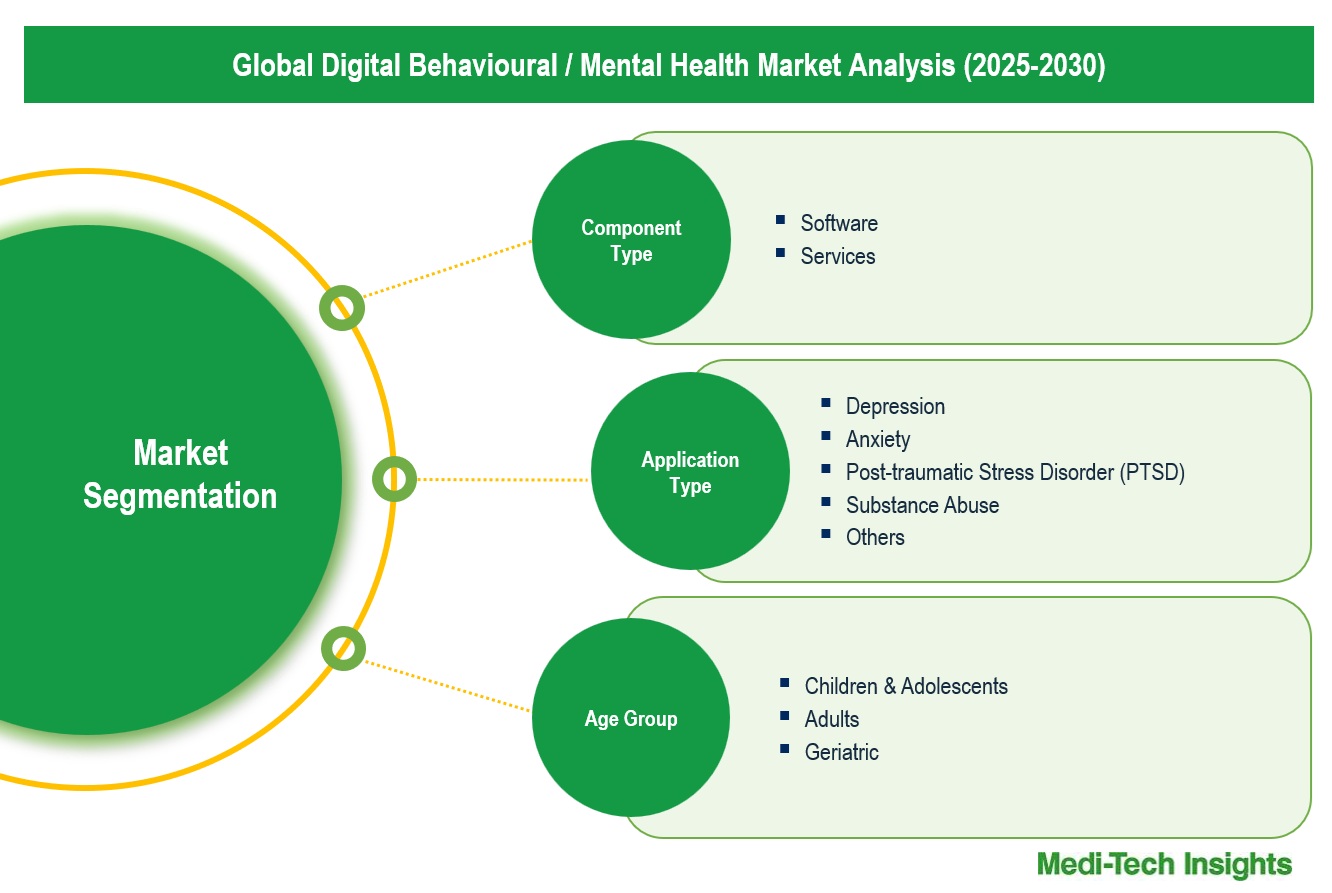
This report by Medi-Tech Insights provides the size of the global digital behavioral/mental health market at the regional- and country-level from 2023 to 2030. The report further segments the market based on component type, application type, age group and end-user.
Market Size & Forecast (2023-2030), By Component Type, USD Million
- Software
- Services
Market Size & Forecast (2023-2030), By Application Type, USD Million
- Depression
- Anxiety
- Post-traumatic Stress Disorder (PTSD)
- Substance Abuse
- Others
Market Size & Forecast (2023-2030), By Age Group, USD Million
- Children & Adolescents
- Adults
- Geriatric
Market Size & Forecast (2023-2030), By End-user, USD Million
- Patients
- Providers
- Payers
- Employers
Market Size & Forecast (2023-2030), By Region, USD Million
- North America
- US
- Canada
- Europe
- UK
- Germany
- France
- Italy
- Spain
- Rest of Europe
- Asia Pacific
- China
- India
- Japan
- Rest of Asia Pacific
- Latin America
- Middle East & Africa
Key Strategic Questions Addressed
- What is the market size & forecast of the digital behavioral/mental health market?
- What are historical, present, and forecasted market shares and growth rates of various segments and sub-segments of the digital behavioral/mental health market?
- What are the key trends defining the market?
- What are the major factors impacting the market?
- What are the opportunities prevailing in the market?
- Which region has the highest share in the global market? Which region is expected to witness the highest growth rate in the next 5 years?
- Who are the major players operating in the market?
- What are the key strategies adopted by players?
Need a More Tailored Analysis?
- Discuss the market sizing methodology and forecast assumptions with our healthcare analysts.
- Expand the scope with additional countries, market segments, technologies, or competitor profiling.
- Use the insights to support strategic planning, market entry, commercial due diligence, and long-term revenue growth initiatives.