Download FREE Sample


Report Overview
Fetal monitoring involves the continuous or periodic observation of a fetus's heart rate, movement, and overall health throughout pregnancy and labor. It helps healthcare professionals evaluate fetal well-being, detect signs of distress, and ensure a safe delivery. Fetal heart rate monitoring identifies variations in the baby's heartbeat, including increase, decrease, and overall variability. The normal fetal heart rate typically ranges from 110 to 160 beats per minute but may fluctuate in response to conditions within the uterus. An abnormal heart rate or pattern could indicate inadequate oxygen supply or other complications, potentially requiring an emergency cesarean (C-section) delivery.
To learn more about the research report, download a sample report.
The rising incidence of high-risk pregnancies increases fetal monitoring adoption
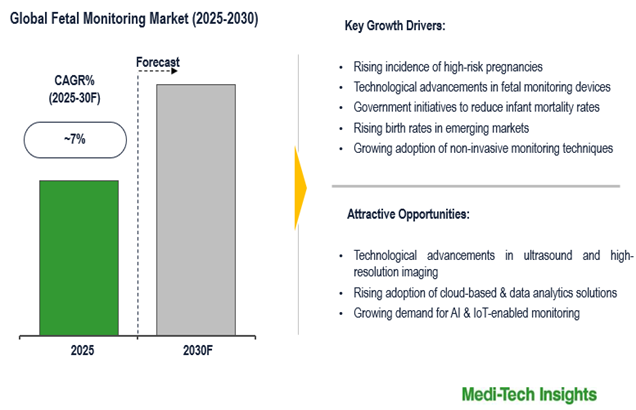
High-risk pregnancies involve conditions that may endanger the health of the mother, fetus, or newborn, requiring continuous monitoring to ensure their well-being. These risks can stem from factors such as chronic diseases, multiple gestation, previous pregnancy complications, or new obstetric and non-obstetric conditions that develop during pregnancy. Medical conditions like diabetes, hypertension, thyroid disorders, psychiatric disorders, genetic factors, and past pregnancy complications necessitate the use of advanced fetal monitoring technologies to detect potential issues early and facilitate timely medical intervention. Hypertension during pregnancy, for instance, has long been recognized as a major risk factor that can negatively impact both the placenta and fetus, potentially leading to serious maternal and fetal complications. Consequently, high-risk pregnancies require intensive monitoring, including frequent prenatal visits, blood tests, ultrasonography, and specialized fetal monitoring techniques to manage complications effectively. With the global rise in high-risk pregnancies, the demand for accurate, efficient, and accessible fetal monitoring systems continues to grow, driving advancements in maternal-fetal healthcare.
To learn more about the research report, download a sample report.
Technological advancements in fetal monitoring devices drive market growth
Fetal monitoring plays a vital role in obstetric care, ensuring the safe delivery of a healthy baby. Traditionally, it relied on intermittent auscultation using a fetal stethoscope or Pinard horn. However, advancements in medical technology have led to the development of sophisticated, non-invasive monitoring techniques, enabling continuous fetal assessment. These innovations have significantly improved obstetric outcomes by allowing healthcare providers to identify potential complications early and take preventive measures.
One of the most notable advancements is electronic fetal monitoring (EFM), which has become the standard of care in many clinical settings. EFM enables continuous fetal heart rate (FHR) monitoring, allowing early detection of distress and reducing the risks of neonatal seizures, asphyxia, and cerebral palsy. Additionally, fetal pulse oximetry (FPO) enhances fetal monitoring by measuring oxygen saturation in fetal blood, providing a more comprehensive assessment when used alongside EFM. Emerging technologies such as fetal electroencephalography (fEEG) are also being developed, offering insights into fetal brain activity and helping detect neurological abnormalities early.
Moreover, non-invasive fetal monitoring solutions, including advanced Doppler ultrasound and AI-powered predictive analytics, are revolutionizing maternal-fetal healthcare by improving diagnostic accuracy while reducing the need for invasive procedures. With healthcare systems increasingly prioritizing maternal and fetal health, the demand for smart, AI-integrated, and remote fetal monitoring technologies continues to rise, driving market growth and innovation.
Competitive Landscape Analysis
The global fetal monitoring market is marked by the presence of established and emerging market players such as Becton, Dickinson, and Company; Biolight Medical; Cardinal Health; DOTO Health; EDAN Instrument; FUJIFILM Holdings Corporation; GE Healthcare; Huntleigh Healthcare (Arjo); Koninklijke Philips; Medtronic; Natus Medical Incorporated; Siemens AG; Neoventa Medical AB; MedGyn Products, Inc; and Mindray Medical; among others. Some of the key strategies adopted by market players include new product development, strategic partnerships and collaborations, and investments.
Report Scope
|
Report Scope |
Details |
|
Base Year Considered |
2024 |
|
Historical Data |
2023 - 2024 |
|
Forecast Period |
2025 - 2030 |
|
Growth Rate |
~7% |
|
Market Drivers |
|
|
Attractive Opportunities |
|
|
Segment Scope |
Product, Portability, Method, Application, and End User |
|
Regional Scope |
|
|
Key Companies Mapped |
Becton, Dickinson, and Company; Biolight Medical; Cardinal Health; DOTO Health; EDAN Instrument; FUJIFILM Holdings Corporation; GE Healthcare; Huntleigh Healthcare (Arjo); Koninklijke Philips; Medtronic; Natus Medical Incorporated; Siemens AG; Neoventa Medical AB; MedGyn Products, Inc; and Mindray Medical |
|
Report Highlights |
Market Size & Forecast, Growth Drivers & Restraints, Trends, Competitive Analysis |
Market Segmentation
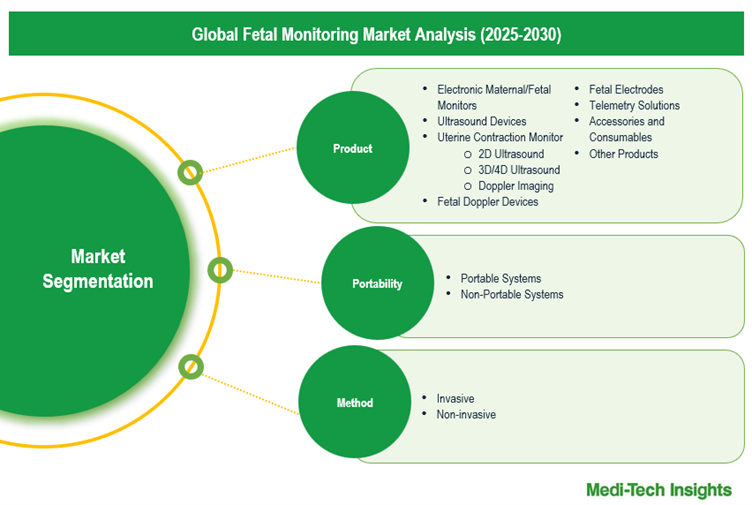
This report by Medi-Tech Insights provides the size of the global fetal monitoring market at the regional and country levels from 2023 to 2030. The report further segments the market based on product, portability, method, application, and end user.
- Market Size & Forecast (2023-2030), By Product, USD Million
- Electronic Maternal/Fetal Monitors
- Ultrasound Devices
- Uterine Contraction Monitor
- 2D Ultrasound
- 3D/4D Ultrasound
- Doppler Imaging
- Fetal Doppler Devices
- Fetal Electrodes
- Telemetry Solutions
- Accessories and Consumables
- Other Products
- Market Size & Forecast (2023-2030), By Portability, USD Million
- Portable Systems
- Non-Portable Systems
- Market Size & Forecast (2023-2030), By Method, USD Million
- Invasive
- Non/li>
- Market Size & Forecast (2023-2030), By Application, USD Million
- Antepartum
- Intrapartum
- Market Size & Forecast (2023-2030), By End User, USD Million
- Obstetrics & Gynaecology Clinics
- Hospitals
- Home Care Settings
- Market Size & Forecast (2023-2030), By Region, USD Million
- North America
- US
- Canada
- Europe
- UK
- Germany
- France
- Italy
- Spain
- Rest of Europe
- Asia Pacific
- China
- India
- Japan
- Rest of Asia Pacific
- Latin America
- Middle East & Africa
- North America
Need a More Tailored Analysis?
- Discuss the market sizing methodology and forecast assumptions with our healthcare analysts.
- Expand the scope with additional countries, market segments, technologies, or competitor profiling.
- Use the insights to support strategic planning, market entry, commercial due diligence, and long-term revenue growth initiatives.