Download FREE Sample


Glucagon-like peptide-1 (GLP-1) analogues are medications primarily used in the treatment of type 2 diabetes and obesity, which mimic the action of the natural hormone GLP-1, which is necessary for regulating glucose levels in the body. GLP-1 stimulates insulin secretion, suppresses glucagon release, delays the emptying of the stomach, and increases satiety. This hormone is released post-meals by intestinal L-cells. GLP-1 analogues target several pathophysiological variables linked to type 2 diabetes primarily by enhancing the body's natural ability to regulate blood sugar levels and thereby lowering the risk of hypoglycemia. Additionally, even in non-diabetic populations, their ability to decrease hunger has created opportunities for their application in weight management.

To learn more about this report, download the PDF brochure
The dual burden of type 2 diabetes and obesity drives the demand for GLP-1 analogues
A key factor driving the demand for GLP-1 analogues is the surge in the number of people with type 2 diabetes and obesity due to growing adoption of sedentary lifestyles, poor food choices, and rapid urbanization. According to the International Diabetes Federation (IDF), 589 million adults (20-79 years) are living with diabetes, and in 2024, statistics show that diabetes alone caused 3.4 million deaths. The World Obesity Federation-s 2025 Atlas projects that over 1 billion people will be living with obesity by 2030.
GLP-1 analogues are particularly effective as they address weight loss and glycemic management simultaneously, so they become essential in managing the dual burden of diabetes and obesity. Growing awareness of the long-term complications of uncontrolled dineuropathy and cardiovascular disease, is also a critical aspect which further drives the demand for GLP-1 analogues. Additionally, growing awareness of early diagnosis, preventive care, and lifestyle modification programs are being actively promoted by public health groups and health authorities is indirectly increasing demand for GLP-1-based therapies.
To learn more about this report, download the PDF brochure
GLP-1 analogues for weight management in non-diabetic populations gain traction
One of the notable trends seen in the GLP-1 analogues market is the growing adoption of these therapies for obesity treatment in non-diabetic patients. GLP-1 analogues like semaglutide and liraglutide, which were primarily used for glycemic control, are now being widely prescribed, particularly for the management of chronic weight management. Obesity is increasingly associated with many severe disorders, like cardiovascular disorders, sleep apnea, and certain cancers; hence, healthcare professionals are looking for therapies that are effective for long-term weight management.
The global shift toward preventive wellness, along with significant sustained weight loss by GLP-1 analogues, has further strengthened their role in metabolic health. As a result, GLP-1 analogues are now positioned not only as diabetes drugs but also as cornerstone therapies in modern obesity care, drawing in new patient segments. Moreover, pharma companies are accelerating R&D to evaluate their impact in other sectors. For instance,
- In July 2024, the MHRA approved Semaglutide, a GLP-1 receptor agonist, to reduce the risk of major cardiovascular events in obese or overweight people, underscoring its expanding benefits beyond glycemic control
- In December 2023, Eli Lilly and Company launched Zepbound (tirzepatide), the first dual-GIP/GLP-1 receptor agonist for chronic weight management in adults with obesity or other weight-related medical problems such as hypertension, dyslipidemia, type 2 diabetes mellitructive sleep apnea or cardiovascular disease
Together, such developments are reshaping the role of GLP-1 analogues from single-purpose treatments to comprehensive metabolic health solutions.
Competitive Landscape Analysis
The global GLP-1 analogues market comprises of several well-established and emerging players, including Eli Lilly and Company; Novo Nordisk A/S; Pfizer Inc.; AstraZeneca PLC; Sanofi S.A.; Sun Pharmaceutical Industries Limited; Boehringer Ingelheim International GmbH; PegBio Co., Ltd.; Innovent Biologics, Inc.; and Amgen Inc., among others. Key strategies adopted by these players include the development of advanced therapies, mergers and acquisitions, and investment in R&D to enhance diabetic and chronic weight management solutions and meet growing global demand.
Report Scope
| Report Metric | Details |
| Base Year Considered | 2025 |
| Historical Data | 2024 - 2025 |
| Forecast Period | 2026 - 2031 |
| Growth | 14% |
| Market Drivers |
|
| Attractive Opportunities |
|
| Segment Scope | Product, Route of Administration, Application, and End-user |
| Regional Scope |
|
| Key Companies Mapped | Eli Lilly and Company; Novo Nordisk A/S; Pfizer Inc.; AstraZeneca PLC; Sanofi S.A.; Sun Pharmaceutical Industries Limited; Boehringer Ingelheim International GmbH; PegBio Co., Ltd.; Innovent Biologics, Inc.; and Amgen Inc.; among others |
| Report Highlights | Market Size & Forecast, Growth Drivers & Restraints, Trends, Competitive Analysis |
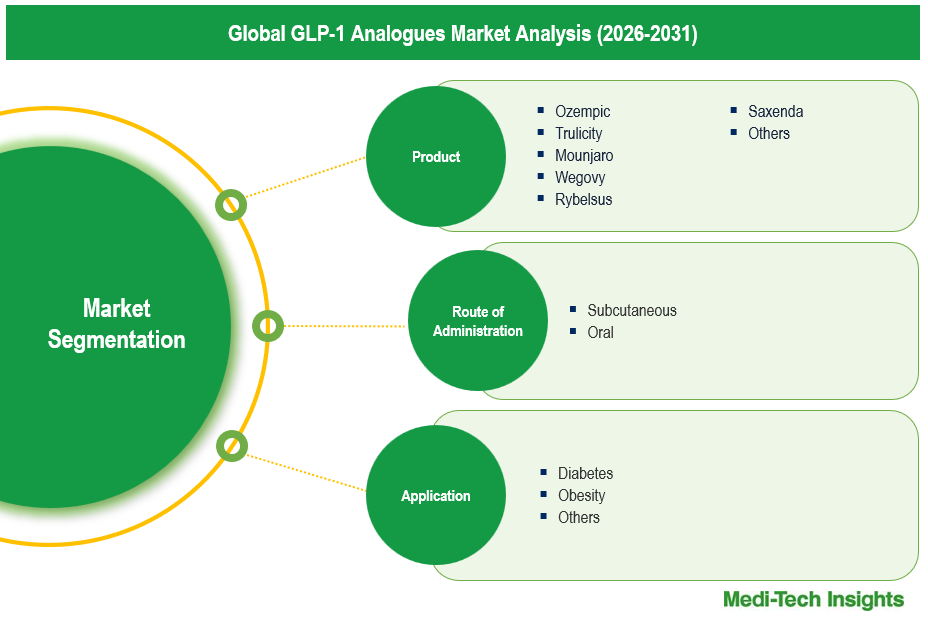
Global GLP-1 Analogues Market Segmentation
This report by Medi-Tech Insights provides thesize of the global GLP-1 analogues market at theregional- and country-level from 2024 to 2031. The report further segments the market based on product, route of administration, application, and end-user.
Market Size & Forecast (2024-2031), By Product, USD Million
- Ozempic
- Trulicity
- Mounjaro
- Wegovy
- Rybelsus
- Saxenda
- Others
Market Size & Forecast (2024-2031), By Route of Administration, USD Million
- Subcutaneous
- Oral
Market Size & Forecast (2024-2031), By Application, USD Million
- Diabetes
- Obesity
- Others
Market Size & Forecast (2024-2er, USD Million
- Hospitals
- Specialty Clinics
- Home-care Settings
- Others
Market Size & Forecast (2024-2031), By Region, USD Million
- North America
- US
- Canada
- Europe
- UK
- Germany
- France
- Italy
- Spain
- Rest of Europe
- Asia Pacific
- China
- India
- Japan
- Rest of Asia Pacific
- Latin America
- Middle East & Africa
Need a More Tailored Analysis?
- Discuss the market sizing methodology and forecast assumptions with our healthcare analysts.
- Expand the scope with additional countries, market segments, technologies, or competitor profiling.
- Use the insights to support strategic planning, market entry, commercial due diligence, and long-term revenue growth initiatives.