Download FREE Sample


Report Overview
Image-guided therapy systems leverage medical imaging to assist in surgical procedures and therapeutic interventions, offering precise visualization and navigation. These advanced systems enable healthcare professionals to accurately target diseased tissues, guide surgical instruments, and enhance treatment outcomes, all while minimizing damage to surrounding healthy structures. Utilizing imaging modalities such as X-rays, CT scans, MRI, and ultrasound, these systems provide access to areas that previously required more invasive techniques. By facilitating minimally invasive procedures, image-guided therapy contributes to shorter hospital stays, reduced recovery times, and fewer repeated interventions, ultimately improving patient care and surgical efficiency.
To learn more about this report, download the PDF brochure
Expanding applications of image-guided therapy systems in different medical specialties fuel its demand
Image-guided therapy has found applications in various medical specialties, revolutionizing the way healthcare is delivered. Some of the key areas where these advanced systems are widely utilized include:
- Interventional Radiology: Real-time imaging enables minimally invasive procedures to treat conditions such as liver cancer, uterine fibroids, and vascular diseases. By guiding catheters and other instruments with precision, image-guided techniques reduce recovery times and improve patient outcomes.
- Cardiology: Image-guided therapy systems are essential for precise cardiac interventions, allowing for enhanced accuracy in procedures like angioplasty, stenting, and heart valve repair. These technologies help optimize treatment effectiveness while minimizing risks.
- Neurosurgery: The integration of imaging in neurosurgical procedures allows surgeons to navigate intricate brain structures with exceptional precision. Image-guided therapy is widely used for tumor removal, epilepsy surgery, and deep brain stimulation (DBS), improving both safety and surgical success rates.
- Orthopedics: In orthopedic surgery, image-guided therapy assists in procedures such as joint replacements, spinal surgeries, and fracture repairs. Real-time imaging enhances visualization and guidance, leading to improved accuracy and better patient outcomes.
With continuous advancements in AI, robotics, and augmented reality (AR), image-guided therapy is expanding into even more medical specialties, further transforming the way healthcare is delivered.
Growing demand for minimally invasive procedures drives market growth
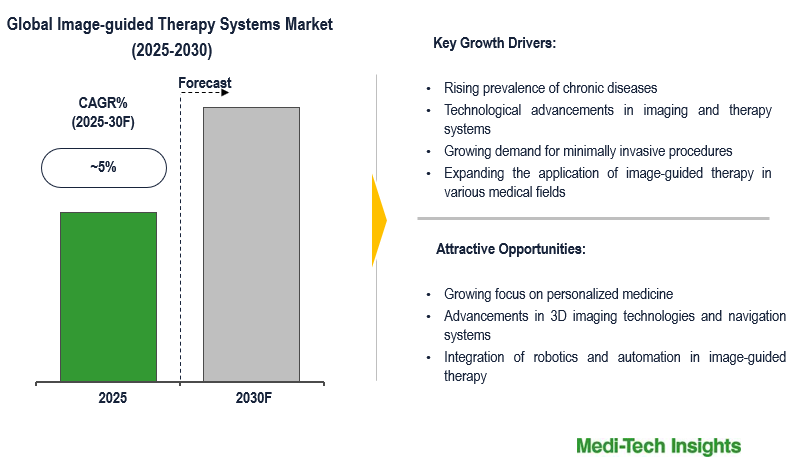
Over the years, image-guided therapy (IGT) systems have transformed the way medical procedures are performed, shifting from traditional open surgeries characterized by larger incisions and prolonged recovery times to minimally invasive techniques. The introduction of advanced imaging technologies, such as X-rays, CT scans, MRI, and ultrasound, has enabled surgeons to perform procedures with greater precision, reduce trauma, and improve patient outcomes. The growing preference for less invasive treatments is driven by benefits like reduced pain, shorter recovery times, lower risk of complications, and minimal scarring.
Image-guided therapy systems play a crucial role in achieving real-time visualization, precise targeting, and enhanced accuracy across multiple medical specialties, including interventional radiology, cardiology, neurosurgery, and orthopedics. As the global healthcare industry continues to prioritize minimally invasive techniques, the demand for cutting-edge image-guided therapy systems is expected to grow, fueling significant market expansion.
To learn more about this report, download the PDF brochure
Competitive Landscape Analysis
The global image-guided therapy systems market is marked by the presence of established and emerging market players such as Koninklijke Philips N.V.; Medtronic; Siemens Healthineers; Analogic Corporation; GE Healthcare; Varian Medical Systems, Inc.; Brainlab AG; Olympus Corporation; Stryker; Canon Medical Systems Corporation; and Hitachi Medical Corporation; among others. Some of the key strategies adopted by market players include new product development, strategic partnerships and collaborations, and investments.
Report Scope
| Report Metric | Details |
| Base Year Considered | 2024 |
| Historical Data | 2023 - 2024 |
| Forecast Period | 2025 - 2030 |
| Growth Rate | 5% |
| Market Drivers |
|
| Attractive Opportunities |
|
| Segment Scope | Product, Application, and End User |
| Regional Scope |
|
| Key Companies Mapped | Koninklijke Philips N.V.; Medtronic; Siemens Healthineers; Analogic Corporation; GE Healthcare; Varian Medical Systems, Inc.; Brainlab AG; Olympus Corporation; Stryker; Canon Medical Systems Corporation; and Hitachi Medical Corporation |
| Report Highlights | Market Size & Forecast, Growth Drivers & Restraints, Trends, Competitive Analysis |
Global Image-guided Therapy Systems Market Segmentation
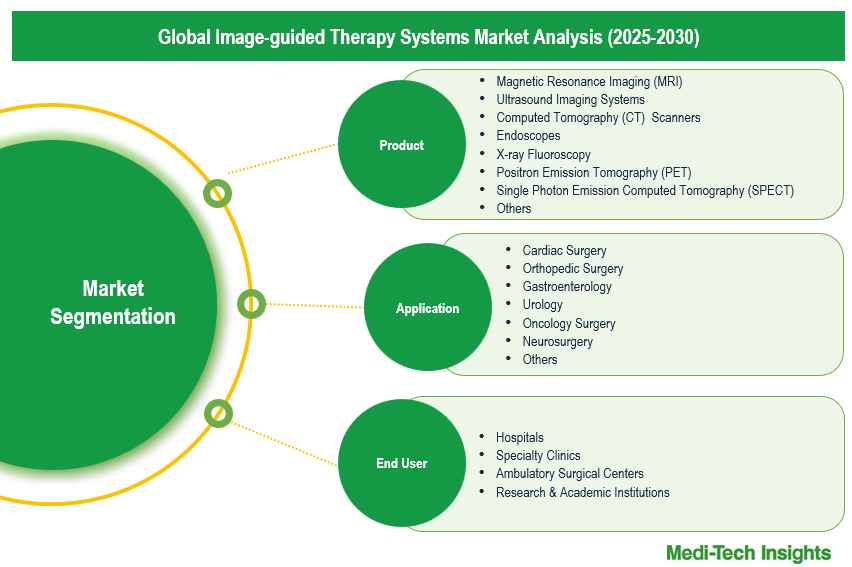
This report by Medi-Tech Insights provides the size of the global image-guided therapy systems market at the regional- and country level from 2023 to 2030. The report further segments the market based on product, application, and end user.
Market Size & Forecast (2023-2030), By Product, USD Million
- Magnetic Resonance Imaging (MRI)
- Ultrasound Imaging Systems
- Computed Tomography (CT) Scanners
- Endoscopes
- X-ray Fluoroscopy
- Positron Emission Tomography (PET)
- Single Photon Emission Computed Tomography (SPECT)
- Others
Market Size & Forecast (2023-2030), By Application, USD Million
- Cardiac Surgery
- Orthopedic Surgery
- Gastroenterology
- Urology
- Neurosurgery
- Others
Market Size & Forecast (2023-2030), By End User, USD Million
- Hospitals
- Specialty Clinics
- Ambulatory Surgical Centers
- Research & Academic Institutions
Market Size & Forecast (2023-2030), By Region, USD Million
- North America
- US
- Canada
- Europe
- UK
- Germany
- France
- Italy
- Spain
- Rest of Europe
- Asia Pacific
- China
- India
- Japan
- Rest of Asia Pacific
- Latin America
- Middle East & Africa
Key Strategic Questions Addressed
- What is the market size & forecast of the image-guided therapy systems market?
- What are the historical, present, and forecasted market shares and growth rates of various segments and sub-segments of the image-guided therapy systems market?
- What are the key trends defining the market?
- What are the major factors impacting the market?
- What are the opportunities prevailing in the market?
- Which region has the highest share in the global market? Which region is expected to witness the highest growth rate in the next 5 years?
- Who are the major players operating in the market?
- What are the key strategies adopted by players?
Need a More Tailored Analysis?
- Discuss the market sizing methodology and forecast assumptions with our healthcare analysts.
- Expand the scope with additional countries, market segments, technologies, or competitor profiling.
- Use the insights to support strategic planning, market entry, commercial due diligence, and long-term revenue growth initiatives.