Download FREE Sample


Report Overview
Immuno-oncology is a rapidly evolving field of cancer treatment that harnesses the body's immune system to recognize, attack, and eliminate cancer cells. Unlike conventional therapies like chemotherapy and radiation, which directly target tumors, immuno-oncology therapies enhance the immune response against cancer. Key approaches include immune checkpoint inhibitors like PD-1/PD-L1 inhibitors, CAR-T cell therapy, bispecific antibodies, and cancer vaccines. These therapies have revolutionized cancer care by offering durable responses and improved survival in various malignancies. Ongoing research focuses on enhancing efficacy, overcoming resistance, and expanding applications to more cancer types through combination strategies and personalized medicine approaches.
To learn more about the research report, download a sample report.
Increasing incidence and prevalence of cancer to propel market demand
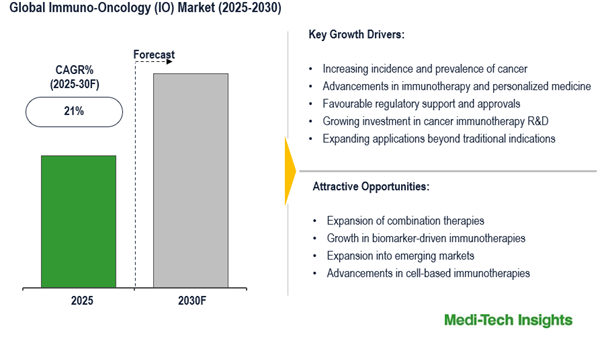
The rising global incidence and prevalence of cancer are major drivers of the immuno-oncology market. With cancer being a leading cause of death worldwide, the demand for advanced, effective treatments is growing. . According to the WHO In 2022, there were an estimated 20 million new cancer cases and 9.7 million deaths, and the cancer cases are expected to increase significantly due to aging populations, lifestyle changes, and environmental factors. And, over 35 million new cancer cases are predicted in 2050, a 77% increase from the estimated in 2022 The increasing cases of lung, colorectal, breast, and prostate cancers necessitate innovative therapies like immune checkpoint inhibitors, CAR-T cell therapies, and cancer vaccines. Additionally, aging populations and lifestyle factors, such as smoking and obesity, contribute to higher cancer rates, further driving market expansion. As a result, pharmaceutical companies are investing heavily in immuno-oncology research to develop novel, targeted therapies that improve patient outcomes and survival rates.
To learn more about the research report, download a sample report.
Advancements in Immuno-Oncology Products: Emerging Therapies and Future Opportunities
The immuno-oncology field is advancing rapidly, with recent FDA approvals of bispecific T-cell engagers (BiTEs) and renewed interest in cancer vaccines, particularly mRNA-based therapies. Cell therapies, including CAR-T, are expanding into new indications and earlier treatment lines, such as non-Hodgkin-s lymphoma (NHL). Bispecific antibodies offer a promising approach by combining T-cell redirection with checkpoint modulation, potentially overcoming T-cell exhaustion. Additionally, dual-targeting immune checkpoint inhibitors (ICIs) may enhance efficacy over traditional combinations. Innovations in modifying the tumor microenvironment to counteract resistance present significant opportunities for the immuno-oncology market, driving new therapeutic strategies and improved patient outcomes.<Competitive Landscape Analysis
The global immuno-oncology market is marked by the presence of established and emerging market players such as Bristol-Myers Squibb Company, Novartis AG, F. Hoffmann-La Roche Ltd, Gilead Sciences, Inc., AstraZeneca, Sanofi, Moderna, Inc., GSK plc, AbbVie Inc., and Merck & Co., Inc.; among others. Some of the key strategies adopted by market players include new product development, strategic partnerships and collaborations, and geographic expansion.
Report Scope
|
Report Scope |
Details |
|
Base Year Considered |
2024 |
|
Historical Data |
2023 - 2024 |
|
Forecast Period |
2025 - 2030 |
|
Growth Rate |
21% |
|
Market Drivers |
|
|
Attractive Opportunities |
|
|
Segment Scope |
Therapy Type, Cancer Type, End User |
|
Regional Scope |
|
|
Key Companies Mapped |
Bristol-Myers Squibb Company, Novartis AG, F. Hoffmann-La Roche Ltd, Gilead Sciences, Inc., AstraZeneca, Sanofi, Moderna, Inc., GSK plc, AbbVie Inc., and Merck & Co., Inc. among others |
|
Report Highlights |
Market Size & Forecast, Growth Drivers & Restraints, Trends, Competitive Analysis |
Market Segmentation
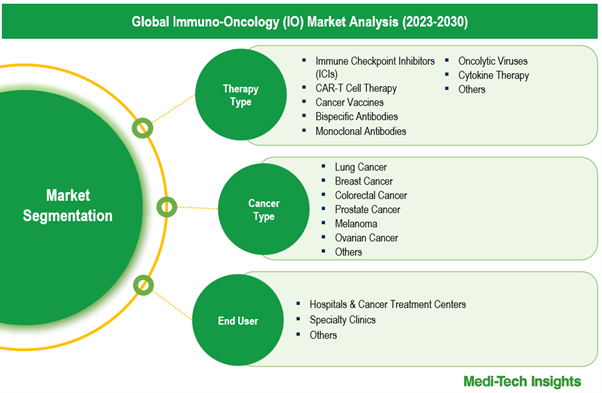
This report by Medi-Tech Insights provides thesize of the global immuno-oncology market at theregional- and country-level from 2023 to 2030. The report further segments the market based on therapy type, cancer type, end user.
- Market Size & Forecast (2023-2030), By Therapy Type, USD Million
- Immune Checkpoint Inhibitors (ICIs)
- CAR-T Cell Therapy
- Cancer Vaccines
- Bispecific Antibodies
- Monoclonal Antibodies
- Oncolytic Viruses
- Cytokine Therapy
- Others
- Market Size & Forecast (2023-2030), By Cancer Type, USD Million
- Lung Cancer
- Breast Cancer
- Colorectal Cancer
- Prostate Cancer
- Melanoma
- Ovarian Cancer
- Others
- Market Size & Forecast (2023-2030), By End User, USD Million
- Hospitals & Cancer Treatment Centers
- Clinics
- Others
- Market Size & Forecast (2023-2030), By Region, USD Million
- North America
- US
- Canada
- Europe
- UK
- Germany
- France
- Italy
- Spain
- Rest of Europe
- Asia Pacific
- China
- India
- Japan
- Rest of Asia Pacific
- Latin America
- Middle East & Africa
- North America
Key Strategic Questions Addressed
- What is the market size & forecast of the immuno-oncology market?
- What are historical, present, and forecasted market shares and growth rates of various segments and sub-segments of the immuno-oncology market?
- What are the key trends defining the market?
- What are the major factors impacting the market?
- What are the opportunities prevailing in the market?
- Which region has the highest share in the global market? Which region is expected to witness the highest growth rate in the next 5 years?
- Who are the major players operating in the market?
- What are the key strategies adopted by players?
Need a More Tailored Analysis?
- Discuss the market sizing methodology and forecast assumptions with our healthcare analysts.
- Expand the scope with additional countries, market segments, technologies, or competitor profiling.
- Use the insights to support strategic planning, market entry, commercial due diligence, and long-term revenue growth initiatives.