Download FREE Sample


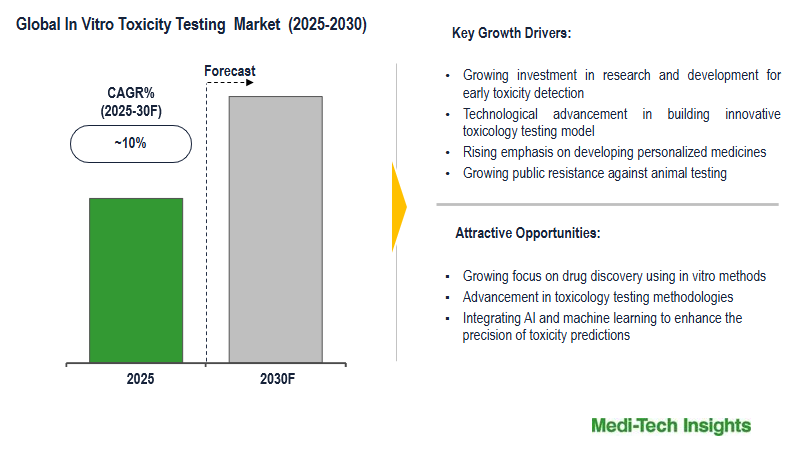
The in vitro toxicity testing market is projected to grow at a CAGR of 10% over the forecast period. Major factors driving growth include growing investment in research and development for early toxicity detection, rising awareness regarding environmental toxicology and its impact on ecosystems, technological advancement in building innovative toxicology testing models, growing public resistance against animal testing, and rising emphasis on developing personalized medicines. However, the market faces certain limitations, such as the possibility that a substance toxic to a single cell line may not exhibit toxicity at the organ level. This occurs because other cells within the organ might compensate for the imbalance.
In vitro toxicity testing is a scientific approach used to study the adverse effects of chemical, biological, or physical agents on cultured cells or tissues in a controlled laboratory environment. The term "in vitro," meaning "in glass," signifies that these tests are conducted in test tubes, Petri dishes, or similar laboratory setups rather than in a living organism (in vivo). In vitro, tests typically focus on the toxicological processes occurring at the cellular and molecular levels. These studies can provide valuable information, such as metabolic pathways, interactions of active metabolites with cellular and molecular targets, and measurable toxic endpoints that may serve as molecular biomarkers of exposure.
To learn more about this report, download the PDF brochure
Growing public resistance against animal testing driving market growth
Public concerns regarding the welfare of animals in research and testing have prompted the implementation of laws and policies designed to minimize or eliminate animal pain and distress. These regulations ensure that animals are used only when scientifically justified and in the smallest numbers necessary to achieve valid scientific results. Currently, in vitro tests often serve as an initial screening tool to assess substances for their mutagenic potential. This aids decision-making on whether in vivo genotoxicity tests are required and, if so, which specific tests to conduct.
In many cases, the availability of in vitro tests has made it possible to avoid in vivo testing altogether during the discovery phase. Moreover, regulatory animal testing may not be required if in vitro genotoxicity tests for chemicals and biocides yield negative results. Additionally, increasing restrictions on animal testing, particularly in regions such as Europe (under REACH regulations) and the US (through FDA modernization initiatives), are significantly driving the growth of in vitro toxicity testing in the market.
Technological advancements in toxicology testing models propel market growth
Advancements in toxicology testing models are revolutionizing the field by enhancing reliability, efficiency, and ethical practices. Emerging technologies such as organoids, artificial intelligence (AI), and omics provide unparalleled insights into human-specific toxicity mechanisms. These innovations reduce reliance on animal models, expedite the development of safer products across industries, and pave the way for more predictive and personalized toxicology approaches. Key trends and cutting-edge technologies driving these advancements include:
To learn more about this report, download the PDF brochure
Competitive Landscape Analysis
The global in vitro toxicity testing market is marked by the presence of established and emerging market players such as Labcorp Drug Development (formerly Covance); Bio-Rad Laboratories; General Electric Company; Eurofins Scientific SE; BioIVT; Charles River Laboratories International; Thermo Fisher Scientific; Agilent Technologies; Catalent; SGS Group; MB Research Laboratories; Tecan Group; Toxicon Corporation; and Cyprotex; among others. Some of the key strategies adopted by market players include new product development, strategic partnerships and collaborations, and investments.
Report Scope
| Report Metric | Details |
| Base Year Considered | 2024 |
| Historical Data | 2023 - 2024 |
| Forecast Period | 2025 - 2030 |
| Growth Rate | 10% |
| Market Drivers |
|
| Attractive Opportunities |
|
| Segment Scope | Product & Service, Method, Technology, Application, and Industry |
| Regional Scope |
|
| Key Companies Mapped | Labcorp Drug Development (formerly Covance); Bio-Rad Laboratories; General Electric Company; Eurofins Scientific SE; BioIVT; Charles River Laboratories International; Thermo Fisher Scientific; Agilent Technologies; Catalent; SGS Group; MB Research Laboratories; Tecan Group; Toxicon Corporation; and Cyprotex |
| Report Highlights | Market Size & Forecast, Growth Drivers & Restraints, Trends, Competitive Analysis |
Global In Vitro Toxicity Testing Market Segmentation
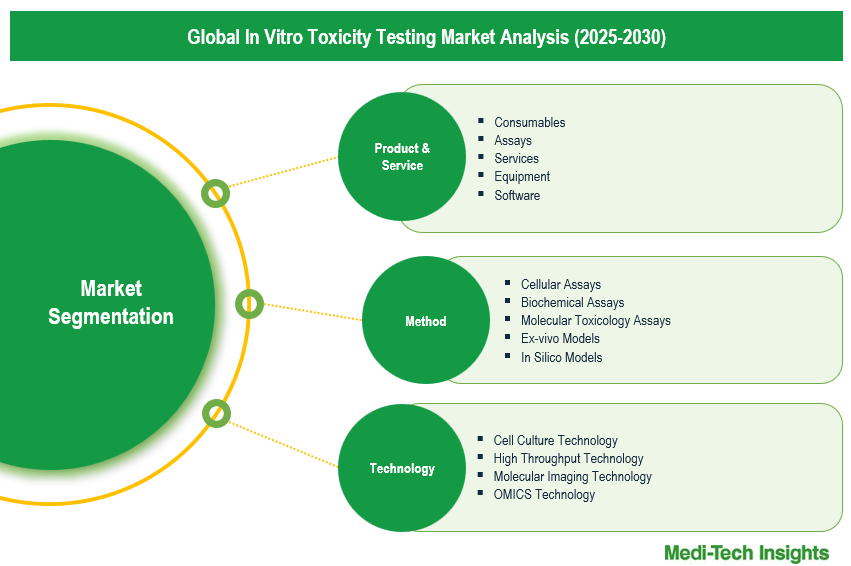
This report by Medi-Tech Insights provides the size of the global in vitro toxicity testing market at the regional- and country-level from 2023 to 2030. The report further segments the market based on product & service, method, technology, application, and industry.
Global In Vitro Toxicity Testing Market Size & Forecast (2023-2030), By Product & Service, USD Million
- Consumables
- Assays
- Services
- Equipment
- Software
Global In Vitro Toxicity Testing Market Size & Forecast (2023-2030), By Method, USD Million
- Cellular Assays
- Biochemical Assays
- Molecular Toxicology Assays
- Ex-vivo Models
- In Silico Models
Global In Vitro Toxicity Testing Market Size & Forecast (2023-2030), By Technology, USD Million
- Cell Culture Technology
- High Throughput Technology
- Molecular Imaging Technology
- OMICS Technology
Global In Vitro Toxicity Testing Market Size & Forecast (2023-2030), By Application, USD Million
- Systemic Toxicology
- Genotoxicity
- Cytotoxicity
- Ocular Toxicity
- Organ Toxicity
- Dermal Toxicity
- Phototoxicity
- Others
Market Size & Forecast (2023-2030), By Region, USD Million
- North America
- US
- Canada
- Europe
- UK
- Germany
- France
- Italy
- Spain
- Rest of Europe
- Asia Pacific
- China
- India
- Japan
- Rest of Asia Pacific
- Latin America
- Middle East & Africa
Need a More Tailored Analysis?
- Discuss the market sizing methodology and forecast assumptions with our healthcare analysts.
- Expand the scope with additional countries, market segments, technologies, or competitor profiling.
- Use the insights to support strategic planning, market entry, commercial due diligence, and long-term revenue growth initiatives.