Download FREE Sample


Report Overview
Interventional radiology (also known as IR) is a minimally invasive, image-guided procedure for diagnosing and treating diseases in nearly every organ system. It utilizes imaging techniques such as X-ray, ultrasound, CT (computed tomography), and MRI (magnetic resonance imaging) to guide small instruments like catheters and needles through the body to treat conditions without the need for open surgery.
To learn more about this report, download the PDF brochure
Rising prevalence of chronic diseases drives market growth
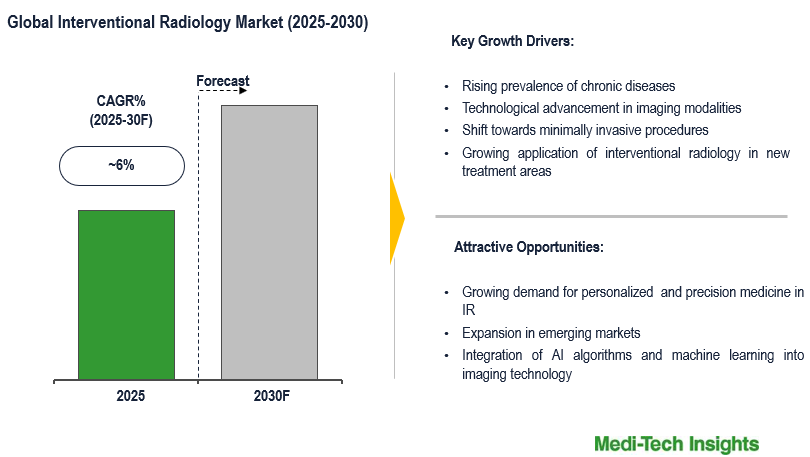
The increasing prevalence of chronic diseases such as cardiovascular disorders, cancer, and neurological conditions is a significant driver of the interventional radiology (IR) market. With the rising global burden of diseases like stroke, peripheral artery disease, and liver cancer, there is a growing need for minimally invasive procedures that offer faster recovery times, reduced complications, and improved patient outcomes. Interventional radiology techniques, including angioplasty, embolization, and tumor ablation, provide effective treatment options for managing these conditions without the need for traditional open surgery. The aging population further contributes to the demand for IR procedures, as older individuals are more susceptible to chronic illnesses requiring continuous monitoring and intervention. As healthcare systems worldwide prioritize early diagnosis and non-surgical treatment methods, the adoption of interventional radiology continues to expand, fueling market growth and technological advancements in imaging and catheter-based interventions.
Technological advancements in imaging modalities fuel its demand
Innovations in MRI, CT, ultrasound, and fluoroscopy have significantly enhanced the precision, safety, and effectiveness of minimally invasive procedures. High-resolution imaging, 3D/4D visualization, and AI-powered image analysis have added a layer of precision to IR procedures, allowing for real-time, three-dimensional visualizations of the targeted area. Coupled with AR, this technology provides radiologists with overlay images for more accurate interventions, reducing risks and improving outcomes. Additionally, portable and hybrid imaging systems are expanding access to IR in outpatient settings and remote areas. The integration of robotics and augmented reality further enhances procedural control and reduces radiation exposure for both patients and physicians. As imaging technologies continue to evolve, interventional radiology is poised for further expansion, offering safer and more effective alternatives to traditional surgical interventions. For instance, In June 2024, GE HealthCare and MediView XR Inc. announced the first installation of the OmnifyXR interventional suite at North Star Vascular and Interventional (NSVI) in Minneapolis, Minnesota. This innovative augmented reality-based interventional radiology suite combines a holographic heads-up display streaming live medical imaging, 3D anatomy model visualization, and advanced imaging technologies while enabling the opportunity for remote collaboration to help advance the delivery of precision care across a variety of interventional procedures
To learn more about this report, download the PDF brochure
Competitive Landscape Analysis
The global interventional radiology market is marked by the presence of established and emerging market players such as GE Healthcare; Koninklijke Philips; Siemens Healthineers; Fujifilm Holdings Corp.; Boston Scientific Corporation; Medtronic; Terumo Corporation; Shimadzu Corp.; Canon Medical Systems Corporation; Carestream Health; Abbott Laboratories; Teleflex Incorporated; Hologic Inc.; Cook Medical; Esaote SpA; Hitachi Medical Corporation; and United Imaging Healthcare; among others. Some of the key strategies adopted by market players include new product development, strategic partnerships and collaborations, and investments.
Report Scope
| Report Metric | Details |
| Base Year Considered | 2024 |
| Historical Data | 2023 - 2024 |
| Forecast Period | 2025 - 2030 |
| Growth Rate | ~6% |
| Market Drivers |
|
| Attractive Opportunities |
|
| Segment Scope | Product, Procedure, Application, and End User |
| Regional Scope |
|
| Key Companies Mapped | GE Healthcare; Koninklijke Philips; Siemens Healthineers; Fujifilm Holdings Corp.; Stryker; Boston Scientific Corporation; Medtronic; Terumo Corporation; Shimadzu Corp.; Canon Medical Systems Corporation; Carestream Health; Abbott Laboratories; Teleflex Incorporated; Hologic Inc.; Cook Medical; Esaote SpA; Hitachi Medical Corporation; and United Imaging Healthcare |
| Report Highlights | Market Size & Forecast, Growth Drivers & Restraints, Trends, Competitive Analysis |
Global Interventional Radiology Market Segmentation
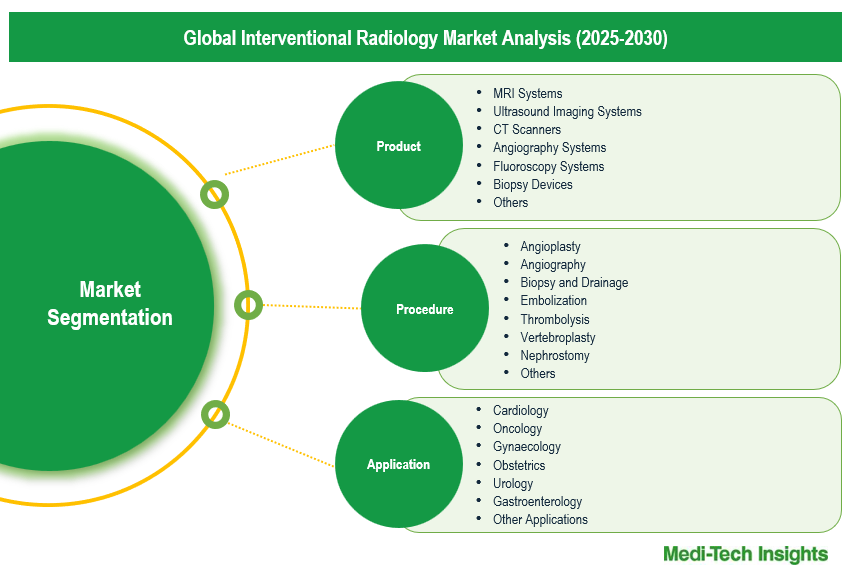
This report by Medi-Tech Insights provides thesize of the global interventional radiology market at theregional- and country-level from 2023 to 2030. The report further segments the market based on product, procedure, application, and end user.
Market Size & Forecast (2023-2030), By Product, USD Million
- MRI Systems
- Ultrasound Imaging Systems
- CT Scanners
- Angiography Systems
- Fluoroscopy Systems
- Biopsy Devices
- Others
Market Size & Forecast (2023-2030), By Procedure, USD Million
- Angioplasty
- Angiography
- Biopsy and Drainage
- Embolization
- Thrombolysis
- Vertebroplasty
- Nephrostomy
- Others
Market Size & Fore), By Application, USD Million
- Cardiology
- Oncology
- Gynaecology
- Obstetrics
- Urology
- Gastroenterology
- Other Applications
Market Size & Forecast (2023-2030), By End User, USD Million
- Hospitals
- Clinics
- Ambulatory Surgical Centers
- Others
Market Size & Forecast (2023-2030), By Region, USD Million
- North America
- US
- Canada
- Europe
- UK
- Germany
- France
- Italy
- Spain
- Rest of Europe
- Asia Pacific
- China
- India
- Japan
- Rest of Asia Pacific
- Latin America
- Middle East & Africa
Need a More Tailored Analysis?
- Discuss the market sizing methodology and forecast assumptions with our healthcare analysts.
- Expand the scope with additional countries, market segments, technologies, or competitor profiling.
- Use the insights to support strategic planning, market entry, commercial due diligence, and long-term revenue growth initiatives.