Download FREE Sample


Overview
Laboratory equipment encompasses a diverse range of devices and tools, including spectrometers, centrifuges, incubators, microscopes, and analytical devices, which are crucial for testing, measuring, and experimenting across different sectors. Some of the equipment has multidisciplinary applications and is becoming a significant part not only in biopharma companies, but also in environmental testing, food safety, forensics, and academia. Furthermore, the integration with digital interfaces and data management tools has enhanced precision and reproducibility in laboratory settings.

To learn more about this report, download the PDF brochure
Automation reshaping the laboratory equipment landscape
Automation is now a core innovation that is redefining the laboratory equipment market, which has led to faster results, increased accuracy, and helps maintain cost efficiency. Moreover, automation has enabled experimenting with larger samples with reduced human errors, improved safety and accelerated experimental cycles, all of which are critical in pharmaceuticals, biotechnology, and academia. Equipment like digital-PCR, smart centrifuge, and automatic pipetting system has boosted drug production, diagnostics, and research reproducibility. Additionally, incorporating AI and IoT in the lab settings has enabled analysis of complex datasets to provide real-time insights, predictive analysis, and improved decision support. Automation also helps to bridge the operational gap due to the shortage of trained technicians across the globe. For instance,
- In June 2024, Thermo Fisher Scientific launched Stellar, a mass spectrometer which can be integrated with cloud-based workflows and UHPLC system, thereby providing high-throughput biomarker verification with 10x increased quantitative sensitivity, enhancing the yield by 90%, and accelerating proteomics research
- InSeptember 2023, Bio-Rad Laboratories, Inc. launched the PTC Tempo 48/48 and PTC Tempo 384 thermal cyclers that are designed to enhance PCR applications such as sequencing, cloning, and genotyping. The 48/48 model features dual blocks that allow two protocols to run simultaneously, while the 384 model includes a motorized lid for automation and robotic integration
- In September 2023, Yourgene Health launched the MagBench, an automated DNA extraction instrument and kit in Asia-Pacific and the Middle East markets. This technology streamlines non-invasive prenatal testing (NIPT) workflows with advanced automation, intuitive touchscreen control, rapid processing times, and adjustabloughput
- In February 2023, SCIEX partnered with Beckman Coulter Life Sciences to integrate the Echo MS acoustic ejection mass spectrometry system with automated liquid handlers, creating a fully automated, high-throughput platform for faster sample processing and enhances precision in applications like drug screening and synthetic biology; supporting the growing shift toward automation in modern laboratories
Cloud-based lab systems driving efficiency, connectivity, and data security
Cloud-based lab management systems have streamlined the workflows in modern diagnostic and research laboratories. These platforms support storage and analysis of a large volume of complex data, enabling digital integration of equipment and sample tracking, further reducing manual errors and enhancing traceability in clinical settings. These systems allow lab professionals to remotely access real-time data, thereby facilitating faster decision-making and helping to streamline opons. Additionally, cloud-based technologies facilitate the integration of AI and machine learning, enabling laboratories to examine extensive datasets for trends, predictive maintenance, and decision-making, especially for multi-site clinical trials and laboratories where consistency and traceability are essential. For instance, in September 2022, BD launched its BD-Research Cloud, a cloud software platform that streamlines the entire flow cytometry workflow, which includes panel design, instrument integration, data analysis, and collaboration, to accelerate research insights and improve experimental efficiency.
To learn more about this report, download the PDF brochure
Competitive Landscape Analysis
The global laboratory equipment market is marked by the presence of established and emerging market players such as Agilent Technologies; Thermo Fisher Scientific Inc.; Bio-Rad Laboratories Inc.; Waters Corporation; Danaher Corporation; Siemens Healthineers; Eppendorf AG; PerkinElmer, Inc.; Pace Analytical Services, Inc.; and Becton, Dickinson and Company among others. Some of the key strategies adopted by market players include new product development, strategic partnerships and collaborations, and geographic expansion.
Report Scope
| Report Metric | Details |
| Base Year Considered | 2024 |
| Historical Data | 2023 - 2024 |
| Forecast Period | 2025 - 2030 |
| Growth Rate | 8% |
| Market Drivers |
|
| Attractive Opportunities |
|
| Segment Scope | Product and End-user |
| Regional Scope |
|
| Key Companies Mapped | Agilent Technologies; Thermo Fisher Scientific Inc.; Bio-Rad Laboratories; Inc., Waters Corporation; Danaher Corporation; Siemens Healthineers; Eppendorf AG; PerkinElmer, Inc.; Pace Analytical Services, Inc.; and Becton, Dickinson and Company among others |
| Report Highlights | Market Size & Forecast, Growth Drivers & Restraints, Trends, Competitive Analysis |
Global Laboratory Equipment Market Segmentation
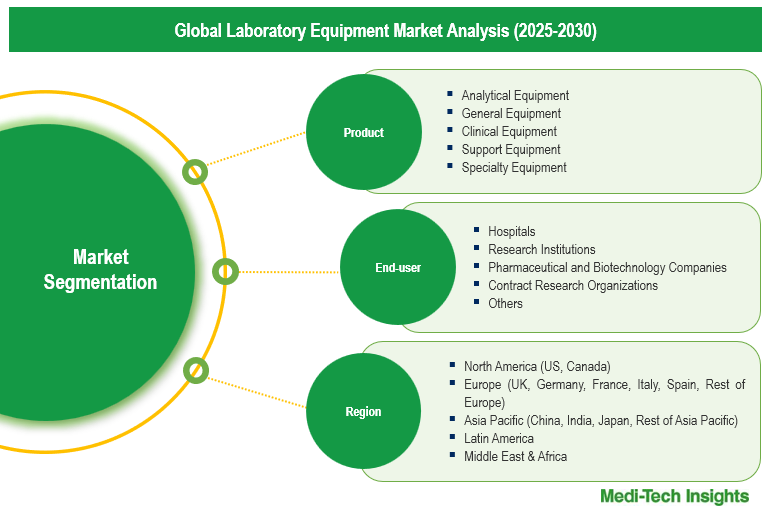
This report by Medi-Tech Insights provides thesize of the global laboratory equipment market at theregional- and country-level from 2023 to 2030. The report further segments the market based on product and end-user.
Market Size & Forecast (2023-2030), By Product, USD Million
- Analytical Equipment
- General Equipment
- Clinical Equipment
- Support Equipment
- Specialty Equipment
Market Size & Forecast (2023-2030), By End-User, USD Million
-
- Hospitals
- Research Institutions
- Pharmaceutical and Biotechnology Companies
- Contract Research Organizations
- Others
Market Size & Forecast (2023-2030), By Region, USD Million
- North America
- US
- Canada
- Europe
- UK
- Germany
- France
- Italy
- Spain
- Rest of Europe
- Asia Pacific
- China
- India
- Japan
- Rest of Asia Pacific
- Latin America
- Middle East & Africa
Need a More Tailored Analysis?
- Discuss the market sizing methodology and forecast assumptions with our healthcare analysts.
- Expand the scope with additional countries, market segments, technologies, or competitor profiling.
- Use the insights to support strategic planning, market entry, commercial due diligence, and long-term revenue growth initiatives.