Download FREE Sample


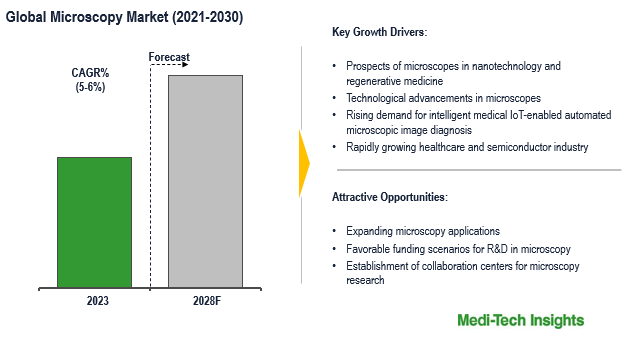
The Global Microscopy Market is expected to witness a CAGR of ~5-6% in the next 5 years. Prospects of microscopes in nanotechnology and regenerative medicine, technological advancements in microscopes, rising demand for intelligent medical IoT-enabled automated microscopic image diagnosis, and the rapidly growing healthcare and semiconductor industry are some of the key factors driving the market.
A microscope is a scientific tool that allows observation of minute objects invisible to the naked eye by enlarging their image through lenses. Over the years, technological advancements in microscopes have enhanced ease of operation and image quality.
The following are the commonly used 5 types of microscopes:
- Stereo Microscopes: Stereo microscopes are widely used in various fields. These microscopes offer 10x to 40x magnification for handheld samples, making them ideal for non-light-transmitting samples
- Compound Microscopes: Compound microscopes are used in labs and education and require samples on slides with coverslips. Students often use pre-prepared slides for efficiency
- Inverted Microscopes: Inverted microscopes are tailored for live samples in petri dishes. They provide magnifications of 40x, 100x, and sometimes 200x and 400x that is crucial for research in various life science fields
- Metallurgical Microscopes: Metallurgical microscopes are designed for high magnification. They are essential for examining samples impermeable to light, with magnifications at 50x, 100x, 200x, and occasionally 500x
- Polarizing Microscopes: Polarizing microscopes utilize polarized light for examining chemicals, rocks, and minerals. They find regular use in geology, petrology, chemistry, and the pharmaceutical industry.
Prospects of Microscope in Nanotechnology and Regenerative Medicine Drives the Market
Substantial investments in nanotechnology research and development are expected to drive the global microscopy market. In the realm of nanomaterial research, the pivotal phase of structural characterization necessitates extensive microscope utilization. Conventional optical microscopes prove inadequate due to the minuscule size of nanomaterials, highlighting the essential role of advanced microscopic tools for in-depth structural and surface analysis at the molecular and atomic levels. This upswing in microscopy application extends beyond nanotechnology, reaching into regenerative medicine research. The field of regenerative medicine, involving therapeutic stem cells, skin cells, tissues, and tissue engineering for functional organ production, has witnessed substantial growth in recent years. The microscope plays a pivotal role in regenerative medicine to quantitatively determine and assess key indicators related to culture state and quality.
Technological Advancements in Microscopes Fuels Demand
Recent technological progress has transformed microscopy, significantly enhancing its capabilities. Advanced microscopic solutions now enable researchers to examine biological and material structures at a heightened resolution and increased accuracy. Super-resolution microscopy, along with advancements in software and image analysis tools, represents the latest developments in the microscopy market. Researchers persistently seek to push the boundaries of microscopy, and the integration of technology into microscopy solutions continues to expand over time. For example, researchers from the University of Texas Southwestern (UTSW), in collaboration with colleagues in Australia and England, have created an optical microscope featuring multi-angle projection imaging systems. This innovation enables users to acquire 3D image information in a significantly reduced timeframe.
Fill out the "Quick Inquiry Form" to request a sample copy.
Microscopy Market - Competitive Landscape
Some of the top key players operating in the market include Carl Zeiss, Bruker, Thermo Fisher Scientific, Nikon, Olympus, NT-MDT Spectrum Instruments, Hitachi High-Tech Corp., JEOL, and Oxford Instruments (Asylum Corporation), among others.
Organic and Inorganic Growth Strategies Adopted by Players to Establish Their Foothold in the Market
Players operating in this market are adopting organic and inorganic growth strategies such as launching new products, acquiring related firms, and entering into collaborations to garner higher market share. For instance,
- In September 2023 Nikon introduced the digital inverted microscope, Smart Imaging System -ECLIPSE Ji-. -ECLIPSE Ji-utilizes AI to automate the acquisition and analysis of cellular images, streamlining research workflows involving cancer and nerve disease ZEISS Microscopy established a strategic collaboration with LabCentral, offering researchers at LabCentral in the United States access to cutting-edge life science microscopy innovations. This partnership aims to provide advanced imaging and analysis solutions, catering to routine cell culture assessment, automated high-resolution imaging of live cells, and whole slide scanning for fixed cells and tissues
- In April 2022, Thermo Fisher Scientific Inc. unveiled an advanced cryo-transmission electron microscope. This cutting-edge instrument was designed for the advancement of future treatments, pharmaceuticals, and diagnostic procedures, providing a distinct competitive advantage for the company
The Microscopy Market is expected to gain further momentum in the coming years due to expanding microscopy applications, favourable funding scenarios for R&D in microscopy, the adoption of electron microscopy in healthcare and life science, and establishment of collaboration centers for microscopy research.
Microscopy Market Scope
|
Report
Metric |
Details |
|
Market Growth |
CAGR of ~5-6%
in the next 5 years. |
|
Historical
data |
2019 – 2023 |
|
Base year |
2024 |
|
Forecast
period |
2024-2030 |
|
Key Driving
Factors |
|
|
Types of
Microscopes |
Stereo
Microscopes, Compound Microscopes, Inverted Microscopes, Metallurgical
Microscopes, Polarizing Microscopes |
|
Market
Drivers al Advancements |
Recent
progress in microscopy includes super-resolution microscopy, advanced
software, and image analysis tools. Example: Optical microscope with
multi-angle projection imaging systems. Integration of technology continues
to expand capabilities. |
|
Competitive
Landscape |
Key Players:
Carl Zeiss, Bruker, Thermo Fisher Scientific, Nikon, Olympus, NT-MDT Spectrum
Instruments, Hitachi High-Tech Corp., JEOL, Oxford Instruments (Asylum
Corporation), among others. |
|
Market
Outlook |
Expected to
gain momentum due to expanding microscopy applications, favorable R&D
funding, adoption of electron microscopy in healthcare and life science, and
collaboration centers for microscopy research. |
Need a More Tailored Analysis?
- Discuss the market sizing methodology and forecast assumptions with our healthcare analysts.
- Expand the scope with additional countries, market segments, technologies, or competitor profiling.
- Use the insights to support strategic planning, market entry, commercial due diligence, and long-term revenue growth initiatives.