Download FREE Sample


Report Overview
Monoclonal antibodies (mAbs) are antibodies produced by a clonal population of B cells and bind to a single target antigen. A therapeutic mAb is a homogenous collection of antibodies used to treat illnesses. mAbs are selected based on their affinity for a target antigen. The target can be a plasma protein, infectious organism, cell surface antigen, or IgG receptor, depending on the mechanism of treatment. mAbs are used in immunotherapies in different ways, like to stimulate the patient-s immune system, to modulate/inhibit a biochemical disease pathway to deliver a therapeutic radionuclide or drug to a target cell type. Therapeutic mAbs exhibit much higher specificity than small molecule drugs, which minimizes adverse side effects, especially when highly toxic drug substances must be delivered.
To learn more about this report, download the PDF brochure
Increasing prevalence of chronic and autoimmune diseases to drive market growth
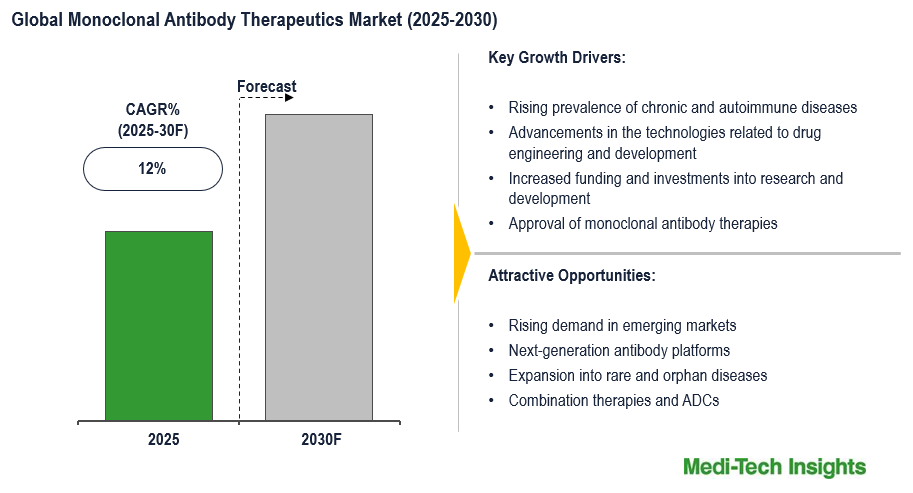
Severity and prevalence of chronic and autoimmune diseases are the key factors driving the market for mAB therapeutics. In 2023, 76.4% of adults over the age of 18 in the US were suffering from at least one chronic illness, this marks an increase from 72.3% reported in 2013. In addition, participants with multiple chronic conditions (two or more) also showed an increase from 47.3% to 51.4% during the same time period (Source: CDC). Furthermore, autoimmune diseases affect 5 to 10% of the population in industrialized countries (Source: Global Autoimmune Institute). The growing prevalence of such chronic and autoimmune diseases is driving the global need for mAbs or monoclonal antibodies which are precise and strongly effective directed therapies. The high specificity of mAbs helps in protecting healthy tissues from damage which greatly improves outcomes. mAbs are most suitable for the treatment of complex immune related disorders due to their ability to target disease related epitope markers, leading to increased mAbs market growth.
Advancements in the technologies related to drug engineering and development to propel market growth
Advancements in-the drug engineering and therapy development technologies are propelling the growth of the monoclonal antibody therapeutics market. Modern advances, including recombinant DNA, high-throughput screening,-and complex cell line development, have pushed therapies to the limits of efficacy, safety, and specificity of treatment with monoclonal antibodies. These approaches enable production of both humanized and completely human, as shielded, or bispecific-antibodies as well as those with improved therapeutic indexes and less side effects. In addition,-the efficacy of mAb of cancer and other diseases can be increased by antibody-drug conjugaicity and potently active drugs. These improvements shorten the timescale taken to develop drugs and reduce-production expenses, expanding the scope of treatable conditions and rendering the market bigger.
To learn more about this report, download the PDF brochure
Competitive Landscape Analysis
The global monoclonal antibody therapeutics market is marked by the presence of established and emerging market players such as F. Hoffmann-La Roche Ltd; AbbVie Inc.; Johnson & Johnson Services, Inc.; Merck & Co., Inc.; Bristol-Myers Squibb (BMS); Amgen Inc.; Novartis AG; Eli Lilly and Company; Sanofi; and AstraZeneca; among others. Some of the key strategies adopted by market players include new product development, strategic partnerships and collaborations, and geographic expansion.
Report Scope
| Report Metric | Details |
| Base Year Considered | 2024 |
| Historical Data | 2023 - 2024 |
| Forecast Period | 2025 - 2030 |
| Growth Rate | ~12% |
| Market Drivers |
|
| Attractive Opportunities |
|
| Segment Scope | Source, Application, End User |
| Regional Scope |
|
| Key Companies Mapped | F. Hoffmann-La Roche Ltd; AbbVie Inc.; Johnson & Johnson Services, Inc.; Merck & Co., Inc.; Bristol-Myers Squibb (BMS); Amgen Inc.; Novartis AG; Eli Lilly and Company; Sanofi; and AstraZeneca; among others |
| Report Highlights | Market Size & Forecast, Growth Drivers & Restraints, Trends, Competitive Analysis |
Global Monoclonal Antibody Therapeutics Market Segmentation
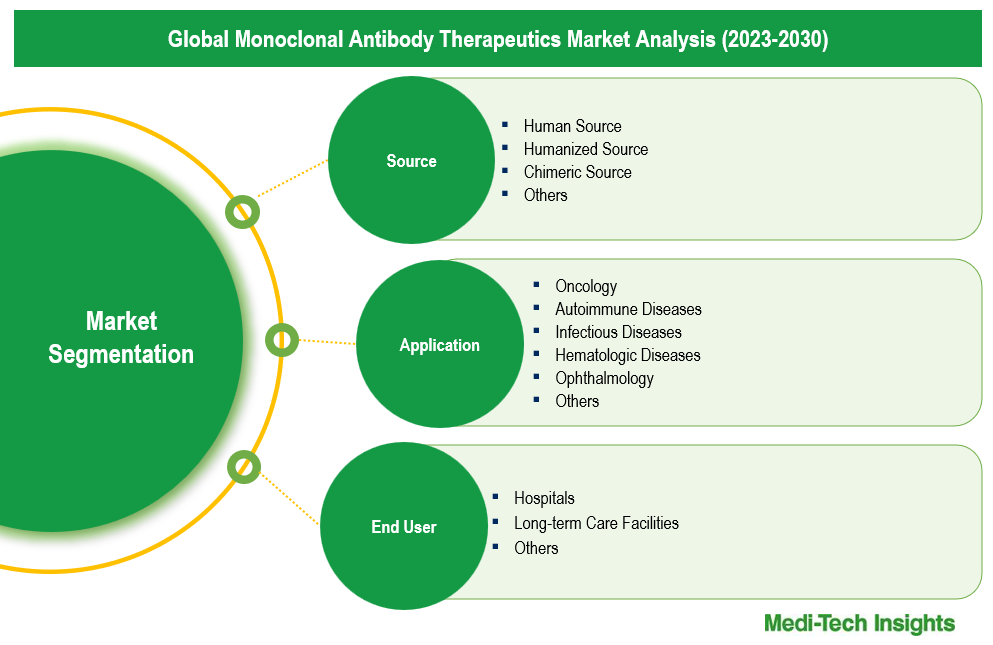
This report by Medi-Tech Insights provides thesize of the global monoclonal antibody therapeutics market at theregional- and country-level from 2023 to 2030. The report further segments the market based on source, application, end user.
Market Size & Forecast (2023-2030), By Source, USD Million
- Human Source
- Humanized Source
- Chimeric Source
- Others
Market Size & Forecast (2023-2030), By Application, USD Million
- Oncology
- Autoimmune Diseases
- Infectious Diseases
- Hematologic Diseases
- Ophthalmology
- Others
Market Size & Forecast (2023-2030), By End User, USD Million
- Hospitals
- Long-term Care Facilities
- Others>Market Size & Forecast (2023-2030), By Region, USD Million
- North America
- US
- Canada
- Europe
- UK
- Germany
- France
- Italy
- Spain
- Rest of Europe
- Asia Pacific
- China
- India
- Japan
- Rest of Asia Pacific
- Latin America
- Middle East & Africa
- North America
Need a More Tailored Analysis?
- Discuss the market sizing methodology and forecast assumptions with our healthcare analysts.
- Expand the scope with additional countries, market segments, technologies, or competitor profiling.
- Use the insights to support strategic planning, market entry, commercial due diligence, and long-term revenue growth initiatives.