Download FREE Sample


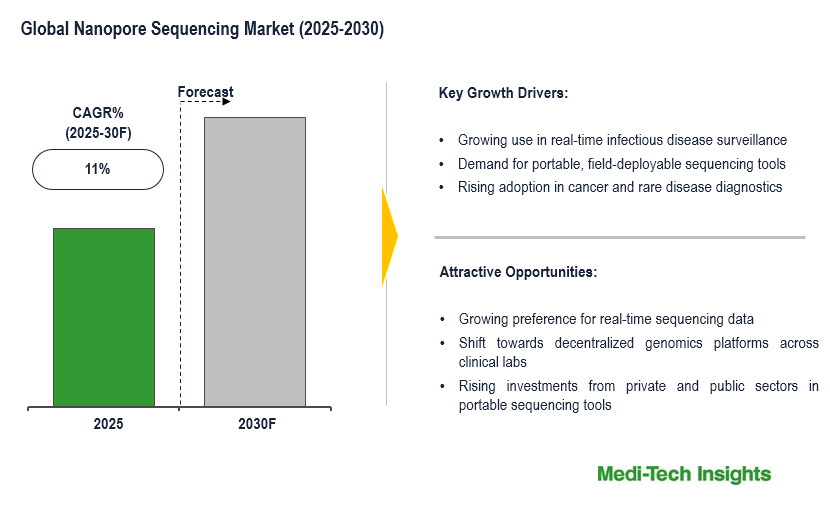
The nanopore sequencing market is expected to grow at a CAGR of approximately 11% during the forecast period, which is primarily driven by the increasing demand for real-time and field-portable DNA sequencing technology, especially in infectious disease studies and clinical diagnostics. However, the market may be hindered due to higher error rates in this sequencing and lack of standardization protocols for sample preparation.
Nanopore sequencing is a DNA sequencing technique that interprets genetic material by detecting alterations in electric current when strands of DNA or RNA pass through a protein pore inserted within a membrane. In contrast to conventional sequencing platforms, the process does not need amplification or labeling of nucleic acid. It supports long-read sequencing in real time and is particularly important for the discovery of structural variants and complex genomic rearrangements. Its portability and flexibility have expanded new avenues across areas from environment monitoring to rapid pathogen identification in remote settings.
To learn more about this report, download the PDF brochure
Real-time diagnostics fuel adoption of portable nanopore sequencing
The increasing adoption of nanopore sequencing in clinical diagnostics and infectious disease monitoring is the primary factor driving market growth. Its capacity to deliver fast, real-time genomic information in near-patient environments is radically changing the way diseases are identified and tracked. During outbreaks such as COVID-19 and antimicrobial resistance, the portability and speed of nanopore devices enabled scientists and health officials to conduct field-based genetic sequencing, unlike with cumbersome laboratory-based platforms. This field suitability has not just accelerated the timeframe to actionable answers but has also democratized access to genomic information in resource-poor settings. Additionally, clinicians can now track viral mutations and trends in bacterial resistance more nimbly, and this means more accurate and timely interventions. With healthcare trending towards advancements in personalized medicine and rapid diagnostics, the practical usefulness of nanopore sequencing is becoming increasingly clear, with a firm foundation in both day-to-day clinical labs and global health initiatives.
To learn more about this report, download the PDF brochure
Biochemical upgrades drive precision in nanopore sequencing tools
One of the key innovations that has improved the performance and reliability of nanopore sequencing is the creation of R10 nanopores. In contrast to previous generations, R10 nanopores have dual reader heads that enhance the resolution of DNA strand detection, particularly in challenging areas such as homopolymers. This has had a direct impact on improved consensus accuracy, solving one of the most quoted limitations of the technology. In addition to these advances, improvements in motor proteins that regulate the rate at which DNA is passed through the pore have notably enhanced signal stability and readability. These innovations are essential since they enable researchers to obtain more consistent results without compromising on the fundamental advantage of portability and the ability to produce long reads. By focusing on the biochemical mechanics of sequencing rather than computation-based solutions to these problems, these innovationsmake the technologyrobust,broadeningits appeal forresearch and diagnosticusesthatrequiregreateraccuracy.
Competitive Landscape Analysis
The global nanopore sequencing market is marked by the presence of established and emerging market players such as QIAGEN"https://nanoporetech.com/">Oxford Nanopore Technologies Limited, Eurofins Scientific, Agilent Technologies, Inc., F. Hoffmann-La Roche Ltd., Bio-Rad Laboratories, Inc., Danaher Corporation, PerkinElmer Inc., Thermo Fisher Scientific, Pacific Biosciences, and Myriad Genetics, Inc. among others. Some of the key strategies adopted by market players include new product development, strategic partnerships and collaborations, and geographic expansion.
Report Scope
| Report Metric | Details |
| Base Year Considered | 2024 |
| Historical Data | 2023 - 2024 |
| Forecast Period | 2025 2030 |
| Growth Rate | 11% |
| Market Drivers |
|
| Attractive Opportunities |
|
| Segment Scope | Product, Type of Nanopore, Type of Nucleotide Sequenced, Application and End-user |
| Regional Scope |
|
| Key Companies Mapped | Pacific Biosciences, Oxford Nanopore Technologies Limited QIAGEN, Eurofins Scientific, Agilent Technologies, Inc., F. Hoffmann-La Roche Ltd., Bio-Rad Laboratories, Inc., Danaher Corporation, PerkinElmer Inc., Thermo Fisher Scientific, and Myriad Genetics, Inc., among others |
| Report Highlights | Market Size & Forecast, Growth Drivers & Restraints, Trends, Competitive Analysis |
Global Nanopore Sequencing Market Segmentation
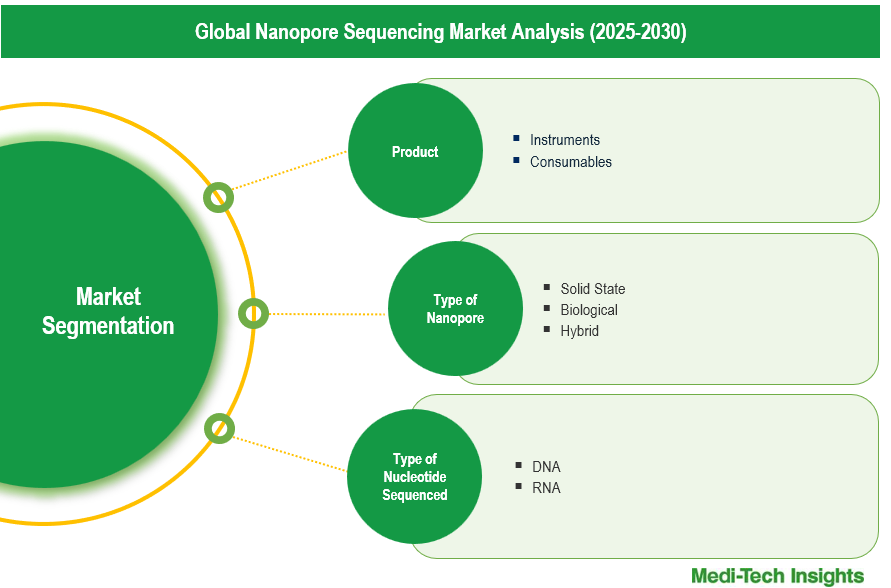
This report by Medi-Tech Insights provides thesize of the global nanopore sequencing market at theregional- and country-level from 2023 to 2030. The report further segments the market based on product, type of nanopore, type of nucleotide sequenced, application and end-user.
Market Size & Forecast (2023-2030), By Product, USD Million
- Instruments
- Consumables
Market Size & Forecast (2023-2030), By Type of Nanopore, USD Million
- Solid State
- Biological
- Hybrid
Market Size & Forecast (2023-2030), By Type of Nucleotide Sequenced, USD Million
- DNA
- RNA
Market Size & Forecast (2023-2030), By Application, USD Million
- Human Gtics
- Clinical Research
- Animal Research
- Others
Market Size & Forecast (2023-2030), By End-user, USD Million
- Biotechnological Companies
- Clinical Laboratories
- Academic & Research Institutes
- Others
Market Size & Forecast (2023-2030), By Region, USD Million
- North America
- US
- Canada
- Europe
- UK
- Germany
- France
- Italy
- Spain
- Rest of Europe
- Asia Pacific
- China
- India
- Japan
- Rest of Asia Pacific
- Latin America
- Middle East & Africa
Key Strategic Questions Addressed
- What is the market size & forecast of the nanopore sequencing market?
- What are historical, present, and forecasted market shares and growth rates of various segments and sub-segments of the nanopore sequencing market?
- What are the key trends defining the market?
- What are the major factors impacting the market?
- What are the opportunities prevailing in the market?
- Which region has the highest share in the global market? Which region is expected to witness the highest growth rate in the next 5 years?
- Who are the major players operating in the market?
- What are the key strategies adopted by players?
Need a More Tailored Analysis?
- Discuss the market sizing methodology and forecast assumptions with our healthcare analysts.
- Expand the scope with additional countries, market segments, technologies, or competitor profiling.
- Use the insights to support strategic planning, market entry, commercial due diligence, and long-term revenue growth initiatives.