Download FREE Sample


Oral administration of protein and peptide drugs offers an appealing alternative to injections, especially for treating chronic conditions like diabetes and hormone-related disorders. To improve absorption and stability, researchers have developed advanced drug delivery systems. Nanocarriers like liposomes and polymeric nanoparticles can encase the drug, shielding it from enzymatic breakdown and promoting uptake. Enteric coatings allow drugs to bypass the stomach and release in more favourable conditions of the intestine. Mucoadhesive formulations extend retention time at the absorption site, increasing the chance of systemic entry. Other approaches include using permeability enhancers that temporarily open tight junctions between intestinal cells and modifying the chemical structure of the drug to improve resistance to degradation.

To learn more about this report, download the PDF brochure
The rising burden of chronic disease is accelerating the expansion of the oral proteins and peptides market
The growing burden of chronic diseases is reshaping the landscape of the oral proteins and peptides market, acting as a catalyst for innovation. Conditions such as type 2 diabetes, obesity, inflammatory bowel disease, and autoimmune disorders are not only increasing but also demanding more patient-friendly treatment options. Traditional injectable therapies, while effective, often pose challenges like pain, inconvenience, and reduced adherence, especially for patients requiring long-term management. This has led to a shift towards oral delivery systems, which are a more comfortable and convenient alternative.
Pharmaceutical companies are investing in advanced technologies that protect proteins and peptides from enzymatic degradation in the gastrointestinal tract. Techniques such as enteoatings, nanoparticle carriers, and permeation enhancers are being refined to improve bioavailability and therapeutic performance. Oral semaglutide, for instance, has emerged as a breakthrough in treating type 2 diabetes and obesity, demonstrating that oral biologics can match the efficacy of injectables while enhancing patient experience.
Additionally, the rise in chronic diseases has fuelled the expansion of oral peptides beyond metabolic disorders, in other therapeutic areas, including neurological conditions like Alzheimer-s, hormonal imbalances, and rare genetic disorders. To conclude, with the increasing geriatric populations and lifestyle-related health issues globally, the demand for non-invasive, effective treatments is expected to accelerate.
To learn more about this report, download the PDF brochure
AI integration in drug discovery is fuelling the market growth
Artificial Intelligence (AI) is becoming an integral part of the development of oral proteins and peptides, aiming to overcome their limited bioavailability and GI-related constraints. Tools like AlphaFold and BioEmu have enabled the prediction of how proteins react with physiological barriers in the human body, which is important for improving their stability and absorption in the digestive system. Deep generative models such as generative adversarial networks (GANs), variational autoencoder (VAE) and diffusion models are being used to create new therapeutic peptides with desired properties such as high stability and target specificity.
AI systems are also being used to forecast oral absorption, toxicity, and formulation techniques, reducing the need for time-consuming and expensive trial-and-error laboratory screening methods. Fomple, AI Platforms like Latent-X allow scientists to design protein binders and macrocycles without needing to write code, making the design process more accessible. AI platforms have enabled researchers to work more efficiently and expand the use of peptides to treat conditions like diabetes, obesity, and Alzheimer-s. These AI-driven tools and insights are helping push the boundaries of what oral drug delivery can achieve in future.
Competitive Landscape Analysis
The global oral proteins and peptides market is marked by the presence of established and emerging market players such as Novo Nordisk A/S; Abbvie Inc.; Oramed Pharmaceuticals Inc.; Pfizer Inc.; Rani Therapeutics Inc.; Acadia Pharmaceuticals Inc.; Johnson and Johnson; AstraZeneca PLC; Aurinia Pharmaceuticals Inc., and Amgen Inc., among others. Some of the key strategies adopted by market players include new product development, strategic partnerships and collaborations, and geographic expansion.
Report Scope
| Report Metric | Details |
| Base Year Considered | 2025 |
| Historical Data | 2024 - 2025 |
| Forecast Period | 2026 - 2031 |
| Growth | 16% |
| Market Drivers |
|
| Attractive Opportunities |
|
| Segment Scope | Molecule, Drug Class, Formulation, Therapeutic Area, and End-user |
| Regional Scope |
|
| Key Companies Mapped | Novo Nordisk A/S; Abbvie Inc.; Oramed Pharmaceuticals Inc.; Pfizer Inc.; Rani Therapeutics Inc.; Acadia Pharmaceuticals Inc.; Johnson and Johnson; AstraZeneca PLC; Aurinia Pharmaceuticals Inc.; and Amgen Inc.; among others |
| Report Highlights | Market Size & Forecast, Growth Drivers & Restraints, Trends, Competitive Analysis |
Global Oral Proteins and Peptides Market Segmentation
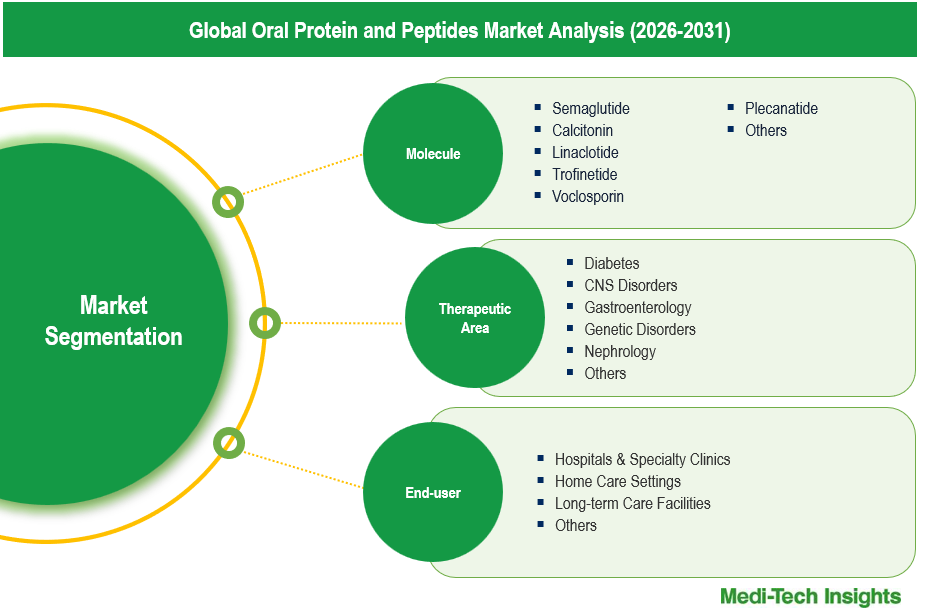
This report by Medi-Tech Insights provides thesize of the global oral proteins and peptides market at theregional- and country-level from 2024 to 2031. The report further segments the market based on molecule, drug class, formulation, therapeutic area, and end-user.
Market Size & Forecast (2024-2031), By Molecule, USD Million
- Semaglutide
- Calcitonin
- Linaclotide
- Trofinetide
- Voclosporin
- Plecanatide
- Others
Market Size & Forecast (2024-2031), By Drug Class, USD Million
- GLP-1 Receptor Agonists
- CGRP Receptor Agonists
- GC-C Agonists
- GPE
- Others
Market Size & Forecast (2024-2031), By Formulation, >
- Tablets
- Capsules
- Oral Solutions
Market Size & Forecast (2024-2031), By Therapeutic Area, USD Million
- Diabetes
- CNS Disorders
- Gastroenterology
- Genetic Disorders
- Nephrology
- Others
Market Size & Forecast (2024-2031), By End-user, USD Million
- Hospitals & Specialty Clinics
- Home Care Settings
- Long-term Care Facilities
- Others
Market Size & Forecast (2024-2031), By Region, USD Million
- North America
- US
- Canada
- Europe
- UK
- Germany
- France
- Italy
- Spain
- Rest of Europe
- Asia Pacific
- China
- India
- Japan
- Rest of Asia Pacific
- Latin America
- Middle East & Africa
Need a More Tailored Analysis?
- Discuss the market sizing methodology and forecast assumptions with our healthcare analysts.
- Expand the scope with additional countries, market segments, technologies, or competitor profiling.
- Use the insights to support strategic planning, market entry, commercial due diligence, and long-term revenue growth initiatives.