Download FREE Sample


Report Overview
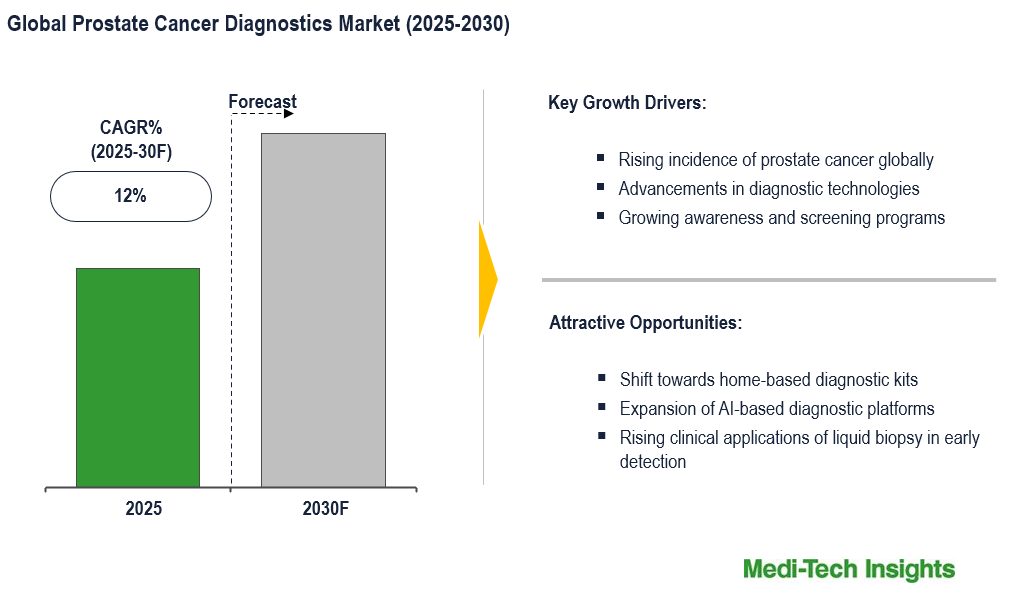
Prostate cancer has become a common type of cancer and one of the leading causes of cancer-related deaths in men. It predominantly affects the older male population, especially those who are above 60 and are at higher risk of detection. It causes urinary problems such as blood in urine, frequent urination, and also affects bones and causes mobility issues when cancer reaches advanced stages. The disease is generally asymptomatic in its early stages, so routine screening becomes necessary, especially for high-risk individuals with a genetic predisposition or family history, as early detection can improve survival outcomes.
To learn more about this report, download the PDF brochure
Surge in cancer incidence and demand for reliable testing drives the market
According to the National Centre for Biotechnology Information (NCBI), the incidence of prostate cancer has significantly increased from 6.3 to 83.4 per 100,000 people. Aging is considered a major risk factor as it is more prevalent in men above 60. The numbers are expected to further rise in the coming years with an increase in life expectancy and a sedentary lifestyle. Further, according to an article published by WHO, in 2023, there were 1.5 million cases of prostate cancer, approximately 7.3% of total reported cancer cases, making it the most common type after lung, breast, and colorectal cancer. This rise in the number of prostate cancer cases is a primary driver of the market; thereby increasing demand for accurate and reliable diagnostics tools. For instance,
Advances in diagnostic technologies fuel market growtrong>
Prostate-specific antigen (PSA) testing is the standard test to diagnose prostate cancer. Due to PSA-s limitations, including its inability to detect slow-growing tumours, there has been a shift toward sophisticated tools like multi-parametric MRI, liquid biopsies, and genomic assays, enabling better differentiation between indolent and aggressive tumours. These advanced techniques offer better accuracy and are more reliable, which have significantly improved early detection, therapy planning, and recovery outcomes. Some of the related developments are listed below-
- In December 2024, Siemens Healthineers acquired Advanced Accelerator Applications from Novartis, strengthening its molecular imaging capabilities with PSMA-targeted PET tracers for precision cancer diagnostics
- In October 2024, Prostate Cancer Foundation of Australia (PCFA) and the Australian and New Zealand Urogenital and Prostate Cancer Trials Group (ANZUP) entered into a three-year research partnershielerate clinical trials and drive therapeutic innovations for advanced and aggressive prostate cancer
- In May 2024, MDxHealth announced a collaboration with the University of Oxford to clinically validate its Genomic Prostate Score (GPS) test to predict prostate cancer progression following localized treatment, thereby improving risk stratification and guiding personalized patient management
- In June 2022, Roche launched the BenchMark ULTRA PLUS platform, streamlining immunohistochemistry assays to detect prostate cancer biomarkers more consistently and efficiently
Adoption of non-invasive and liquid biopsy techniques to drive demand for prostate cancer diagnostics
Traditionally, prostate cancer detection biopsy methods like tissue or transrectal ultrasound-guided (TRUS) were painful and caused infection, discomfort, and anxiety in patients. The emergence of non-invasive liquid biopsies serves as a better alternative as they detect cancer by analyzing body fluids like blood and urine. When integrated with digital PCR and next-generation sequencing (NGS), it increases the specificity and sensitivity. Advanced medical tests like MyProstateScore 2.0 and PCA3 tests urine, facilitate in early detection of cancer. For instance, some notable progress includes,
- In February 2025, Myriad Genetics entered into a strategic collaboration with PathomIQ to integrate its AI-powered PATHOMIQ_PRAD platform into Myriad-s oncology portfolio, aiming to enhance prostate cancer diagnostics by leveraging advanced image-based analytics to improve treatment decisions and support the upcoming launch of a new diagnostic test
- In September 2024, Novigenix received a -1.75-million Eurostars grant to lead the MY-SIGNATURE consortium in developing MYELO-SCAN, the world-s first liquid biopsy designed to predict intratumoral myeloid-derived suppressor cell (MDSC) infiltration in metastatic castration-resistant pros resistance prediction and improve patient outcomes
To learn more about this report, download the PDF brochure
Competitive Landscape Analysis
The global prostate cancer diagnostics market is marked by the presence of established and emerging market players such as F. Hoffmann-La Roche Ltd, Abbott, MDx Healthcare, Inc., Myriad Genetics, Siemens Healthineers, ACON Laboratories, Humasis, Opko Health Inc., Beckman Coulter, Inc., Ipsen Pharma, Diasorin, among others. Some of the key strategies adopted by market players include new product development, strategic partnerships and collaborations, and geographic expansion.
Report Scope
| Report Metric | Details |
| Base Year Considered | 2024 |
| Historical Data | 2023 - 2024 |
| Forecast Period | 2025 - 2030 |
| Growth Rate | ~12% |
| Market Drivers |
|
| Attractive Opportunities |
|
| Segment Scope | Type, Test Type, and End-user |
| Regional Scope |
|
| Key Companies Mapped | F. Hoffmann-La Roche Ltd, Abbott, MDx Healthcare, Inc., Myriad Genetics, Siemens Healthineers, ACON Laboratories, Humasis, Opko Health, Beckman Coulter, Inc., Diasorin, Ipsen Pharma, among others |
| Report Highlights | Market Size & Forecast, Growth Drivers & Restraints, Trends, Competitive Analysis |
Global Prostate Cancer Diagnostics Market Segmentation
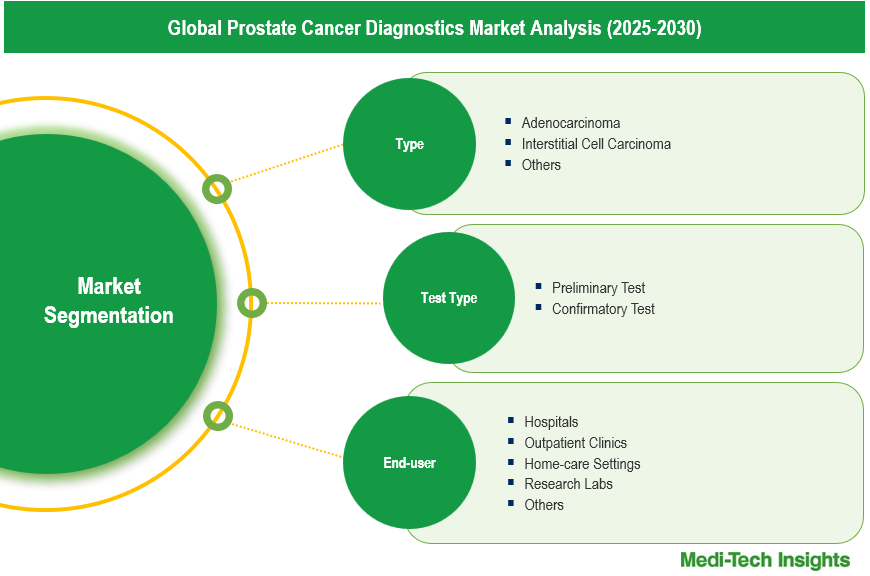
This report by Medi-Tech Insights provides thesize of the global prostate cancer diagnostics market at theregional- and country-level from 2023 to 2030. The report further segments the market based on type, test type, and end-user.
Market Size & Forecast (2023-2030), By Type, USD Million
- Adenocarcinoma
- Interstitial Cell Carcinoma
- Others
Market Size & Forecast (2023-2030), By Test Type, USD Million
- Preliminary Tests
- PSA Tests
- Free PSA Test
- Total PSA Test
- Others
- Confirmatory Tests
- Pca3 Test
- Trans-Rectal Ultrasound
- Biopsy Test
- Others
Market Size & Forecasty End-user, USD Million
- Hospitals
- Outpatient Clinics
- Home-care Settings
- Research Labs
- Others
Market Size & Forecast (2023-2030), By Region, USD Million
- North America
- US
- Canada
- Europe
- UK
- Germany
- France
- Italy
- Spain
- Rest of Europe
- Asia Pacific
- China
- India
- Japan
- Rest of Asia Pacific
- Latin America
- Middle East & Africa
Need a More Tailored Analysis?
- Discuss the market sizing methodology and forecast assumptions with our healthcare analysts.
- Expand the scope with additional countries, market segments, technologies, or competitor profiling.
- Use the insights to support strategic planning, market entry, commercial due diligence, and long-term revenue growth initiatives.