Download FREE Sample


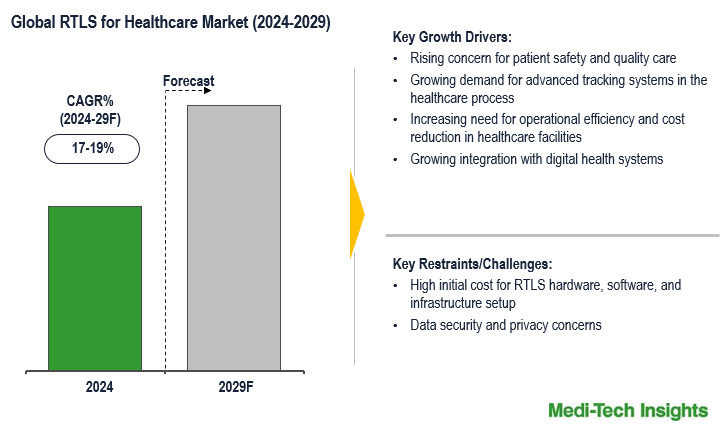
Real-Time Location Systems (RTLS) in healthcare enable instant tracking and management of medical equipment, staff, and patients across various care settings. An RTLS setup includes fixed receivers or readers (location sensors) that capture wireless signals from small ID badges or tags attached to specific objects or individuals. This allows for accurate determination of the location of tagged items or people within a facility or designated indoor or outdoor area.
To learn more about the research report, download a sample report.
Adoption of technology-enabled RTLS solutions propels market growth
RTLS technology is transforming healthcare operations by significantly improving patient safety and boosting operational efficiency with exceptional accuracy. This advanced technology is not only redefining emergency response capabilities but also optimizing everyday workflows within medical facilities. RTLS in healthcare relies on various technologies. These include RFID (Radio Frequency Identification), Wi-Fi, and ultrasound for tracking. Each technology has its unique strengths such as:
- RFID for Inventory and Asset Management: RFID offers both passive and active tags. They are increasingly gaining popularity in RTLS for tracking medical equipment, inventory, and other assets accurately, making it easier to manage equipment maintenance, reduce loss, and increase utilization.
- Ultra-Wideband (UWB) for Precision: UWB technology is being adopted for its high accuracy in indoor positioning, which is especially beneficial for tracking sensitive or high-value equipment, and precise location needs in critical areas like operating rooms.
- Wi-Fi for cost reduction: Wi-Fi-based RTLS uses existing healthcare facility networks. This makes it a cost-effective choice for large areas.
To learn more about the research report, download a sample report.
Growing demand for RTLS solutions in hospital settings drives market growth
RTLS plays a crucial role in improving patient care, optimizing workflows, and ensuring the safety and efficiency of clinicians and staff in healthcare settings. The data insights generated by an RTLS system can drive impactful, long-term decisions across the organization, leading to substantial positive outcomes such as:
- Supports Patient and Staff Safety in Hospitals: RTLS enhances patient and staff safety by providing real-time location information. It helps prevent patient elopement, reduces response times during emergencies, hospital-acquired infections, or physical attacks, and ensures that patients are receiving the right care in the right place.
- Improves Patient Experience: RTLS reduces wait times by optimizingent flow within hospitals, monitoring patient wait times, and reallocating resources as necessary. This enhancement improves the patient experience and alleviates congestion in high-traffic areas like the ER. Additionally, RTLS enables caregivers to provide more personalized care by anticipating patients' needs through real-time location data, ultimately boosting patient satisfaction.
- Streamlines Workflow: RTLS streamlines workflows in healthcare by providing real-time visibility into the location and status of patients, staff, and equipment. Tracking patient flow for throughput management can also help to recognize and address bottlenecks such as long wait times, overcrowding in outpatient clinics, emergency rooms, and post-anesthesia care units, delayed or rescheduled surgeries, and not having enough beds for patients.
- Reduces Cost with Analytics: RTLS can also help integrate your data systems and streamline information across the entire health system. This is especially helpful when considering hospital business processes.
Competitive Landscape Analysis
The global RTLS for healthcare market is marked by the presence of innovative and emerging market players such as Securitas Healthcare LLC., Zebra Technologies Corp., Hewlett Packard Enterprise Development LP, Impinj Inc., TeleTracking Technologies Inc., CenTrak, Inc., GE HealthCare, Stanley Healthcare, AiRISTA Flow Inc., Sonitor Technologies, and Midmark Corporation, among others. Some of the key strategies adopted by the market players include product launches, mergers and acquisitions, strategic partnerships, and collaborations.
Report Scope
| Report Scope | Details |
| Base Year Considered | 2023 |
| Historical Data | 2022 - 2023 |
| Forecast Period | 2024 - 2029 |
| Market Drivers |
|
| Key Market Trends |
|
| Segment Scope | Offering, Technology, Application, Facility Type |
| Regional Scope |
|
| Key Companies Mapped | Securitas Healthcare LLC., Zebra Technologies Corp., Hewlett Packard Enterprise Development LP, Impinj Inc., TeleTracking Technologies Inc., CenTrak, Inc., GE HealthCare, Stanley Healthcare, AiRISTA Flow Inc., Sonitor Technologies, and Midmark Corporation, among others |
| Report Highlights | Market Size & Forecast, Growth Drivers & Restraints, Trends, Competitive Analysis |
Market Segmentation
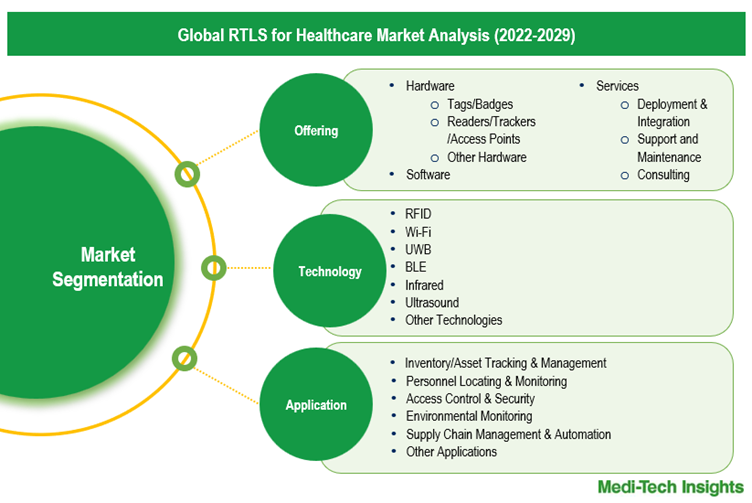
This report by Medi-Tech Insights provides thesize of the global RTLS for healthcare market at theregional- and country level from 2022 to 2029. The report further segments the market based on offering, technology, application, and facility type.
- Market Size & Forecast (2022-2029), By Offering, USD Million
- Hardware
- Tags/Badges
- Readers/Trackers/Access Points
- Other Hardware
- Software
- Services
- Deployment & Integration
- Support and Maintenance
- Consulting
- Hardware
- Market Size & Forecast (2022-2029), By Technology, USD Million
- RFID
- Wi-Fi
- UWB
- BLE
- Infrared
- Ultrasound
- Other Technologies
- Market Size & Forecast (2022-2029), By Application, USD Million
- Inventory/Asset Tracking & Management
- Personnel Locating & Monitoring
- Environmental Monitoring
- Supply Chain Management & Automation
- Other Applications
- Market Size & Forecast (2022-2029), By Facility Type, USD Million
- Hospital & Healthcare Facilities
- Senior Living Facilities
- Market Size & Forecast (2022-2029), By Region, USD Million
- North America
- US
- Canada
- Europe
- UK
- Germany
- France
- Italy
- Spain
- Rest of Europe
- Asia Pacific
- China
- India
- Japan
- Rest of Asia Pacific
- Latin America
- Middle East & Africa
- North America
Frequently Asked Questions About This Report
What is the market size & forecast of the RTLS for healthcare market?
What are the historical, present, and forecasted market shares and growth rates of various segments and sub-segments of the RTLS for healthcare market?
What are the key trends defining the market?
What are the major factors impacting the market?
What are the opportunities prevailing in the market?
Need a More Tailored Analysis?
- Discuss the market sizing methodology and forecast assumptions with our healthcare analysts.
- Expand the scope with additional countries, market segments, technologies, or competitor profiling.
- Use the insights to support strategic planning, market entry, commercial due diligence, and long-term revenue growth initiatives.