Download FREE Sample


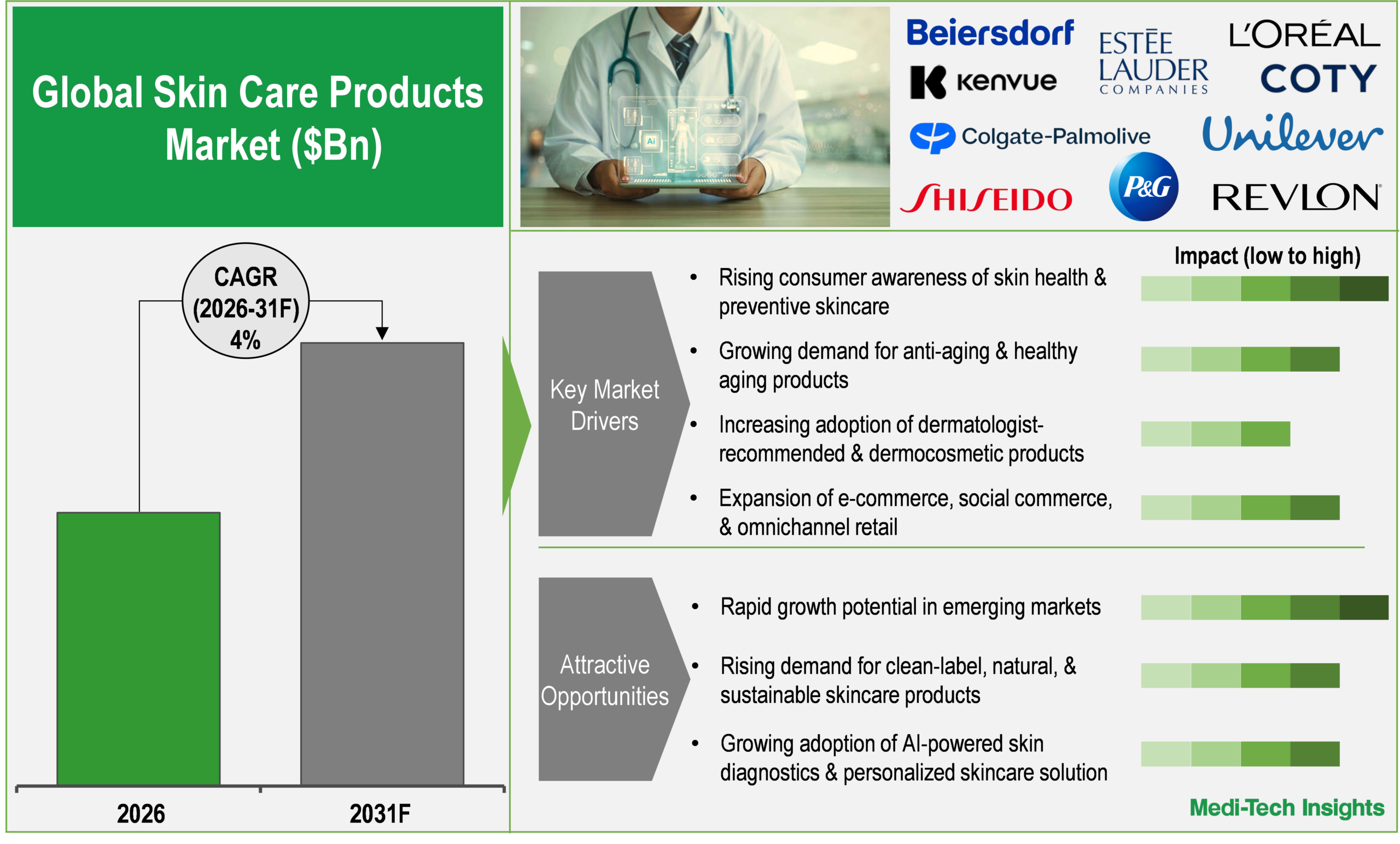
The global skin care products market size is set to
grow at 4% CAGR over the next 5 years. Rising consumer awareness
of skin health & preventive skincare; growing demand for anti-aging &
healthy aging products; increasing adoption of dermatologist-recommended &
dermocosmetic products; expansion of e-commerce, social commerce, &
omnichannel retail; and innovation in active ingredients & personalized
skincare solutions are some of the key factors driving the growth of the global
market. However, intense market competition and product saturation, stringent
regulatory requirements & ingredient safety concerns, and counterfeit
products are expected to impact the market’s growth.
Skin care products encompass a wide range of creams, lotions, serums, and other formulations designed to improve skin health and appearance. These products target various concerns, including moisturizing, anti-aging, acne treatment, and sun protection. With the rising trend of holistic beauty and personalized skincare regimens, consumers are increasingly seeking products that address specific skin types and conditions, boosting the demand for innovative skincare solutions.
Rising consumer awareness of skin health & preventive skincare to drive market growth
Rising consumer awareness of skin health and preventive skincare is one of the primary factors driving the growth of the global skin care products market. Consumers are increasingly recognizing that maintaining healthy skin requires consistent daily care rather than treating skin concerns only after they develop. This shift in behaviour has significantly increased demand for products such as facial cleansers, moisturizers, sunscreens, serums, and barrier repair creams that help protect the skin from environmental damage, dehydration, and premature aging.
Growing access to dermatological information through healthcare professionals, skincare specialists, digital health platforms, and social media has further strengthened consumer understanding of preventive skincare practices. Increasing awareness of the harmful effects of ultraviolet (UV) radiation, air pollution, blue light exposure, and lifestyle-related skin damage has also encouraged the routine use of sun protection and antioxidant-based skincare products. At the same time, consumers are seeking formulations containing clinically validated active ingredients such as hyaluronic acid, niacinamide, retinol, ceramides, and vitamin C to support long-term skin health.
The expanding focus on preventive skincare across younger demographics, coupled with rising demand for dermatologist-recommended and science-backed formulations, is encouraging continuous product innovation. As skincare increasingly becomes an essential component of personal wellness and self-care, manufacturers are investing in advanced formulations, personalized solutions, and premium product offerings, supporting sustained growth of the global skin care products market throughout the forecast period.
To learn more about this report, download the PDF brochure
Rapid growth potential in emerging markets to create significant growth opportunities
Emerging markets are expected to offer substantial growth opportunities for the global skin care products market during the forecast period. Countries across Asia Pacific, Latin America, the Middle East, and Africa are experiencing rapid urbanization, rising disposable incomes, and an expanding middle-class population, all of which are contributing to higher spending on personal care and skincare products. As consumers become increasingly aware of skin health, preventive skincare, and premium beauty products, demand for facial care, sun protection, anti-aging solutions, and specialized skincare formulations continues to rise.
The rapid expansion of organized retail networks, specialty beauty stores, pharmacies, and e-commerce platforms has significantly improved the accessibility of both domestic and international skincare brands in these regions. In addition, increasing internet penetration, smartphone usage, and the influence of social media and beauty influencers are accelerating consumer awareness of global skincare trends and encouraging the adoption of multi-step skincare routines. International manufacturers are also strengthening their presence through localized product portfolios, strategic partnerships, and investments in regional manufacturing and distribution capabilities to better address diverse consumer preferences and skin types.
As purchasing power continues to improve and demand shifts toward high-quality, science-backed, and premium skincare products, emerging economies are expected to remain key revenue-generating markets, creating long-term growth opportunities for skincare manufacturers and retailers worldwide.
Popularity of personalized & AI-driven skincare regimens: a key market trend
The growing popularity of personalized and AI-driven skincare regimens is emerging as a major trend shaping the global skin care products market. Consumers are increasingly moving away from one-size-fits-all skincare products and seeking personalized solutions tailored to their unique skin type, age, lifestyle, environmental exposure, and specific concerns such as acne, pigmentation, sensitivity, dehydration, and premature aging. This shift is encouraging skincare companies to leverage artificial intelligence (AI), machine learning (ML), and digital diagnostics to deliver more precise product recommendations and customized skincare routines.
AI-powered skin analysis tools, mobile applications, virtual consultations, and connected beauty devices enable consumers to assess their skin condition in real time and receive personalized recommendations based on data-driven insights. These technologies not only improve customer experience but also help brands strengthen consumer engagement, increase product effectiveness, and build long-term brand loyalty. In addition, advancements in predictive analytics and digital health technologies are enabling manufacturers to develop customized formulations and targeted skincare solutions that address individual skin needs more effectively.
Leading skincare brands are increasingly investing in AI-enabled platforms, smart beauty technologies, and personalized product portfolios to differentiate themselves in a competitive marketplace. As consumers continue to prioritize efficacy, convenience, and scientifically backed skincare solutions, personalized and AI-driven skincare is expected to become a defining trend, supporting innovation and long-term growth in the global skin care products market.
To learn more about this report, download the PDF brochure
Product Type Segment Outlook
The face creams & moisturizers segment is expected to account for the largest share of the global skin care products market due to their widespread daily use across all age groups and skin types. These products are essential for maintaining skin hydration, strengthening the skin barrier, and addressing concerns such as dryness, sensitivity, and premature aging. Growing consumer awareness of preventive skincare, coupled with increasing demand for formulations containing active ingredients such as hyaluronic acid, ceramides, and niacinamide, continues to drive the segment's growth.
The sunscreen segment is projected to witness the fastest growth during the forecast period, driven by rising awareness of the harmful effects of UV radiation and the increasing adoption of preventive skincare practices. Consumers are incorporating sunscreens into their daily routines to protect against photoaging, pigmentation, and skin cancer risks. Product innovations, including lightweight, broad-spectrum, mineral-based, and multifunctional formulations, are further supporting the rapid growth of this segment in the global skin care products market.
Regional Outlook: Asia Pacific accounted for the largest share, driven by its large consumer base and rising disposable incomes
The Asia-Pacific region is expected to account for the largest share of the global skin care products market, driven by its large consumer base, rising disposable incomes, and strong beauty and personal care culture. Growing awareness of skincare, rapid urbanization, and the popularity of K-Beauty and J-Beauty trends are fuelling demand across both mass-market and premium product categories. Additionally, expanding e-commerce channels and continuous product innovation by regional and global brands are supporting market growth.
The Middle East & Africa region is projected to witness the fastest growth during the forecast period, supported by increasing consumer spending on personal care, rising urbanization, and expanding retail and e-commerce networks. Growing beauty consciousness, a young population, and increasing availability of international skincare brands are driving product adoption. In addition, rising demand for premium skincare and products tailored to regional climatic conditions is expected to accelerate market growth.
Competitive Landscape Analysis
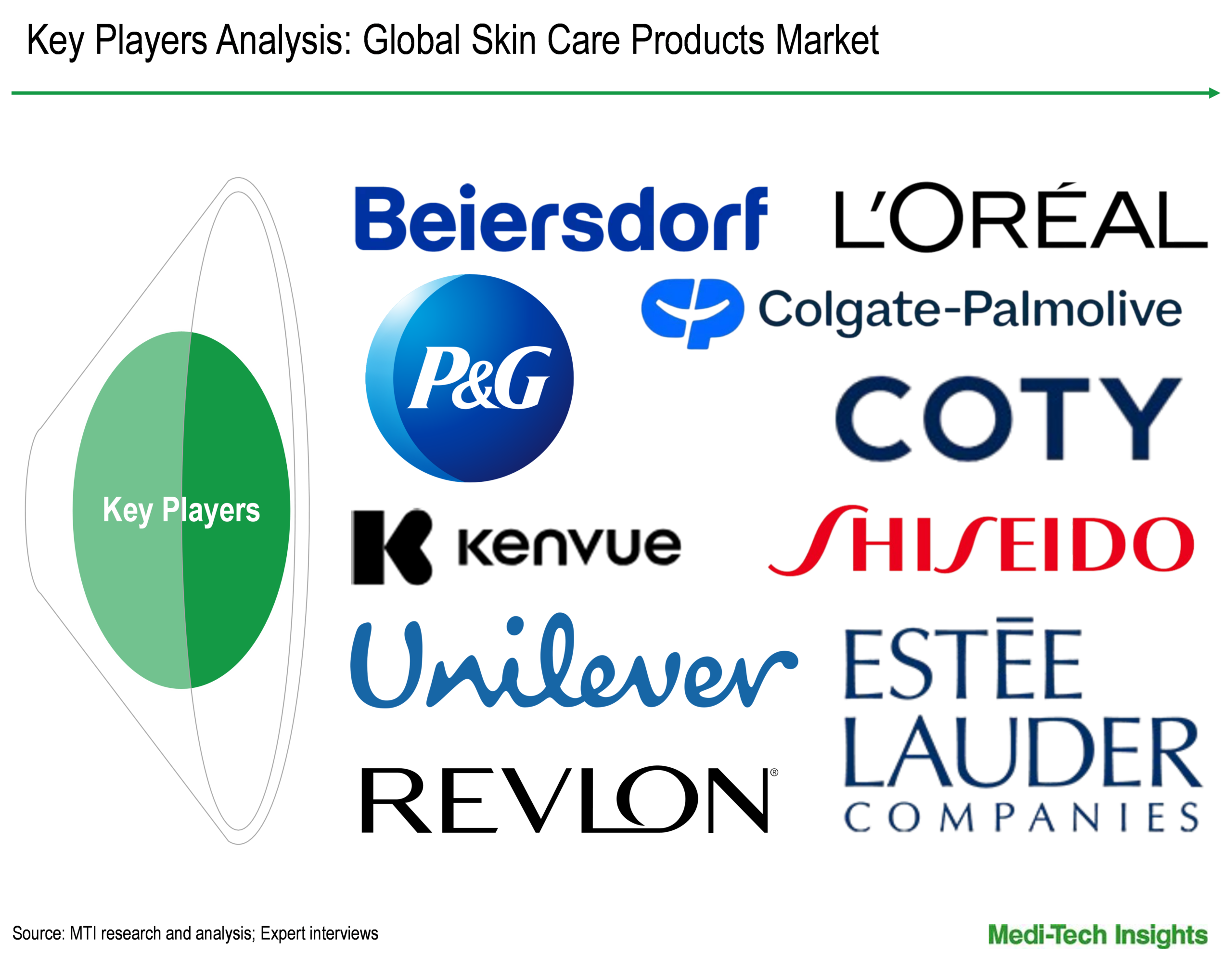
The global skin care products market is marked by the presence of established and emerging market players such as-
- L’Oréal S.A.
- Shiseido Co., Ltd
- Beiersdorf AG
- Procter & Gamble (P&G)
- Kenvue Inc. (acquired by Kimberly-Clark)
- Unilever
- Avon Products, Inc.
- Coty Inc.
- Este Lauder Companies
- Revlon
- Colgate-Palmolive
Get a sample report for competitive landscape analysis
Growth strategies adopted by players to establish their foothold in the skin care products market
Players operating in this market are adopting various growth strategies such as new product launch; acquisitions; expansions; and strategic partnerships, agreements, and collaborations, to garner market share. For instance,
- In March 2026, Coty launched Lancaster Sun Perfect Air SPF 50, a hybrid skincare and sun protection range featuring Full Light Technology and AIR-O- Technology to protect against UV damage, repair photoaging, and strengthen its premium skincare portfolio with multifunctional sun care solutions.
- In December 2025, Beiersdorf launched Eucerin in Japan, introducing its dermatologist-recommended skincare portfolio to one of the world's largest beauty markets. The launch strengthens the company's pia-Pacific and supports its global premium skincare expansion strategy
- In June 2025, L'Oréal signed an agreement to acquire Color Wow, expanding L'Oréal's Professional Products Division, strengthening its premium beauty portfolio, and enhancing its presence across global salon and professional channels
- In February 2025, The Este Lauder Companies partnered with Serpin Pharma to explore anti-inflammatory peptide technology for skincare, supporting the development of next-generation, science-backed formulations designed to reduce skin irritation, improve skin health, and promote healthy aging
Report Scope
Report Metric | Details |
Base Year Considered | 2025 |
Historical Data | 2024 – 2025 |
Forecast Period | 2026 – 2031 |
Growth Rate | 4% |
Segment Scope | Product Type, Formulation Type, Gender, and Distribution Channel |
Regional Scope |
|
Market Drivers |
|
Attractive Opportunities |
|
Key Companies Mapped | L’Oréal S.A.; Shiseido Co., Ltd.; Beiersdorf AG; Procter & Gamble (P&G); Kenvue Inc. (acquired by Kimberly-Clark); Unilever; Avon Products, Inc.; Coty Inc.; Estée Lauder Companies; Revlon; Colgate-Palmolive; among others |
Report Highlights | Market Size & Forecast, Growth Drivers & Restraints, Trends, Competitive Analysis |
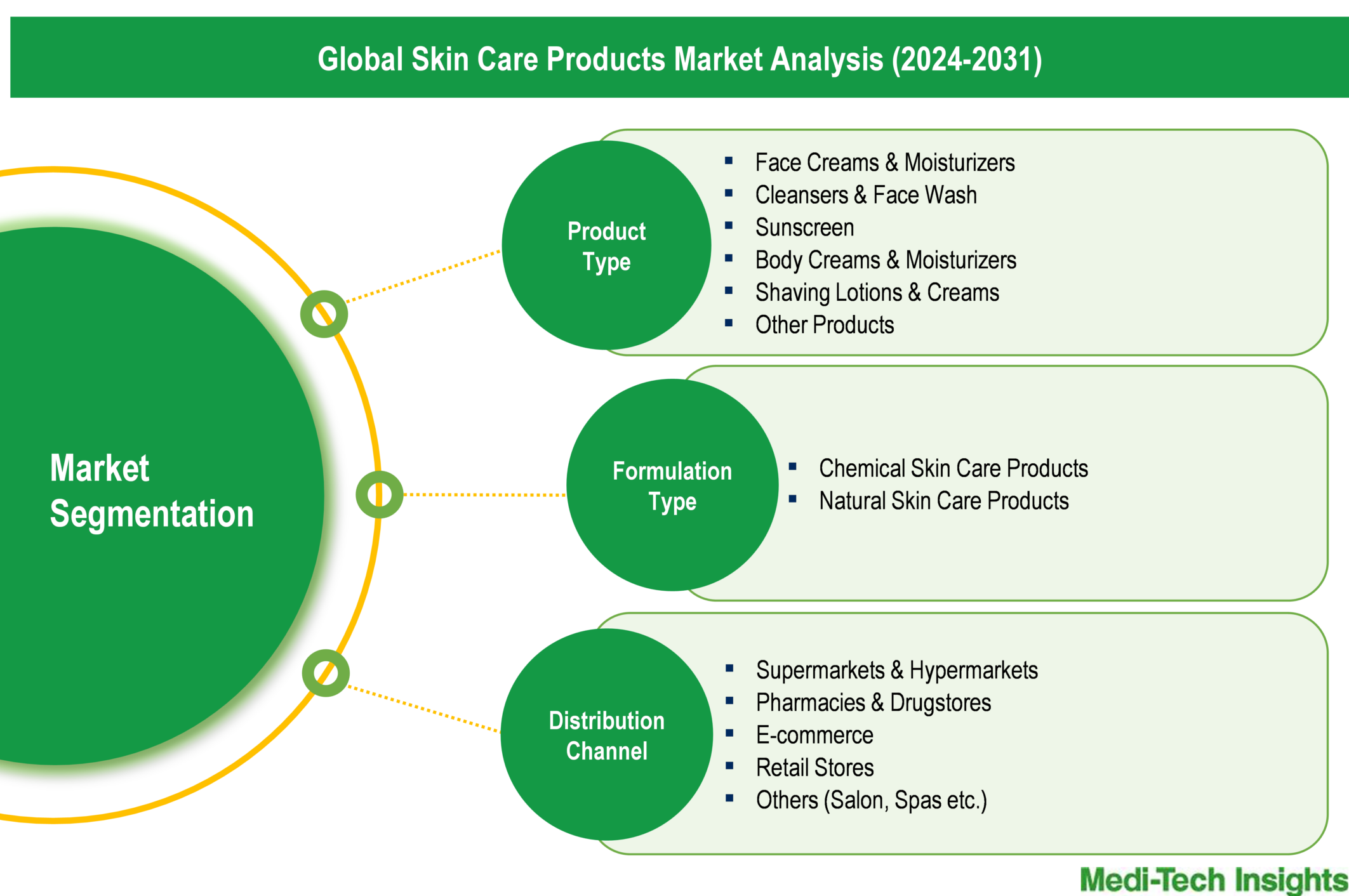
Global Skin Care Products Market Segmentation
This report by Medi-Tech Insights provides the size of the global skin care products market at the regional and country-level from 2024 to 2031. The report further segments the market by product type, formulation type, gender, and distribution channel.
Market Size & Forecast (2024-2031), By Product Type, USD Billion
- Face Creams & Moisturizers
- Cleansers & Face Wash
- Sunscreen
- Body Creams & Moisturizers
- Shaving Lotions & Creams
- Other Products
Market Size & Forecast (2024-2031), By Formulation Type, USD Billion
- Chemical Skin Care Products
- Natural Skin Care Products
Market Size & Forecast (2024-2031), By Gender,4>
- Male
- Female
Market Size & Forecast (2024-2031), By Distribution Channel, USD Billion
-
- Supermarkets & Hypermarkets
- Pharmacies & Drugstores
- E-commerce
- Retail Stores
- Others (Salon, Spas etc.)
Market Size & Forecast (2024-2031), By Region, USD Billion
- North America
- US
- Canada
- Europe
- UK
- Germany
- France
- Italy
- Spain
- Rest of Europe
- Asia Pacific
- China
- India
- Japan
- Rest of Asia Pacific
- Latin America
- Middle East & Africa
Related Reports:
Need a More Tailored Analysis?
- Discuss the market sizing methodology and forecast assumptions with our healthcare analysts.
- Expand the scope with additional countries, market segments, technologies, or competitor profiling.
- Use the insights to support strategic planning, market entry, commercial due diligence, and long-term revenue growth initiatives.