Download FREE Sample


The veterinary dermatology market focuses on the care and treatment of skin, coat, ear, and nail conditions in animals, like companion pets (dogs and cats) and livestock animals among others. It includes products that help veterinarians manage and treat issues such as allergies, infections, parasites, and inflammatory skin diseases among others. The field covers a range of solutions, like prescription medicines and biologics, medicated topicals, and preventive care. As pets are increasingly seen as family members, owners are more aware of skin and allergy problems and actively seek expert care to keep their animals comfortable, healthy, and active.
Rising pet ownership is driving the market growth
The growth of pet ownership is the primary driver of growth in the veterinary dermatology market, as a larger population of animals leads to increased clinic visits and demand for skin-related medical management. For instance, the US pet industry has witnessed a steady growth with the total pet industry expenditures in the country reaching USD 151.9 billion in 2024 from USD 123.6 in 2021. The pet ownership is also expanding, with 94 million US households owning at least one pet in 2025, up from 82 million in 2023 (Source: American Pet Products Association). When a household incorporates dogs, cats, and other companion animals, the prevalence of the number of cases involving allergies, parasitic infestations, bacterial or fungal infections, and chronic inflammatory skin diseases are likely to increase proportionally. The increase in pet population can be viewed as, each additional pet representing a potential patient, each with an individual need for diagnosis, treatment, follow-up, and preventive care, leading to greater incidence of clinic visits and increased product consumption.
Many new pet owners today also pay closer attention to their animals- health and comfort. If a pet shows sskin irritation or hair loss, owners are more likely to schedule a vet appointment rather than wait for the condition to improve on its own. This results in greater use of clinical diagnostic tools, allergy testing, prescription medications, and routine check-ups for long-term conditions like atopic dermatitis. In turn, clinics see higher volumes of dermatology cases and manufacturers see more consistent product usage. The trend is particularly strong in urban areas and in countries where disposable income is rising. People who can spend more on their pets are open to advanced options such as novel oral treatments, targeted biologics, and improved topical solutions. The expectation of better outcomes encourages investment in new therapies and technologies, which further supports market growth.
The increase in pet ownership also boosts related services, including pet insurance and online veterinary pharmacies. Insurance coverage helps reduce cost concerns for owners, allowing veterinarians to recommend the most effective treatment plans. Online platforms make it easier to purchase dermatology products, encouraging adherence to ongoing treatments and year-round parasite prevention. Overall, the growing number of pets, paired with a stronger focus on animal health, is raising awareness of dermatological problems and expanding the market for both treatment and prevention. As this trend continues, demand for veterinary dermatology solutions is expected to follow the same upward path.

To learn more about this report, download the PDF brochure
Innovation in veterinary therapeutics to propel market demand
Advances in veterinary therapeutics is playing a major role in the growth of the veterinary dermatology market. New treatments are helping veterinarians manage skin diseases more effectively than older options, which encourages both clinics and pet owners to rely more on dermatology care. Biologics and other targeted therapies have become important for long-term conditions such as atopic dermatitis. These medicines focus on specific pathways involved in inflammation and itching, so they often provide relief with fewer side effects than traditional steroids. Because they require less frequent dosing and are easier to manage at home, owners are more likely to stay consistent with treatment. Better adherence leads to improved control of symptoms and helps reinforce demand for advanced products.
Besides biologics, new small-molecule drugs are offering additional choices for different types of cases. Some of these medicines have faster effects or different safety advantages, helping veterinarians select the best match for each animal. Improved drug formulations, like flavored tablets or long-acting injections, reduce daily effort for owners and make it easier to treat pets that are difficult to medicate. Topical therapies have also become more practical. Updated shampoos, wipes, and sprays combine ingredients that treat multiple causes of skin irritation at once. Better product design means quicker application, less mess, and shorter treatment periods. These features support wider use in both clinics and home-care routines.
Another contributor to innovation is the progress in diagnostic tools that guide treatment more accurately. When veterinarians can identify the specific cause, such as an allergy, yeast infection, or bacteria, they can prescribe the most effective therapy right away. This improves results and supports responsible use of antibiotics. Pharmaceutical companies are also putting more investment into animal-specific dermatology products rather than relying on modified human drugs. This results in treatments that are better suited to factors like dosing, metabolism, and species differences. Overall, innovation is making dermatology treatment more reliable, easier to administer, and better tailored to pets- needs. As these newer options become more common in veterinary practice, the demand for dermatology medications and services continues to increase.
Growth strategies adopted by players to establish their foothold in the market
Players operating in this market are adopting different growth strategies such as new product launches & approvals, and partnerships & collaborations to garner market share. For instance,
- In September 2024, Elanco received FDA approval and launched Zenrelia, a once-daily oral JAK inhibitor for dogs with allergic and atopic dermatitis, positioning the company as a new competitor in the growing canine dermatology market. The product offers veterinarians and pet owners an alternative to existing treatments
- In May 2023, ILC Therapeutics and Dechra Pharmaceuticals entered a partnership to develop Caniferon, a treatment for atopic dermatitis in dogs, expanding ILC-s technology into the animal health space
November 2025, Dechra has launched Solovecin, a long-acting injectable antibiotic in the US that provides a full course of treatment for skin infections in dogs and cats with a single dose. This product helps eliminate pet owner compliance issues and expands veterinarians- options for in-clinic dermatology care
To learn more about this report, download the PDF brochure
Route of Administration Segment Outlook
Topical treatments hold the largest share of the veterinary dermatology market because they are commonly used for everyday skin problems like itching, infections, or irritation. They are usually easy for owners to apply, relatively affordable, and widely available through clinics and retail channels, which keeps their usage high. On the other hand, injectable therapies are seeing the highest growth. This is mainly due to the increasing use of biologics for long-term skin diseases such as allergic dermatitis. These products often require fewer doses and help improve symptom control, making them an appealing option for both veterinarians and pet owners.
Regional Outlook: North America expected to hold a major share in the veterinary dermatology market
North America currently represents the largest share of the veterinary dermatolorket. This is mainly because pet ownership is high, veterinary services are well-developed, and advanced dermatology treatments such as biologics are more commonly used. Pet insurance availability also makes it easier for owners to pursue specialized care. By comparison, the Asia Pacific region is expanding the fastest. Growth there is fueled by a rise in companion animal adoption, increasing awareness of skin health in pets, and steady improvements in veterinary clinic capabilities. Europe, Latin America, and the Middle East & Africa continue to grow but at more moderate rates due to differences in access and affordability.
Competitive Landscape Analysis
The global veterinary dermatology market is marked by the presence of established and emerging market players such as Elanco Animal Health; Zoetis Services LLC; Merck & Co., Inc.; Virbac; Boehringer Ingelheim International GmbH; Vetoquinol; Dechra Pharmaceuticals; Hester Biosciences Limited; PetIQ, LLC; and Norbrook; among others. Some of the key strategies adopted by market players include product innovation and development, strategic partnerships and collaborations, mergers and acquisitions, and geographic expansion.

Get a sample report for competitive landscape analysis
Report Scope
| Report Metric | Details |
| Base Year Considered | 2025 |
| Historical Data | 2024 - 2025 |
| Forecast period | 2026 - 2031 |
| Growth rate | 9% |
| Segment Scope | Product, Route of Administration, Animal Type, Buyer |
| Regional Scope |
|
| Market Drivers |
|
| Attractive Opportunities |
|
| Key Companies Mapped | Elanco Animal Health; Zoetis Services LLC; Merck & Co., Inc.; Virbac; Boehringer Ingelheim International GmbH; Vetoquinol; Dechra Pharmaceuticals; Hester Biosciences Limited; PetIQ, LLC; and Norbrook; among others |
| Report Highlights | Market Size & Forecast, Growth Drivers & Restraints, Trends, Competitive Analysis |
Global Veterinary Dermatology Market Segmentation
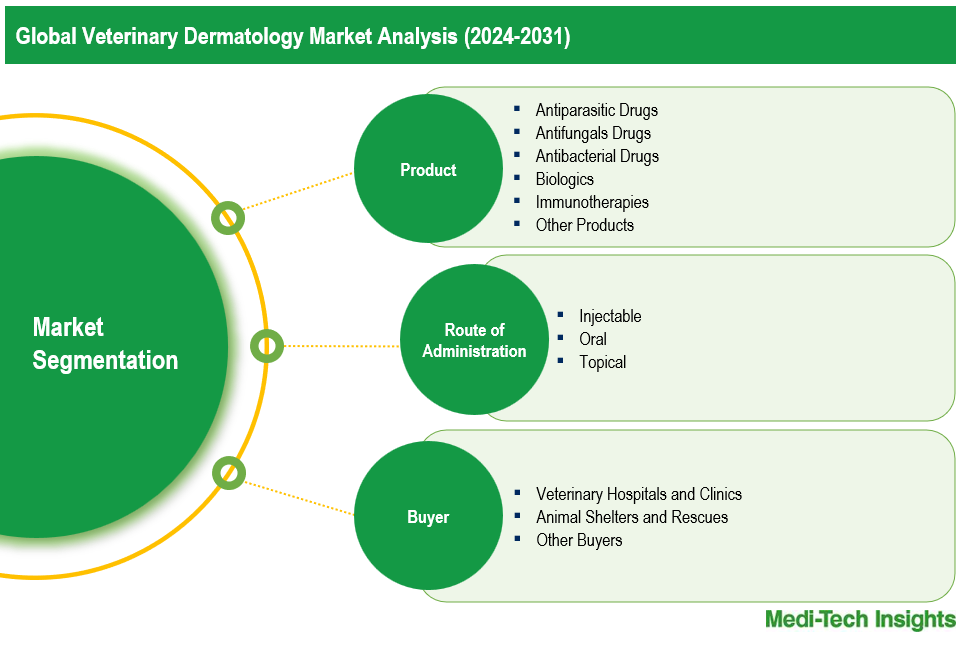
This report by Medi-Tech Insights provides thesize of the global veterinary dermatology market at theregional- and country-level from 2024 to 2031. The report further segments the market based on product, route of administration, animal type, and buyer.
Market Size & Forecast (2024-2031), By Product, USD Billion
- Antiparasitic Drugs
- Antifungals Drugs
- Antibacterial Drugs
- Biologics
- Immunotherapies
- Other Products
Market Size & Forecast (2024-2031), By Route of Administration, USD Billion
- Injectable
- Oral
- Topical
Market Size & Forecast (2024-2031), By Animal Type, USD Billion
- Companion Animals
- Equinetock Animals
Market Size & Forecast (2024-2031), By Buyer, USD Billion
- Veterinary Hospitals and Clinics
- Animal Shelters and Rescues
- Other Buyers
Market Size & Forecast (2024-2031), By Region, USD Billion
- North America
- US
- Canada
- Europe
- UK
- Germany
- France
- Italy
- Spain
- Rest of Europe
- Asia Pacific
- China
- India
- Japan
- Rest of Asia Pacific
- Latin America
- Middle East & Africa
Related Reports
Need a More Tailored Analysis?
- Discuss the market sizing methodology and forecast assumptions with our healthcare analysts.
- Expand the scope with additional countries, market segments, technologies, or competitor profiling.
- Use the insights to support strategic planning, market entry, commercial due diligence, and long-term revenue growth initiatives.