Download FREE Sample


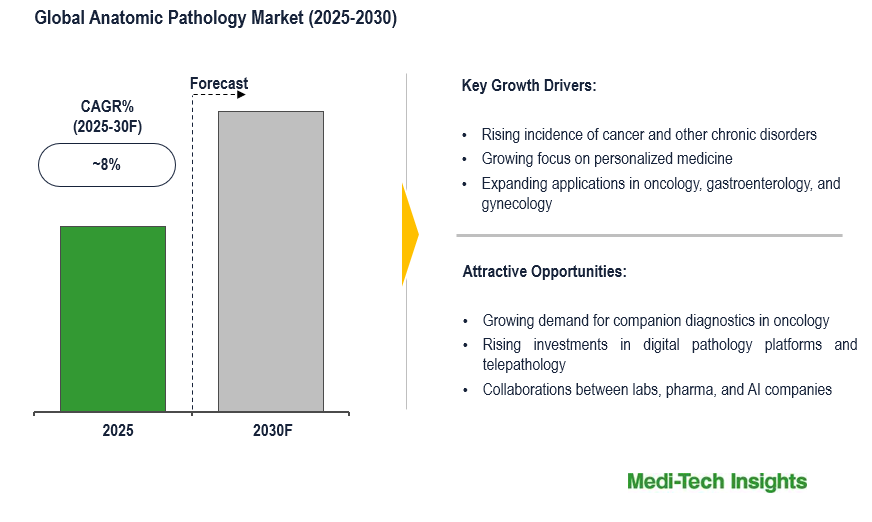
The global anatomic pathology market is expected to grow at a CAGR of 8% during the forecast period. The high incidence of cancer and other chronic disorders, growing focus on personalized medicine, increasing emphasis on early diagnosis & prevention, and expanding applications in oncology, gastroenterology, and gynecology are some of the key driving factors supporting the market growth. However, the lack of skilled professionals and high costs of advanced pathology instruments and maintenance may hinder the market growth.
Overview
Anatomic pathology is a specialized branch of pathology that involves the study of the structural and morphological characteristics of tissues and organs to understand the nature and cause of diseases. It primarily focuses on the examination of tissue specimens, which may be obtained through biopsies, surgical resections, or autopsies. The goal of anatomic pathology is to identify abnormalities in cells and tissues, helping physicians make accurate diagnoses, determine the severity of diseases, and guide appropriate treatment plans-especially in fields like oncology, gastroenterology, and gynecology.
To learn more about this report, download the PDF brochure
Anatomic pathology market is evolving with the adoption of personalized medicine and AI
The increasing demand for personalized medicine is a major catalyst contributing to the expansion of the anatomic pathology market. Personalized medicines are tailored based on an individual-s genetic profile to ensure precise diagnosis, and treatment. For instance, personalized anticancer treatments offer targeted mechanisms of action, resulting in fewer and less severe side effects compared to conventional therapies. These therapies, while most established in oncology, are increasingly being applied in other areas such as cardiovascular disease through pharmacogenomic testing for drug response and autoimmune disorders, where biomarker profiling supports more targeted use of biologics. This growing adoption of personalized therapeutic approaches is expected to drive substantial growth within the anatomic pathology market. Further the integration of AI into pathology is increasingly supporting genomic profiling and biomarker discovery making personalized medicine more accessible, scalable, and responsive to complex disease profiles.

To learn more about this report, download the PDF brochure
Rising demand for companion diagnostics accelerates the anatomic pathology market growth
The rising demand for companion diagnostics (CDx) is one of the primary drivers accelerating the growth of anatomic pathology market. Anatomic pathology serves as the foundation for companion diagnostics by providing detailed insights into tumor morphology, cellular architecture, and molecular alterations. Advanced techniques such as immunohistochemistry (IHC), in situ hybridization (ISH), polymerase chain reaction (PCR), and next-generation sequencing (NGS) are used to examine tissue samples, thereby enabling the detection of genetic mutations and protein expressions, which remains essential in determining a patient-s eligibility for targeted therapies. By leveraging these insights, healthcare professionals can tailor treatments to an individual-s unique biomarker profile, improve clinical outcomes, minimize adverse effects, and avoid ineffective therapies thereby lowering both clinical and economic burden.
Recent developments in the anatomic pathology market
The anatomic pathology landscape is driven by innovation across various sectors including companion diagnostics, liquid biopsy, and digital pathology platforms. Leading healthcare providers and diagnostic laboratories are expanding their portfolios to enhance diagnostic precision, accelerate turnaround times, and enable personalized treatment strategies. For instance,
- In May 2025, NeoGenomic Inc. annh of its c-MET CDx for NSCLC, a companion diagnostic assay that detects c-Met protein overexpression in advanced non-small cell lung cancer patients with a 48-hour turnaround time
- In April 2025, Labcorp introduced two liquid biopsy solutions: Labcorp Plasma Detect, a whole-genome sequencing test for detecting molecular residual disease (MRD) and recurrence risk in stage III colon cancer, and PGDx elio plasma focus Dx, the first FDA-authorized pan-solid tumor liquid biopsy kit for guiding targeted therapy selection from blood samples
- In July 2024, Danaher Corporation announced the launch of two new Clinical Laboratory Improvement Amendments (CLIA) and College of American Pathologists (CAP)-certified labs intended to accelerate the development of companion diagnostics (cdx) and complementary diagnostics (codx)
Competitive Landscape Analysis
The global anatomic pathology market comprises of several well-established and emerging players, including F. Hoffmann-La Roche Ltd.; Danaher Corporation; Agilent Technologies; Merck KGaA; Cardinal Health, Inc.; -PHC Holdings Corp.; PerkinElmer, Inc; Becton, Dickinson and Company; Laboratory Corporation of America (LabCorp); NeoGenomics Laboratories, Inc among others. Key strategies adopted by these players include the development of advanced diagnostic technologies (such as multiplexed biomarker assays and precision tissue staining platforms), mergers and acquisitions, and investment in R&D to enhance pathology workflows, support personalized medicine initiative and meet growing global demand.
Report Scope
| Report Metric | Details |
| Base Year Considered | 2024 |
| Historical Data | 2023 - 2024 |
| Forecast Period | 2025 - 2030 |
| Growth | 8% |
| Market Drivers |
|
| Attractive Opportunities |
|
| Segment Scope | Product & Services, Application, and End-user |
| Regional Scope |
|
| Key Companies Mapped | F. Hoffmann La-Roche Ltd.; Danaher Corporation; Agilent Technologies; Merck KGaA; Cardinal Health Inc.; PHC Holdings Corp.; PerkinElmer, Inc.; Becton, Dickinson and Company; Laboratory Corporation of America (LabCorp); and NeoGenomics Laboratories, Inc.; among others |
| Report Highlights | Market Size & Forecast, Growth Drivers & Restraints, Trends, Competitive Analysis |
Global Anatomic Pathology Market Segmentation
This report by Medi-Tech Insights provides thesize of the global anatomic pathology market at theregional- and country-level from 2023 to 2030. The report further segments the market based on product & services, application, and end-user.
Market Size & Forecast (2023-2030), By Products & Services, USD Million
- Instruments
- Microtomes & Cryostat
- Tissue Processors
- Automatic Stainers
- Whole Slide Imaging Scanners (WSI)
- Other Products
- Consumables
- Reagents & Antibodies
- Probes & Kits
- Others
Market Size & Forecast (2023-2030), By Application, USD Million
-
- Disease Diagnosis
- Drug Discovery and Development
- Others
Market Size & Forecast (2023-2030), By End-user, USD Million
-
- Hospitals
- Research Laboratories
- Diagnostic Laboratories
- Others
Market Size & Forecast (2023-2030), By Region, USD Million
- North America
- US
- Canada
- Europe
- UK
- Germany
- France
- Italy
- Spain
- Rest of Europe
- Asia Pacific
- China
- India
- Japan
- Rest of Asia Pacific
- Latin America
- Middle East & Africa
Key Strategic Questions Addressed
- What is the market size & forecast of the anatomic pathology market?
- What are historical, present, and forecasted market shares and growth rates of various segments and sub-segments of the anatomic pathology market?
- What are the key trends defining the market?
- What are the major factors impacting the market?
- What are the opportunities prevailing in the market?
- Which region has the highest share in the global market? Which region is expected to witness the highest growth rate in the next 5 years?
- Who are the major players operating in the market?
- What are the key strategies adopted by players?
Need a More Tailored Analysis?
- Discuss the market sizing methodology and forecast assumptions with our healthcare analysts.
- Expand the scope with additional countries, market segments, technologies, or competitor profiling.
- Use the insights to support strategic planning, market entry, commercial due diligence, and long-term revenue growth initiatives.