Download FREE Sample


Ultrasound, or sonography, is a non-invasive diagnostic technique utilizing high-frequency sound waves to create images of internal body structures. Widely employed in veterinary medicine, it is used to visualize body parts such as the structure and movement of the kidneys, liver, gallbladder, pancreas, spleen, and vessels in real-time. One of the key advantages of ultrasound imaging is that it can be performed quickly, using minimal restraint or sedation. Veterinarians use ultrasound to diagnose conditions such as kidney/bladder stones, enlarged organs, pancreatitis, and portosystemic shunts and to guide needles for biopsies of tissue.
Rising Population & Adoption of Companion Animals
A global surge in companion animal population and adoption rates has been observed. Numerous studies highlight the positive health impacts of having a companion animal, including cardiac arrhythmia reduction, blood pressure normalization, anxiety decrease, enhanced psychological stability, and improved overall well-being. The worldwide companion animal population has experienced substantial growth in recent years. Pet ownership in the United States has experienced a notable increase over the last thirty years, with 66% of American households (equivalent to 86.9 million homes) owning a pet as of 2024, a rise from 56% reported in 1988, according to pet ownership data. From providing companionship to offering emotional support, pets play an essential role in the lives of their owners. This escalating pet ownership trend is anticipated to fuel demand for veterinary ultrasound systems.
To learn more about this report, download the PDF brochure
Growing Awareness About Pet Healthcare is Driving Market Growth
The growing demand for animal diagnostics to address issues like pregnancy-related complications, organ enlargement, foreign body ingestion, and internal injuries has led to a rise in animal healthcare spending. This trend is expected to contribute to the market's expansion in the forecast period. The increasing emphasis on improved animal healthcare is a key factor propelling the global veterinary ultrasound market. North America, Europe, and Asia Pacific are anticipated to be pivotal regions for the market's growth. Additionally, government support through insurance and investments in the veterinary healthcare sector is further bolstering the veterinary ultrasound market.
Ultrasound Type Segment Analysis
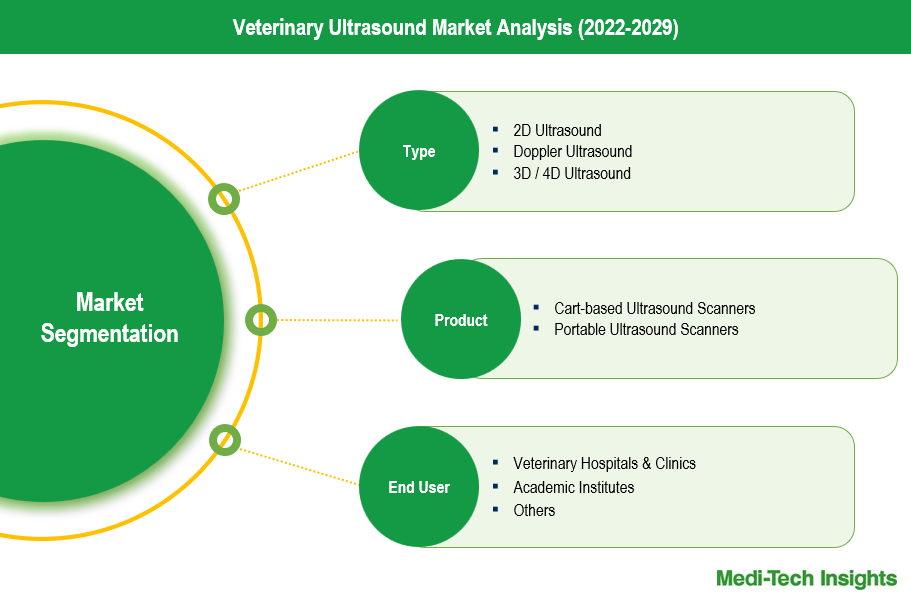
In the veterinary ultrasound market, the distribution of market share among different types of ultrasound segments varies considerably. The 2D ultrasound segment maintains a dominant position, capturing the largest share due to its widespread use in routine imaging procedures for assessing organ structures, detecting abnormalities, and monitoring pregnancies. Doppler ultrasound, renowned for its ability to evaluate blood flow dynamics, holds a significant but slightly smaller market share, particularly valued in cardiovascular and obstetric applications where precise vascular assessments are crucial. The 3D/4D ultrasound segment, while representing a smaller proportion, is experiencing notable growth attributed to advancements in imaging technology, offering veterinarians enhanced visualization capabilities for detailed anatomical examinations and improved prenatal evaluations.
To learn more about this report, download the PDF brochure
Product Type Segment Analysis
Within the veterinary ultrasound market, the distribution of product types reflects the evolving preferences and practical requirements of veterinary professionals. Cart-based ultrasound scanners continue to hold a significant share, favoured for their comprehensive functionality and larger display screens suitable for detailed imaging sessions in clinical settings. However, portable ultrasound scanners have gained considerable traction, steadily increasing their market share due to their versatility and convenience. Portable scanners offer veterinarians the flexibility to conduct examinations in various environments, including on-farm visits and ambulatory care, enhancing accessibility to diagnostic imaging services. As technology advances, portable ultrasound scanners are becoming more sophisticated, bridging the gap in performance with their cart-based counterparts, thus further solidifying their position in the veterinary ultrasound market.
Competitive Landscape
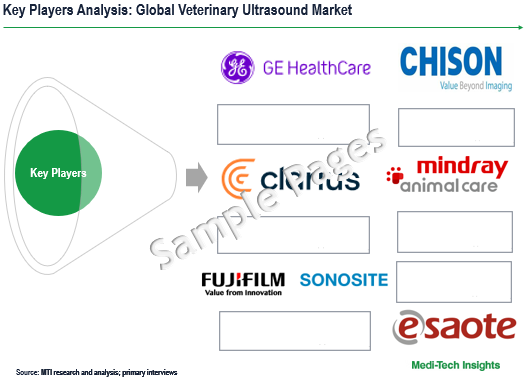
Some of the key players operating in the market include GE Healthcare, Esaote SpA, Clarius Mobile Health, FUJIFILM SonoSite Inc., CHISON, Siemens Healthineers, Samsung Healthcare, Heska Corporation, Shenzhen Mindray Animal Medical Technology Co., Scintica Instrumentation, among others.
Get a sample report for competitive landscape analysis
Organic and Inorganic Growth Strategies Adopted by Players to Establish Their Foothold in the Market
Players operating in this market are adopting organic and inorganic growth strategies such as launching new products, acquiring related firms, and entering into collaborations to garner higher market share. For instance,
- In May 2024, Esaote North America, Inc. introduces the MyLab- Omega eXP VET, a portable ultrasound system aimed at enhancing veterinary care with its exceptional durability, precision, and rapid functionality, providing veterinarians with enhanced flexibility and accuracy in diagnostic imaging across various locations
- In June 2023, Esaote North America introduced new, A.I.-enhanced MyLab X90VET ultrasound system. It is equipped with intelligent proprietary Augmented Insight technology, designed to propel veterinary care forward, deliveringe and precision imaging for a confident diagnosis
- In January 2023, Sound Technologies and GE HealthCare entered into a collaboration agreement to bring Vscan Air handheld ultrasound to veterinary practices across the United States
- In January 2022, Clarius Mobile Health introduced three new ultra-portable wireless smartphone ultrasound scanners for veterinarians. The newly launched ultrasound scanners are pocket-sized, 30% lighter with revolutionary pricing and new features
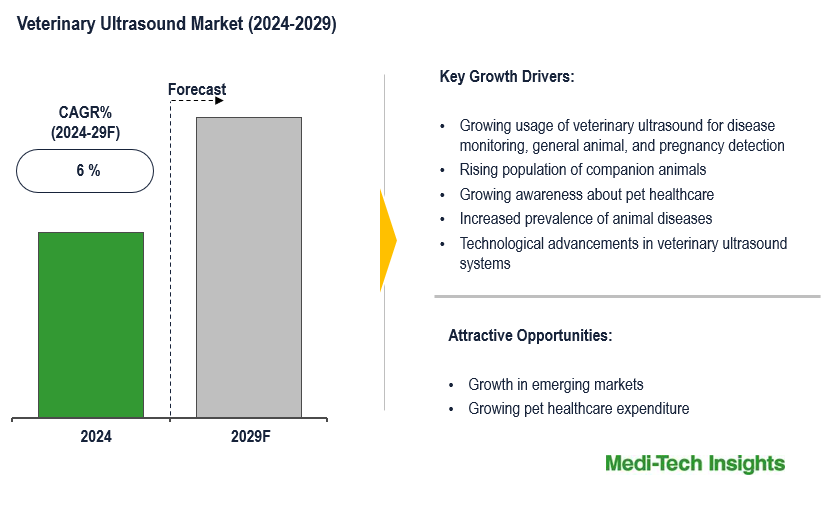
The Veterinary Ultrasound Market is expected to gain further momentum in the coming years due to the increasing number of veterinary practitioners, the foray of new players offering veterinary ultrasound systems, growing pet healthcare expenditure, growth in emerging markets, and aggressive organic and inorganic growth strategies followed by the players.
Report Scope
| Report Scope | Details |
| Base Year Considered | 2023 |
| Historical Data | 2022 - 2023 |
| Forecast Period | 2024 - 2029 |
| Segment Scope | Product, Animal, End User |
| CAGR (2024 - 2029) | 6% |
| Regional Scope |
|
| Key Companies Mapped | GE Healthcare, Esaote SpA, Clarius Mobile Health, FUJIFILM SonoSite Inc., CHISON, Siemens Healthineers, Samsung Healthcare, Heska Corporation, Shenzhen Mindray Animal Medical Technology Co., Scintica Instrumentation, among others |
| Report Highlights | Market Size & Forecast, Growth Drivers & Restraints, Trends, Competitive Analysis |
Frequently Asked Questions About This Report
What is the market size & forecast for the Global Laser Hair Removal Market?
What are the historical, present, and forecasted market shares and growth rates of various segments and sub-segments of the Global Laser Hair Removal Market?
How has COVID-19 impacted the Global Laser Hair Removal Market?
What are the major growth drivers, restraints/challenges impacting the market?
What are the opportunities prevailing in the market?
Need a More Tailored Analysis?
- Discuss the market sizing methodology and forecast assumptions with our healthcare analysts.
- Expand the scope with additional countries, market segments, technologies, or competitor profiling.
- Use the insights to support strategic planning, market entry, commercial due diligence, and long-term revenue growth initiatives.